 Sign Up for One-on-One Coaching and get our Premium Membership FREE for 1 Year!
CLICK HERE TO APPLY
Sign Up for One-on-One Coaching and get our Premium Membership FREE for 1 Year!
CLICK HERE TO APPLY
Markets are beginning the week under renewed pressure as geopolitical risk returns to the forefront, adding another challenge to what had otherwise been a remarkably resilient stretch for U.S. equities. Stocks remain near record territory and the longer-term trend continues to favor the bulls, but the latest escalation between the United States and Iran arrives at a particularly sensitive moment. Inflation remains stubborn, Treasury yields are elevated, the Federal Reserve has become increasingly hawkish, and investors are preparing for a week packed with labor-market data that could have a major influence on the Fed’s September decision.
The biggest development Monday is the renewed confrontation between the United States and Iran. U.S. forces struck Iranian targets over the weekend, followed by Iran launching missiles toward U.S. bases in Jordan. The exchange immediately brought geopolitical risk back into the market and sent oil prices higher as traders considered the possibility of a broader escalation and renewed threats to shipping through the Strait of Hormuz. Energy stocks benefited from the move in crude, while the major equity indices came under modest pressure as investors reduced risk and waited for greater clarity.
The oil move is especially important because it connects directly with one of the market’s biggest existing concerns: inflation. A short-lived geopolitical spike in crude would likely be manageable, but a sustained increase in energy prices could complicate the inflation picture just as the Federal Reserve appears increasingly willing to keep monetary policy restrictive. Fed Chair Kevin Warsh’s hawkish Jackson Hole message continues to reverberate through markets after he emphasized that inflation remains too high and that policymakers still have work to do. Expectations for a September rate hike have consequently increased, making this week’s economic reports even more important.
Treasury yields are reflecting some of those concerns as well. Long-term rates moved higher Monday as investors weighed the combination of stronger oil prices, persistent inflation and the possibility of additional Fed tightening. The 10-year Treasury yield continues to trade within the volatile 4.0% to 4.8% range we have been watching, and I continue to believe the bond market is one of the most important indicators for equities. Stocks have demonstrated that they can coexist with relatively high rates, but another uncontrolled move higher in yields could pressure valuations, particularly across the technology and growth stocks that have led much of the rally.
At the same time, the fundamental support behind the market has not disappeared. Nvidia’s results last week provided another reminder that the artificial-intelligence investment cycle remains powerful, with demand for data centers and computing infrastructure continuing to support extraordinary levels of spending. Corporate earnings have also remained generally constructive, giving investors a fundamental reason to stay invested despite the increasingly complicated macro environment. This distinction is important because the rally is no longer dependent entirely on hopes for easier monetary policy. Earnings growth and AI investment continue to provide genuine support underneath the market.
We should get another look at that technology story this week as earnings season winds down. Dell, Palo Alto Networks and Broadcom are among the important companies reporting, providing additional insight into AI infrastructure, enterprise technology and cybersecurity spending. After Nvidia reinforced confidence in the AI cycle last week, investors will be looking for evidence that demand continues to spread throughout the broader technology ecosystem. Strong results could help offset some of the pressure coming from rates and geopolitics, while disappointing guidance would make elevated technology valuations more difficult to defend.
The economic calendar could ultimately be even more important than earnings. This is one of the heaviest labor-data weeks of the summer, beginning with JOLTS job openings Tuesday and continuing with private-payroll and job-cut data before Friday’s August employment report. Payroll growth, unemployment and wages will all be closely scrutinized because the Fed is increasingly dependent on incoming data. The market will want to see enough labor strength to confirm that the economy is not falling into a sharper slowdown, but not so much strength that wage pressures reinforce the argument for additional rate hikes.
That makes Friday’s jobs report particularly important. Recent economic data have presented a mixed picture, with growth slowing in some areas while the broader economy continues to avoid contraction. A surprisingly strong employment report could push Treasury yields and September rate-hike expectations higher, while a significant downside surprise could revive concerns about economic growth. Somewhere between those outcomes would likely be the most constructive result for equities, especially if wage growth shows additional signs of moderation.
Investors will also receive important information about the broader economy through ISM Manufacturing on Tuesday and ISM Services on Thursday. These reports should help determine whether business activity is stabilizing heading toward the fourth quarter or whether the slowdown evident in portions of the economy is becoming more widespread. Combined with the employment data, they should give investors a much clearer picture of the balance between growth and inflation heading into the Fed’s September meeting.
Trade policy and geopolitics will remain additional sources of uncertainty throughout the week. The G20 finance ministers’ gathering is putting tariffs, Iran sanctions and global trade relationships back into focus, including renewed tensions involving Canada and other major U.S. trading partners. Tariffs have become particularly important because they represent another potential source of inflation at a time when the Fed is already struggling to bring price pressures back toward its target. Any significant policy announcement could therefore affect not only individual industries but also Treasury yields and expectations for monetary policy.
Despite the growing list of risks, I remain firmly in the MARKET BULLISH camp. The market continues to demonstrate impressive resilience, supported by strong corporate earnings, extraordinary AI investment and an economy that, while slowing, has not fallen into a broad contraction. Monday’s geopolitical-driven weakness does not by itself change the larger trend, and periods of volatility should be expected after the strong advance we have seen.
The biggest risk continues to be interest rates remaining higher for longer. The renewed rise in oil increases that concern because sustained energy inflation could make the Fed’s job more difficult and keep pressure on Treasury yields. If geopolitical tensions escalate at the same time that labor data remain strong and inflation refuses to cool, the market could face a more meaningful test. On the other hand, stabilization in oil, moderating employment data and continued earnings strength would give the bulls another opportunity to regain control.
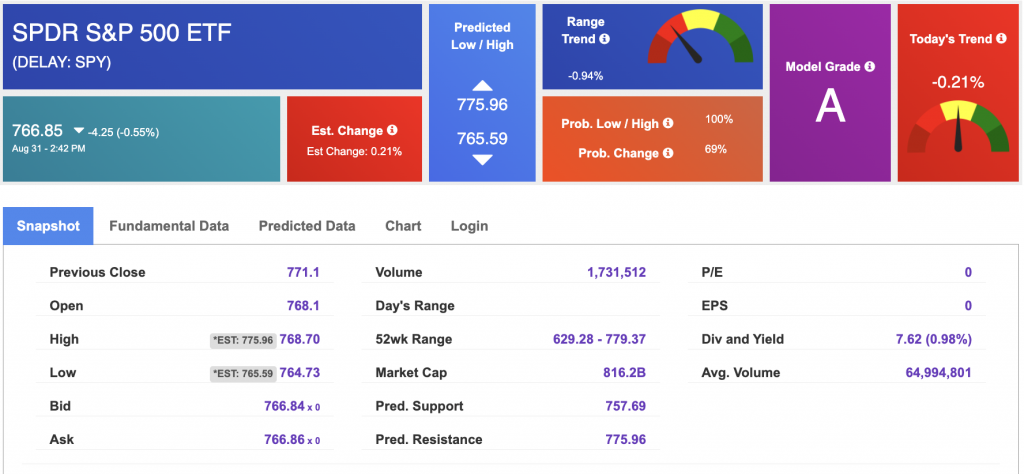
For the next several months, I continue to believe SPY can rally toward the $760 to $780 range, with the $700 to $720 area representing important support. The long-term trend remains intact, but the path higher is unlikely to be smooth. This week’s combination of employment data, ISM reports, technology earnings, geopolitical developments and Treasury volatility should provide an important test of whether the fundamental strength that carried stocks through August can continue to outweigh the macroeconomic risks surrounding the market. For now, the evidence continues to favor the bulls, but discipline and risk management remain essential as we enter September.
Please share this Tradespoon Market Commentary with your friends.



Comments Off on


Tradespoon Tools make finding winning trades in minute as easy as 1-2-3.
Our simple 3 step approach has resulted in an average return of almost 20% per trade!