 Special Offer: Try the 'Elite Trading Circle Membership' for ONLY $37!
CLICK HERE TO LEARN MORE
The midterm election rally lasted barely a day before Wall Street was hit with another brutal tech selloff. AI spending fears, the war with Iran, volatile oil prices, and stubborn inflation are creating a dangerous mix as stocks test critical support. With Treasury yields elevated and major economic reports approaching, is this the beginning of a deeper correction—or the buying opportunity bulls have been waiting for? Here are the key levels and catalysts we’re watching.
One of the more expensive mistakes in trading is confusing a relief rally with a change in trend. Wednesday offered a perfect example. Investors celebrated the midterm election results, oil prices plunged, and stocks staged an impressive comeback. For a few hours, it looked as though Wall Street might finally be ready to put some of its biggest worries behind it. Then Thursday arrived, and the technology sector had other ideas.
It has been quite a week. We have a dramatic political shift in Washington, an ongoing war with Iran, renewed uncertainty over tariffs, volatile oil prices, and an earnings season that is forcing investors to reconsider how much they are willing to pay for artificial intelligence. Add another round of important economic data and a Federal Reserve that remains concerned about inflation, and there is plenty for traders to digest. The good news is that volatility creates opportunity. The challenge is knowing when the market is presenting an opportunity and when it is simply asking for patience.
The S&P 500 is once again testing an important area of support, with SPY under pressure following a sharp reversal in technology stocks. I remain in the market bullish camp, with a potential SPY target of $780–$810 over the next several months, provided the longer-term trend remains intact. However, the $740–$750 area has become increasingly important for the bulls to defend. The market has been trading around its 50-day moving average, and the inability to sustain Wednesday’s rebound is a reminder that buyers have not yet regained control. My longer-term outlook remains constructive, but I expect considerable volatility before the next sustained advance can develop.
The week began with investors still processing the previous week’s technology selloff, as questions surrounding artificial intelligence spending and corporate profitability continued to weigh on sentiment. Those concerns briefly took a back seat following Tuesday’s midterm elections, when Democrats captured control of both the House and Senate. The results reduced one source of political uncertainty and helped fuel Wednesday’s broad market rally. The Dow gained approximately 3%, while the S&P 500 advanced roughly 1.6% and the Nasdaq climbed about 1.4%.
But the celebration proved short-lived. Thursday brought another aggressive selloff, particularly among semiconductor companies and businesses tied to AI infrastructure. The Nasdaq dropped sharply, with the Philadelphia Semiconductor Index experiencing especially heavy losses. Investors who had been encouraged by Wednesday’s broad participation were suddenly confronted with the same questions that dominated the previous week.
The biggest question surrounding artificial intelligence is no longer whether demand exists. It is whether the enormous spending required to support that demand will produce attractive returns for shareholders. Alphabet, Amazon, Intel, and other technology companies have faced intense scrutiny over capital expenditures, cash flow, and forward guidance. Even solid earnings results have not always been enough to satisfy investors concerned about financing costs and the timing of future profits.
The midterm results have also introduced another variable into the AI discussion. A Democratic-controlled Congress could increase scrutiny of data-center development, infrastructure spending, and AI regulation. That does not necessarily mean the AI investment cycle is ending, but it gives investors another reason to reassess valuations that already reflected considerable optimism.
Meanwhile, the war with Iran continues to influence nearly every corner of the financial markets. Oil prices fell dramatically earlier this week as investors responded to signs of possible diplomatic progress. Brent crude briefly moved below $100 per barrel, offering welcome relief to businesses and consumers struggling with elevated energy costs. However, renewed concerns over shipping disruptions and the possibility of further military escalation pushed crude higher again on Thursday.
This is particularly important because oil prices are not simply an energy-sector story. Higher crude prices affect transportation, manufacturing, consumer spending, and ultimately inflation. A sustained decline in energy prices could help ease pressure on the Federal Reserve, while another sharp increase could complicate the inflation outlook just as policymakers are trying to assess the next move in interest rates.
Tariffs remain another important piece of that equation. Businesses continue to report higher supply-chain costs tied to trade policies and fuel expenses, with some companies still working through how much of those increases they can absorb before passing them along to customers. October’s ISM Services Index came in at 54.5, indicating continued expansion, but its prices-paid component remained elevated at 73.0. That combination illustrates the difficult environment facing policymakers: economic activity remains resilient, but inflationary pressures have not disappeared.
The labor market is providing a similarly mixed picture. September’s JOLTS report showed approximately 7.5 million job openings, suggesting that demand for workers remains relatively stable. Wednesday’s ADP report indicated that private employers added 86,000 jobs in October, while Thursday’s productivity report showed a strong 3.6% annualized increase in third-quarter labor productivity. These figures offer some encouragement that the economy can continue expanding without a dramatic deterioration in employment.
Friday’s official October employment report will be another critical test. A stronger-than-expected reading could reinforce expectations that interest rates will remain elevated, while a softer report could provide some relief for Treasury yields. However, a significant deterioration in employment would raise a different set of concerns about economic growth and corporate profits.
The Federal Reserve left its benchmark interest-rate range unchanged at 3.75%–4.00% during last week’s meeting, but two policymakers favored an increase. The message remains clear: inflation is still a concern, and additional tightening cannot be ruled out. The 10-year Treasury yield continues to trade within the broader 4.5%–5.5% range I have been monitoring, recently hovering around 4.9%. Higher borrowing costs remain one of the biggest risks to an otherwise constructive longer-term equity outlook.
We are also seeing important differences beneath the surface of the bond market. Investment-grade corporate credit has remained relatively orderly, while weaker borrowers continue to face much greater refinancing pressure. European sovereign debt, particularly French government bonds, remains another area worth watching. These developments have not produced a broad credit-market breakdown, but they reinforce why investors should pay attention to more than just the major stock indexes.
Volatility has reflected this uncertainty. The VIX traded around the high teens earlier in the week before surging during Thursday’s selloff. I believe the technology sector may be approaching the beginning of a bottoming process, potentially over the coming week or so, but that should not be confused with confirmation that a bottom is already in place. Sharp rebounds, renewed selling, and additional tests of support are all possible before a more durable recovery develops.
Once Friday’s employment report is behind us, attention will shift toward next week’s inflation data. The October Consumer Price Index is scheduled for Tuesday, November 10, followed by the Producer Price Index on Friday, November 13. These releases could prove particularly consequential given the recent volatility in energy prices and the market’s sensitivity to Federal Reserve policy.
A cooler inflation reading, combined with evidence of stable economic growth, would provide a much more favorable environment for equities. On the other hand, stubborn inflation could push Treasury yields higher and place additional pressure on expensive growth stocks. Traders should also continue monitoring earnings guidance, geopolitical developments, and whether semiconductor shares can begin establishing a more stable trading range.
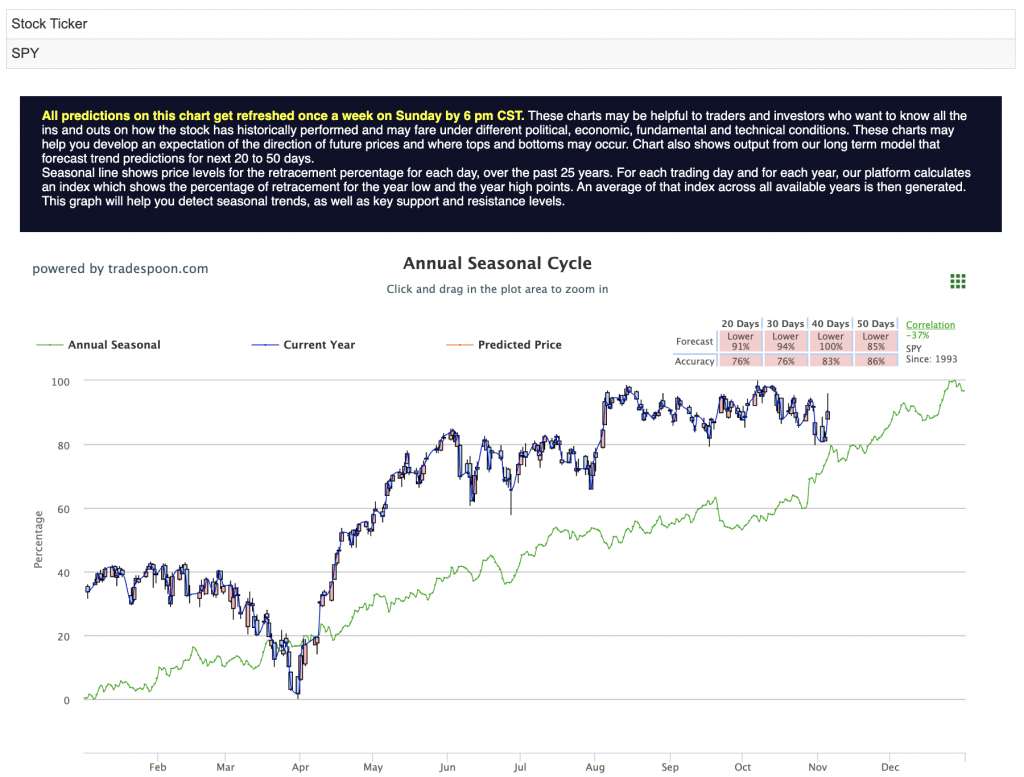
For this week’s trading setup, I am keeping a close eye on SPY rather than trying to predict the exact bottom in individual technology stocks. The $740–$750 support zone is particularly important, while a sustained recovery above the 50-day moving average would provide an encouraging sign that buyers are returning. The longer-term upside objective remains in the $780–$810 range, although reaching those levels will require stronger market participation and greater stability in Treasury yields.
The key is confirmation. I would like to see SPY stabilize, establish a higher low, and demonstrate improving momentum before becoming more aggressive with bullish positions. I would also look for confirmation from our AI forecasting tools rather than assuming that an oversold condition alone represents a buying opportunity. A decisive break below support would call for reassessing the setup and maintaining a defensive posture.
The market has given investors plenty of reasons to be nervous this week, but periods of uncertainty often create attractive opportunities for those willing to remain patient. I am still bullish on the longer-term outlook, even if the next several sessions bring additional volatility.
After all, the goal is not to catch every market move. It is to recognize the ones worth taking and have enough capital left to act when the opportunity arrives.
And that is exactly where RoboInvestor proves its value. Built for a headline-sensitive, range-bound market, our flagship AI-driven advisory helps cut through Fed uncertainty, tariff chatter, geopolitical risk, and AI hype to focus on what matters most: statistically grounded setups and clear risk-reward opportunities. With RoboInvestor, investors can stay engaged, stay disciplined, and act with precision instead of reacting emotionally to every headline.
Every other weekend, you’ll receive the RoboInvestor newsletter—a concise, high-signal read with market context, technical outlooks, updates on open positions, and clear, actionable trade ideas so you’re prepared and confident heading into Monday’s open.
Explore our latest forecasts, trade signals, and live strategy sessions at Tradespoon.com. Navigate uncertainty with confidence—and position yourself ahead of the curve.
Whether you’re targeting blue-chip stocks, ETFs, commodities, or inverse ETFs, RoboInvestor offers a flexible, forward-looking approach tailored to today’s market conditions. Our model portfolio typically holds 12 to 25 carefully selected positions, and we’ve recently adopted an even more selective strategy—focused on quality, resilience, and opportunity.
Join us and take advantage of advanced AI technology to guide your investments with precision and confidence.
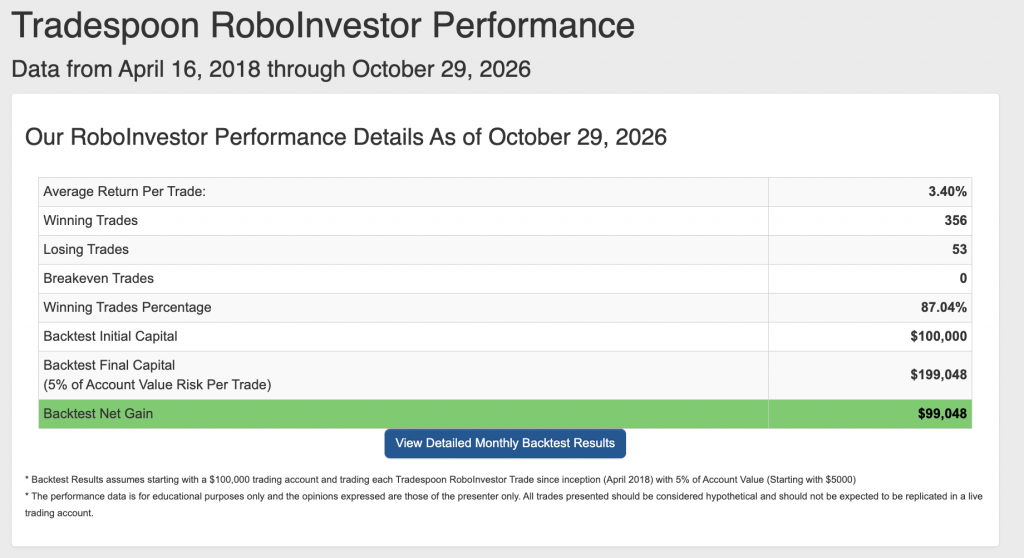
Our track record is one of the best in the retail advisory industry, with a Winning Trades Percentage of 87.04% since April 2018.
In this environment, a disciplined, insight-driven framework matters more than ever—one that cuts through the noise, respects the bond market’s influence, manages rate and employment risk, and helps you position proactively for the opportunities and pivots that tend to define the first quarter.
As we move through Q4 of 2026, investors continue navigating a market that appears calm on the surface but remains highly sensitive beneath it. Geopolitical developments in the Middle East, shifting tariff policy, and an uncertain Federal Reserve path continue to influence investor sentiment as inflation gradually cools, but interest rates remain elevated. Meanwhile, economic data has become more mixed, with the labor market showing signs of moderation while corporate earnings continue to demonstrate remarkable resilience.
Whether you are a seasoned investor or just starting, our team is here to help you every step of the way. Don’t face the challenges of tomorrow alone–join RoboInvestor today and take your investing to the next level.
Stay alert, stay strategic—and trade smart.
And remember, we’re not talking about day trading here. I’m looking for 50-100% gains within the next 3 months, so my weekly updates are timely enough for you to act.
*Please note: RoboStreet is part of your free subscription service. It is not included in any paid Tradespoon subscription service. Vlad Karpel only trades his own personal money for paid subscription services. If you are a paid subscriber, please review your Premium Member Picks, ActiveTrader, MonthlyTrader, or RoboInvestor recommendations. If you are interested in receiving Vlad’s personal picks, please click here.
Please share this Tradespoon Market Commentary with your friends.



Comments Off on


Tradespoon Tools make finding winning trades in minute as easy as 1-2-3.
Our simple 3 step approach has resulted in an average return of almost 20% per trade!