 Save Big on Commissions ($0.65 per Contract)
CLICK HERE TO LEARN MORE
RoboStreet | Thursday, October 22, 2026
Wall Street is facing another test as mixed AI earnings, surging oil prices, and geopolitical tensions challenge investor confidence ahead of next week’s Federal Reserve decision. Despite growing uncertainty, the longer-term bullish trend remains intact as investors watch key technical levels and incoming economic data.
U.S. Markets have spent much of October wrestling with an increasingly difficult question: Can corporate earnings and the artificial intelligence boom continue supporting higher stock prices when borrowing costs, energy prices, and geopolitical uncertainty are all working against the market?
This week’s trading provided another illustration of that tension. Wednesday’s rally was fueled by encouraging results from SpaceX and Super Micro Computer, suggesting that demand for AI infrastructure remains strong despite recent concerns surrounding valuations and profitability. By Thursday, however, optimism had reversed as investors digested earnings from Meta and Tesla, sending technology and semiconductor stocks sharply lower.
The reversal highlights an important shift in market sentiment. Investors are increasingly distinguishing between companies generating meaningful returns from AI investment and businesses relying on enormous capital expenditures to support future growth. Strong revenue alone is no longer enough to satisfy Wall Street when financing costs remain elevated and the timeline for profitability is uncertain.
Meanwhile, renewed tensions involving Iran and Saudi Arabia have pushed oil prices to five-month highs, raising the possibility of another inflationary shock just days before the Federal Reserve’s next monetary policy meeting.
Despite these challenges, the broader economic picture remains more resilient than recent market volatility might suggest. Corporate earnings continue to demonstrate strength, employment conditions remain relatively stable, and the longer-term equity uptrend has not been decisively broken.
For investors, the challenge is determining whether the latest pullback represents another consolidation within an ongoing bull market or the beginning of a more substantial repricing of risk.
And remember, we’re not talking about day trading here. I’m looking for 50-100% gains within the next 3 months, so my weekly updates are timely enough for you to act.
The stock market continues to navigate a complicated intersection of corporate earnings, artificial intelligence investment, inflation, Federal Reserve policy, and geopolitical instability.
Artificial intelligence remains the dominant driver of market leadership, but investors are becoming more skeptical about the cost of that growth.
Wednesday’s technology rally followed encouraging developments from SpaceX, which reported its first profitable quarter as a publicly traded company, and Super Micro Computer, which raised its outlook on strong demand for AI servers and data-center infrastructure. Those results suggested that spending on AI computing capacity remains substantial, helping restore confidence following the previous week’s technology selloff.
However, Thursday’s reaction to earnings from Meta and Tesla revealed the other side of that equation.
Meta reported quarterly revenue of approximately $64.6 billion, representing 26% annual growth, but also disclosed significant legal expenses and negative free cash flow as it continued investing aggressively in AI. The company outlined capital expenditures of $135 billion to $145 billion for the full year and announced the creation of a new non-voting class of shares.
Tesla similarly delivered better-than-expected revenue while reducing its full-year capital expenditure forecast from more than $25 billion to approximately $20 billion. Although the reduction improved near-term cash generation, investors questioned whether slower spending could delay the company’s ambitious robotics, autonomous-driving, and AI initiatives.
Together, these developments illustrate why investors have become increasingly selective. The AI investment cycle remains powerful, but rising capital requirements and financing costs are making earnings quality, profitability, and balance-sheet strength more important.
Geopolitical developments have added another layer of uncertainty.
Brent crude climbed above $112 per barrel Thursday following additional Houthi attacks on Saudi energy infrastructure and growing concerns about a broader escalation in the Middle East.
Reports that the United States and Israel are preparing contingency plans for potential renewed military strikes against Iran after the November elections have further increased the geopolitical risk premium embedded in energy markets. Although no new operation is certain, the possibility of additional disruptions around the Strait of Hormuz and other major shipping routes continues to influence crude prices.
For the broader economy, sustained oil prices above $100 represent a significant challenge. Higher transportation, manufacturing, and fuel costs can pressure corporate margins while reducing consumers’ discretionary spending power.
These developments are particularly concerning because inflation was already running above the Federal Reserve’s target before the latest energy spike.
September’s Consumer Price Index increased 3.7% from a year earlier, while import prices have also accelerated. Tariffs remain another source of uncertainty, contributing to higher costs across certain imported goods and manufacturing supply chains. Renewed trade tensions involving Canada and the United States have highlighted the continuing pressure facing North American automotive and industrial businesses.
The combination of energy inflation and tariff-related price pressures makes the Federal Reserve’s next decision especially consequential.
Following September’s quarter-point interest rate increase, the federal funds rate stands at 3.75%–4.00%. Policymakers are widely expected to leave rates unchanged at their October 27–28 meeting, but another increase in December remains a meaningful possibility.
The latest employment figures further complicate the outlook. Weekly initial jobless claims declined to 194,000, near their lowest level in decades, suggesting that employers remain reluctant to reduce headcount despite elevated borrowing costs.
This resilience is encouraging for economic growth and corporate profitability. At the same time, it gives the Fed less immediate incentive to ease monetary conditions, reinforcing our central concern that interest rates could remain higher for longer.
Bond markets are also beginning to reveal a more significant divergence in financial conditions.
The U.S. 10-year Treasury yield has experienced substantial volatility, trading broadly between 4.5% and 5.5% in recent months. Thursday’s risk-off environment encouraged buying of U.S. government bonds, pulling yields toward the 5.1% area.
Internationally, French government debt has become an increasingly important source of concern. France’s 10-year government bond yield climbed above 5%, its highest level since 2002, as political instability, fiscal challenges, and difficulty reaching agreement on a national budget unsettled investors.
The spread between French and German government borrowing costs has widened to levels last seen during the European sovereign debt crisis, underscoring growing investor concern about fiscal sustainability.
Similar signs of stress are emerging within lower-quality U.S. corporate credit.
While investment-grade and broader high-yield corporate bond spreads remain comparatively contained, borrowing costs for the weakest CCC-rated companies have risen dramatically. This divergence reflects growing concern about refinancing risk among highly leveraged borrowers, particularly those facing substantial debt maturities in an environment of elevated interest rates.
These developments do not necessarily indicate an imminent financial crisis, but they highlight an important vulnerability. Companies dependent on inexpensive financing may encounter increasing difficulty funding operations and long-term growth initiatives.
For AI infrastructure businesses requiring enormous capital commitments, that development deserves particular attention.
Taken together, these conditions suggest an economy that remains fundamentally resilient but faces increasingly complicated financial constraints. Investors are rewarding balance-sheet strength, sustainable earnings, and cash generation while becoming less tolerant of speculative growth and excessive leverage.
Despite the recent volatility, our broader market outlook remains bullish, and we continue to believe the longer-term equity uptrend is intact.
The SPDR S&P 500 ETF Trust (SPY) has been trading around its closely watched 50-day moving average, near the $768 level, with Thursday’s decline bringing renewed attention to short-term technical support.
The market’s inability to sustain Wednesday’s rebound underscores the importance of this technical region. A decisive recovery above the moving average would help restore confidence, while continued weakness could encourage additional profit-taking.
Our intermediate-term upside objective remains $780–$810 for SPY over the next several months, assuming corporate earnings remain supportive and macroeconomic conditions do not deteriorate significantly.
On the downside, we view the $740–$750 area as an important support zone, where a deeper correction could encounter more meaningful buying interest.
Volatility also deserves attention. The CBOE Volatility Index (VIX) has moved back toward 18 following its recent decline toward 16, reflecting renewed uncertainty surrounding technology earnings and geopolitical developments.
A sustained move above 20 would indicate greater investor demand for downside protection and could accompany additional pressure on equities. Conversely, stabilization in the VIX and renewed strength in market breadth would help reinforce the bullish outlook.
Our primary concern remains the possibility that interest rates stay elevated longer than anticipated, particularly if crude oil prices and tariffs continue contributing to inflation.
Nevertheless, we believe the market’s underlying earnings strength and longer-term growth drivers remain supportive. Near-term consolidation and rotations in market leadership should not automatically be interpreted as the end of the bull market.
The next several trading sessions could play a significant role in determining whether the broader market stabilizes or enters a deeper consolidation.
Investors will focus on the Federal Reserve’s October 28 interest rate announcement, looking for indications of whether policymakers believe additional tightening will be necessary before year-end. Although a pause is widely anticipated, commentary from Fed officials could prove just as important as the decision itself, particularly given the competing pressures of persistent inflation and resilient employment.
Thursday, October 29, will bring the advance estimate of third-quarter U.S. GDP alongside September’s Personal Consumption Expenditures inflation report, the Fed’s preferred inflation gauge. Together, these releases will provide a clearer picture of whether the economy can maintain its momentum while inflation remains elevated.
Corporate earnings will remain equally important, particularly as investors continue evaluating the profitability of AI investment, capital spending commitments, and the ability of companies to protect margins.
The continuing conflict involving Iran, developments in European sovereign debt markets, and movements in Treasury yields will also remain important influences on investor sentiment.
While several risks deserve close monitoring, we continue to favor the bullish side of the market over the intermediate term. Strong corporate earnings, resilient employment conditions, and continued investment in productivity-enhancing technologies provide reasons to believe the longer-term uptrend remains intact.
The biggest threat to that outlook is not necessarily a deterioration in corporate earnings, but rather a prolonged environment of elevated interest rates, stubborn inflation, and rising energy costs.
For now, our expectation is that SPY can ultimately advance toward the $780–$810 region over the coming months, although additional volatility and tests of technical support remain possible.
In this environment, disciplined positioning, diversification, and careful risk management will remain essential as investors navigate the next phase of the market cycle.
And that is exactly where RoboInvestor proves its value. Built for a headline-sensitive, range-bound market, our flagship AI-driven advisory helps cut through Fed uncertainty, tariff chatter, geopolitical risk, and AI hype to focus on what matters most: statistically grounded setups and clear risk-reward opportunities. With RoboInvestor, investors can stay engaged, stay disciplined, and act with precision instead of reacting emotionally to every headline.
Every other weekend, you’ll receive the RoboInvestor newsletter—a concise, high-signal read with market context, technical outlooks, updates on open positions, and clear, actionable trade ideas so you’re prepared and confident heading into Monday’s open.
Explore our latest forecasts, trade signals, and live strategy sessions at Tradespoon.com. Navigate uncertainty with confidence—and position yourself ahead of the curve.
Whether you’re targeting blue-chip stocks, ETFs, commodities, or inverse ETFs, RoboInvestor offers a flexible, forward-looking approach tailored to today’s market conditions. Our model portfolio typically holds 12 to 25 carefully selected positions, and we’ve recently adopted an even more selective strategy—focused on quality, resilience, and opportunity.
Join us and take advantage of advanced AI technology to guide your investments with precision and confidence.
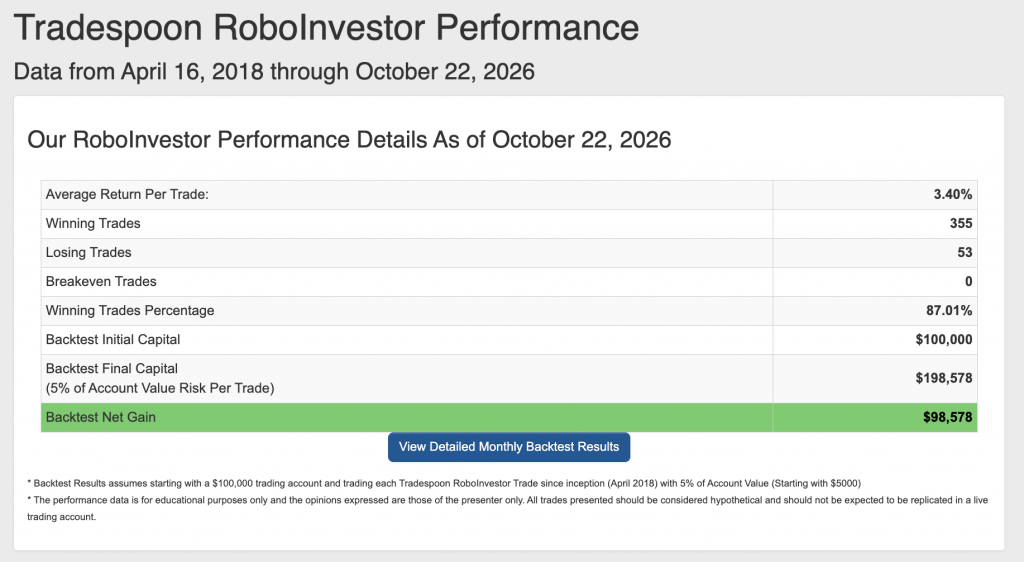
Our track record is one of the best in the retail advisory industry, with a Winning Trades Percentage of 87.01% since April 2018.
In this environment, a disciplined, insight-driven framework matters more than ever—one that cuts through the noise, respects the bond market’s influence, manages rate and employment risk, and helps you position proactively for the opportunities and pivots that tend to define the first quarter.
As we move through Q4 of 2026, investors continue navigating a market that appears calm on the surface but remains highly sensitive beneath it. Geopolitical developments in the Middle East, shifting tariff policy, and an uncertain Federal Reserve path continue to influence investor sentiment as inflation gradually cools, but interest rates remain elevated. Meanwhile, economic data has become more mixed, with the labor market showing signs of moderation while corporate earnings continue to demonstrate remarkable resilience.
Whether you are a seasoned investor or just starting, our team is here to help you every step of the way. Don’t face the challenges of tomorrow alone–join RoboInvestor today and take your investing to the next level.
Stay alert, stay strategic—and trade smart.
And remember, we’re not talking about day trading here. I’m looking for 50-100% gains within the next 3 months, so my weekly updates are timely enough for you to act.
*Please note: RoboStreet is part of your free subscription service. It is not included in any paid Tradespoon subscription service. Vlad Karpel only trades his own personal money for paid subscription services. If you are a paid subscriber, please review your Premium Member Picks, ActiveTrader, MonthlyTrader, or RoboInvestor recommendations. If you are interested in receiving Vlad’s personal picks, please click here.
Please share this Tradespoon Market Commentary with your friends.



Comments Off on


Tradespoon Tools make finding winning trades in minute as easy as 1-2-3.
Our simple 3 step approach has resulted in an average return of almost 20% per trade!