 Are you a Long-Term Trader? Then take a look at our NEW RoboInvestor Service?
CLICK HERE TO LEARN MORE
Another big week for markets as investors navigate a critical Federal Reserve decision, major Big Tech earnings, fresh inflation and GDP data, and escalating geopolitical tensions. Following last week’s technology-led selloff, stocks are attempting to regain momentum, but growing concerns over the profitability of massive AI investments, elevated oil prices, and persistent inflation continue to challenge investor confidence.
With Treasury yields remaining volatile and borrowing costs threatening to stay higher for longer, this week’s developments could determine whether the market’s recent weakness gives way to a renewed rally or deeper consolidation. Despite these near-term risks, our broader outlook remains bullish, with the S&P 500’s long-term uptrend intact and earnings growth providing a foundation for further upside.
Monday’s trading began on a more optimistic note, with the S&P 500 gaining approximately 0.8% and the Nasdaq advancing more than 1% by early afternoon. Technology and semiconductor stocks led the recovery as investors returned to AI-related companies ahead of several major earnings announcements.
One of today’s biggest developments came from Meta Platforms, which announced plans to raise as much as $95 billion in equity financing to support its expanding artificial intelligence infrastructure. The company is initially launching approximately $35 billion in common and preferred stock offerings, with plans for a potential additional $60 billion share-sale program beginning in 2027.
The announcement highlights a growing concern across Wall Street: the extraordinary cost of building the next generation of AI infrastructure. While demand for computing power, advanced semiconductors, and data centers remains significant, investors are increasingly focused on how quickly these investments can translate into sustainable earnings and free cash flow.
Meta’s announcement follows last week’s quarterly results, when the company reported approximately $64.6 billion in revenue but also posted negative free cash flow of $2.1 billion. Its 2026 capital expenditure forecast now stands at $135 billion to $145 billion, illustrating just how aggressively major technology companies are investing in the AI opportunity.
Adding to today’s activity, Anthropic’s public IPO filing renewed interest in the broader AI sector, lifting semiconductor and AI infrastructure stocks. Meanwhile, SpaceX announced an approximately $40 billion computing equipment leasing arrangement involving Apollo Global Management, further demonstrating the enormous capital requirements associated with the industry.
These developments have created a complicated environment for investors. Artificial intelligence remains one of the strongest structural growth opportunities in the economy, but the market is becoming more selective about which companies are positioned to benefit and which may struggle under the financial burden of expansion.
Last week’s trading was characterized by sharp swings in technology stocks, rising oil prices, and increasing uncertainty in global bond markets.
The S&P 500 declined approximately 0.5% for the week, while the Nasdaq fell 0.7%. The Dow Jones Industrial Average managed a modest 0.4% gain, reflecting a rotation away from some of the market’s most expensive technology companies toward other sectors.
Artificial intelligence remained the dominant story. Early enthusiasm surrounding corporate earnings and infrastructure spending gave way to renewed concerns about valuations, financing costs, and the timeline for generating meaningful returns from massive AI investments.
Meta’s increased spending outlook and mixed reactions to Tesla’s earnings contributed to Thursday’s technology selloff, with semiconductor stocks experiencing some of the sharpest losses. Although technology shares stabilized somewhat on Friday, investors remained cautious ahead of this week’s results from Microsoft, Alphabet, and Amazon.
Geopolitical developments added another challenge. Renewed attacks targeting Saudi Arabian energy infrastructure and continued tensions involving Iran raised concerns about potential disruptions to global oil supplies. Brent crude finished Friday near $117 per barrel, its highest level in nearly six months, increasing fears that elevated energy costs could sustain inflationary pressure.
Bond markets also experienced significant volatility. The U.S. 10-year Treasury yield moved back below 5% as investors sought safer assets amid the equity market turbulence.
Overseas, France’s growing fiscal challenges pushed its 10-year government borrowing costs above 5%, while the spread between French and German government bonds reached levels not seen since the European sovereign debt crisis.
The central lesson from last week was that markets remain supported by corporate earnings and long-term growth expectations, but investor confidence is increasingly sensitive to borrowing costs, liquidity, and geopolitical developments.
The most important macroeconomic event this week will be the Federal Reserve’s October 27–28 policy meeting.
Following September’s interest rate increase, the federal funds target range stands at 3.75% to 4.00%. Investors widely expect policymakers to leave rates unchanged on Wednesday, shifting attention toward Chair Kevin Warsh’s comments and the potential direction of monetary policy heading into December.
The challenge facing the Federal Reserve has become increasingly complicated.
Although economic growth and labor-market conditions have remained relatively resilient, inflation continues to exceed the central bank’s target. September’s consumer inflation reading of 3.7% year over year highlighted persistent pricing pressures, while elevated energy costs threaten to increase transportation, production, and consumer expenses.
The bond market continues to reflect these concerns. The 10-year Treasury yield has been trading within a broad 4.5% to 5.5% range, recently approaching multidecade highs before retreating toward 5%.
For equity investors, the possibility of higher interest rates for longer remains one of the most important risks to the market’s bullish outlook.
Elevated yields increase financing costs for corporations, create competition for equities from fixed-income investments, and place additional pressure on highly valued growth companies whose expected earnings are concentrated further into the future.
Even if the Federal Reserve leaves rates unchanged this week, the tone of its commentary could significantly influence market direction. Investors will be listening closely for indications that policymakers are becoming more concerned about inflation, particularly with another rate increase potentially under consideration before year-end.
Beyond the Federal Reserve, investors face one of the busiest corporate earnings calendars of the quarter, with approximately one-third of S&P 500 companies scheduled to report.
Tuesday brings results from Coca-Cola, Boeing, and Visa, offering additional insight into consumer demand, transportation and manufacturing activity, and spending trends across the economy. Economic reports covering durable goods orders, consumer confidence, and housing will provide an early look at how businesses and households are responding to elevated borrowing costs.
Wednesday will be especially important. The Federal Reserve is scheduled to release its policy decision at 2:00 p.m. Eastern, followed by Chair Warsh’s press conference. After the closing bell, Microsoft and Alphabet will report quarterly results.
Both companies occupy central positions in the artificial intelligence industry, making their earnings and forward guidance particularly significant. Investors will focus on cloud revenue growth, AI-related demand, capital expenditures, operating margins, and whether expanding infrastructure investments are generating meaningful financial returns.
The government will release its preliminary estimate of third-quarter GDP alongside September’s Personal Consumption Expenditures inflation report, the Federal Reserve’s preferred inflation measure. Economists expect annual core PCE inflation to remain near 3.1%, while GDP growth is projected around 3% to 3.2% on an annualized basis.
These reports will be particularly important because they arrive one day after the Federal Reserve’s decision. Strong economic growth combined with persistent inflation could reinforce the argument for keeping interest rates elevated, while softer inflation would provide some reassurance to investors.
Amazon will report Thursday evening, offering another critical examination of AI infrastructure spending, cloud computing growth, and consumer behavior. Caterpillar, Intel, Mastercard, and Eli Lilly are also among the companies reporting that day.
Friday concludes the week with the Employment Cost Index, another important measure of underlying inflationary pressure, along with earnings from ExxonMobil and Chevron. Given the recent surge in crude oil, commentary from major energy producers regarding supply conditions, production expectations, and geopolitical risks could be especially relevant.
Investors will also be monitoring monetary policy decisions from other major central banks, including the European Central Bank and Bank of Japan, as global interest rates and currency movements continue to influence financial conditions.
While equity investors remain focused on the earnings outlook, developments in the bond and credit markets deserve close attention.
Monday brought some relief to European debt markets after Moody’s maintained France’s sovereign credit rating, helping French government bond yields retreat below 5%. However, the country’s unresolved fiscal challenges and political uncertainty continue to create risks for European financial markets.
Corporate credit markets are also showing increasing signs of divergence.
Higher-quality investment-grade debt has remained comparatively stable, while the weakest corporate borrowers have experienced a much sharper increase in borrowing costs. Spreads on CCC-rated bonds have widened substantially, reflecting investor concerns about refinancing obligations, excessive leverage, and the ability of financially weaker companies to withstand prolonged high interest rates.
This divergence does not necessarily indicate an approaching credit crisis, but it suggests that financial conditions are becoming less forgiving for companies with weaker balance sheets.
Oil represents another important variable. Although crude prices eased during Monday’s trading, Brent remains above $110 per barrel following last week’s sharp advance.
Continued tensions involving Iran, threats to shipping and regional infrastructure, and uncertainty surrounding potential military escalation could keep an elevated geopolitical risk premium embedded in energy prices.
If oil remains expensive for an extended period, the resulting pressure on inflation could complicate the Federal Reserve’s efforts to stabilize prices and ultimately weigh on consumer spending and corporate profit margins.
Despite the recent volatility, our broader market outlook remains bullish.
Corporate earnings continue to provide an important foundation for equity valuations, economic activity has remained resilient, and long-term investment themes surrounding artificial intelligence, infrastructure, and technological productivity remain compelling.
However, the market is entering a period when fundamentals and financial discipline are becoming increasingly important.
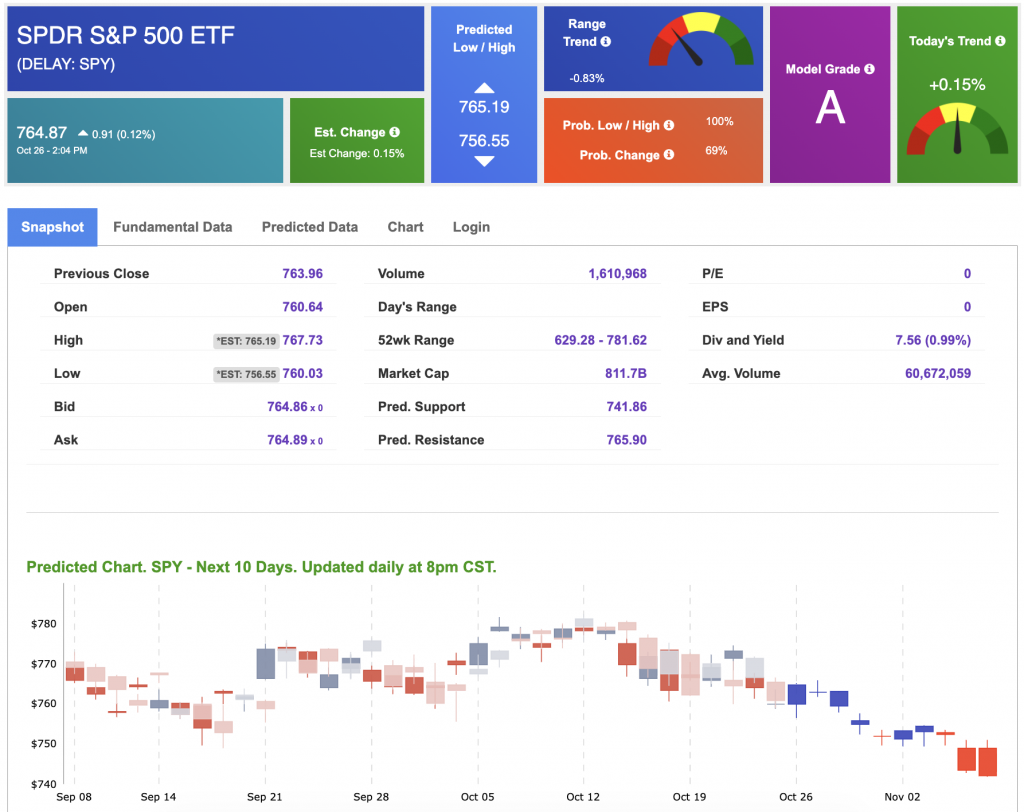
The S&P 500 ETF (SPY) remains our primary benchmark for evaluating the broader market trend. Over the next several months, we believe SPY has the potential to advance toward the $780–$810 range, provided corporate earnings continue to support expectations and inflationary pressures do not force a substantial repricing of interest rates.
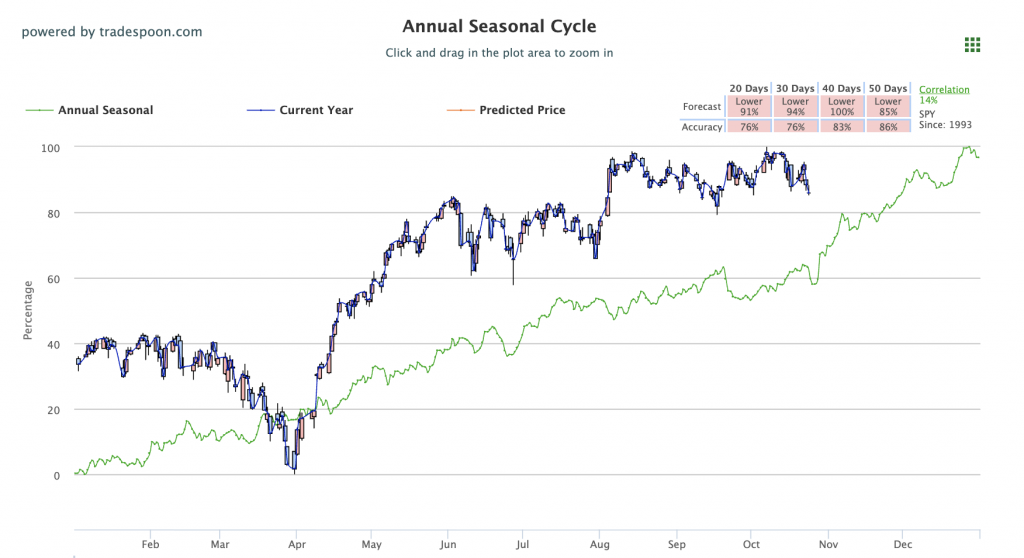
On the downside, the $740–$750 area represents an important support zone within our intermediate-term outlook. Holding this region during market pullbacks would support the argument that recent weakness represents consolidation within the longer-term uptrend rather than a sustained reversal.
In the near term, investors should also monitor whether SPY can regain and maintain its shorter-term moving averages, particularly the 50-day moving average, as a sign of strengthening momentum.
Our primary concern remains the possibility that interest rates stay higher for longer than investors anticipate. With the 10-year Treasury yield continuing to fluctuate within the 4.5%–5.5% range, renewed upward pressure on yields could challenge valuations, especially among technology and other growth-oriented companies.
A sustained increase in oil prices, disappointing corporate guidance, or evidence of broader credit-market deterioration could also trigger additional volatility.
Nevertheless, the combination of resilient earnings, continued investment, and positive long-term growth expectations suggests that the broader bullish trend has not yet been broken.
This week’s Federal Reserve decision, inflation data, GDP report, and technology earnings will help determine whether stocks can build on Monday’s recovery or face another period of consolidation.
For now, our strategy remains focused on the longer-term upside while maintaining disciplined risk management around the market’s important support levels.
The opportunity remains intact, but as the market enters another decisive earnings and policy week, investors should be prepared for volatility and increasingly selective leadership.
Please share this Tradespoon Market Commentary with your friends.



Comments Off on


Tradespoon Tools make finding winning trades in minute as easy as 1-2-3.
Our simple 3 step approach has resulted in an average return of almost 20% per trade!