 Save Big on Commissions ($0.65 per Contract)
CLICK HERE TO LEARN MORE
Save Big on Commissions ($0.65 per Contract)
CLICK HERE TO LEARN MORE
RoboStreet – Stocks are ending a volatile week with the S&P 500 still holding near key support despite the Fed’s first rate hike in more than three years, oil above $100 and the 10-year Treasury yield testing 5%. With the VIX near 16 and the longer-term trend still intact, the next move could come down to whether yields and crude finally cool—or force another test of the 50-day moving average.
Markets are closing out another volatile week with investors balancing resilient corporate fundamentals against a much more challenging macro backdrop. The Federal Reserve, oil prices and Treasury yields remain at the center of the conversation, while geopolitical risk, tariffs and questions surrounding the next stage of the AI boom continue to create sharp rotations underneath the major indexes.
The biggest development came Wednesday when the Federal Reserve raised its benchmark interest rate by 25 basis points to 3.75%–4.00%, its first increase since 2023. The decision itself was widely anticipated, but policymakers also signaled that additional tightening could be necessary as inflation remains above the Fed’s target. Stocks initially sold off following the announcement before recovering strongly Thursday as investors concluded that much of the move had already been priced into the market.
And remember, we’re not talking about day trading here. I’m looking for 50-100% gains within the next 3 months, so my weekly updates are timely enough for you to act.
That rebound was helped by a temporary retreat in two of the biggest obstacles facing equities: oil prices and Treasury yields. The 10-year Treasury yield fell toward 4.93% Thursday before moving back toward 5% Friday, while crude oil also eased from its recent highs. Those levels have become increasingly important for the market. A 10-year yield around 5% increases competition for equity valuations and raises borrowing costs across the economy, while oil above $100 threatens to keep inflation elevated and complicate the Fed’s efforts to stabilize prices.
Energy remains particularly sensitive to the continuing conflict in the Middle East. Brent crude recently surged above $109 per barrel as disruptions to Gulf energy infrastructure raised concerns about global supply. Prices have since retreated toward the low-$100s as some supply fears eased, but the situation remains fluid. For equities, that creates a difficult balance: elevated crude can support energy producers while simultaneously acting as a tax on consumers, transportation companies and rate-sensitive growth stocks.
Technology remains another critical piece of the market puzzle. AI and semiconductor stocks came under pressure earlier in the week after several prominent technology executives called for greater caution surrounding the pace of advanced AI development. However, there is still little evidence that the enormous capital-spending cycle surrounding AI infrastructure is coming to an abrupt end. Semiconductor shares were once again showing relative strength Friday, reinforcing the idea that investors remain willing to buy leading technology companies during periods of weakness.
Trade policy is also moving back onto the market’s radar. President Donald Trump and Chinese President Xi Jinping are expected to meet next week, with tariffs, semiconductor restrictions, rare-earth supplies and broader trade relations likely to be important topics. Any meaningful change in U.S.-China policy could quickly influence technology, industrials and multinational companies.
Despite these crosscurrents, the broader market has remained surprisingly resilient. The S&P 500 is still up more than 11% for the year and recently stood only about 2% below its August record high. That resilience is important. Investors have already absorbed sharply higher oil prices, a 5% 10-year Treasury yield and the first Federal Reserve rate hike in more than three years without seeing a major deterioration in the longer-term equity trend.
The VIX remains near 16, suggesting that volatility has increased but has not reached levels normally associated with broad market panic. From my perspective, the long-term trend remains intact and I continue to remain in the MARKET BULLISH camp. The primary risk is that inflation remains stubborn enough to keep interest rates higher for longer, particularly if energy prices remain elevated and the Federal Reserve continues tightening.
For SPY, I continue to see the potential for the rally to eventually reach the $760–$780 area, while the $700–$720 region remains an important support zone over the next several months. In the near term, I will continue watching the 10-year Treasury yield, oil prices and the market’s reaction around the 50-day moving average. If yields can sustainably move back below 5%, crude stabilizes and earnings remain supportive, the conditions would improve for equities to challenge their previous highs. Until then, investors should expect volatility and sharp sector rotations while keeping the larger bullish trend in perspective.
Explore our latest forecasts, trade signals, and live strategy sessions at Tradespoon.com. Navigate uncertainty with confidence—and position yourself ahead of the curve.
Whether you’re targeting blue-chip stocks, ETFs, commodities, or inverse ETFs, RoboInvestor offers a flexible, forward-looking approach tailored to today’s market conditions. Our model portfolio typically holds 12 to 25 carefully selected positions, and we’ve recently adopted an even more selective strategy—focused on quality, resilience, and opportunity.
Join us and take advantage of advanced AI technology to guide your investments with precision and confidence.
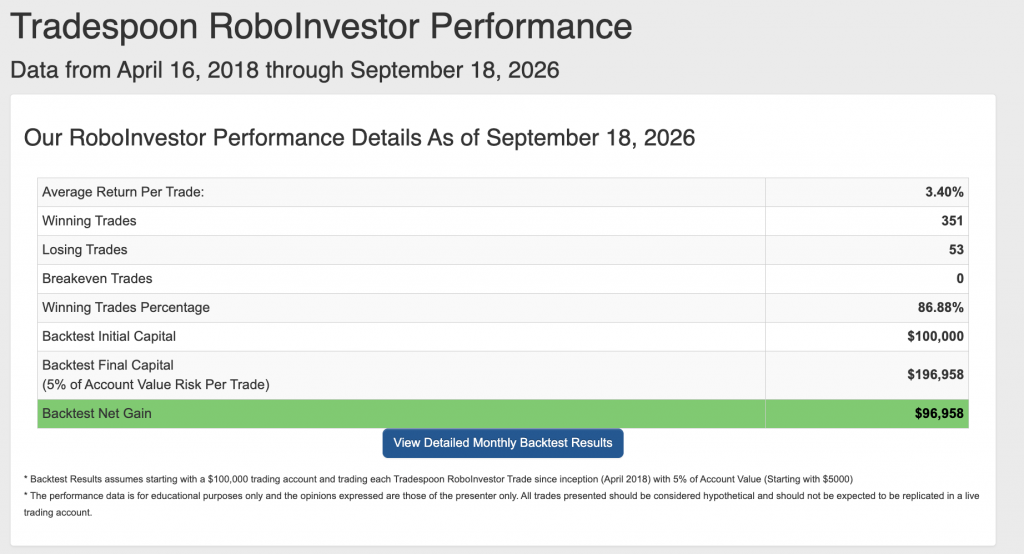
Our track record is one of the best in the retail advisory industry, with a Winning Trades Percentage of 86.88% since April 2018.
In this environment, a disciplined, insight-driven framework matters more than ever—one that cuts through the noise, respects the bond market’s influence, manages rate and employment risk, and helps you position proactively for the opportunities and pivots that tend to define the first quarter.
As we move through the second half of 2026, investors continue navigating a market that appears calm on the surface but remains highly sensitive beneath it. Geopolitical developments in the Middle East, shifting tariff policy, and an uncertain Federal Reserve path continue to influence investor sentiment as inflation gradually cools, but interest rates remain elevated. Meanwhile, economic data has become more mixed, with the labor market showing signs of moderation while corporate earnings continue to demonstrate remarkable resilience.
Whether you are a seasoned investor or just starting, our team is here to help you every step of the way. Don’t face the challenges of tomorrow alone–join RoboInvestor today and take your investing to the next level.
Stay alert, stay strategic—and trade smart.
And remember, we’re not talking about day trading here. I’m looking for 50-100% gains within the next 3 months, so my weekly updates are timely enough for you to act.
*Please note: RoboStreet is part of your free subscription service. It is not included in any paid Tradespoon subscription service. Vlad Karpel only trades his own personal money for paid subscription services. If you are a paid subscriber, please review your Premium Member Picks, ActiveTrader, MonthlyTrader, or RoboInvestor recommendations. If you are interested in receiving Vlad’s personal picks, please click here.
Please share this Tradespoon Market Commentary with your friends.



Comments Off on


Tradespoon Tools make finding winning trades in minute as easy as 1-2-3.
Our simple 3 step approach has resulted in an average return of almost 20% per trade!