 Are you a Long-Term Trader? Then take a look at our NEW RoboInvestor Service?
CLICK HERE TO LEARN MORE
Wall Street is beginning the new trading week with a much-needed rebound following one of the most turbulent stretches of the year. After last week’s dramatic technology selloff, investors are returning to equities as oil prices retreat, Treasury yields stabilize, and bargain hunters move back into some of the market’s hardest-hit sectors. However, with critical inflation data approaching and questions surrounding artificial intelligence spending far from resolved, the market’s recovery faces an important test.
Major indexes advanced sharply during Monday’s session, with the S&P 500 and Nasdaq gaining more than 2% around midday. Semiconductor stocks participated in the recovery, even as Nvidia faced additional selling pressure. The rebound is encouraging, particularly after Thursday’s historic decline, but one strong session does not necessarily establish a durable bottom. Investors still need confirmation that the underlying market environment is improving.
Last week’s volatility demonstrated how quickly sentiment can change. Following the midterm elections, which delivered Democratic control of both chambers of Congress, Wednesday’s relief rally suggested investors were welcoming greater political clarity and the possibility of constraints on future policy changes. That optimism reversed dramatically on Thursday, when the S&P 500 plunged 4.36%, the Nasdaq declined 5.52%, and the Dow lost more than 1,800 points. Semiconductor and AI infrastructure companies suffered particularly severe losses as investors reassessed valuations, capital spending requirements, and the possibility of additional regulatory obstacles.
My broader market outlook remains unchanged. I continue to be MARKET BULLISH, with an upside objective of 780–810 for SPY over the coming months. Nevertheless, the recent correction has made the technical picture considerably more complicated, and the next several sessions could be especially important in determining whether the market is preparing for another sustained advance.
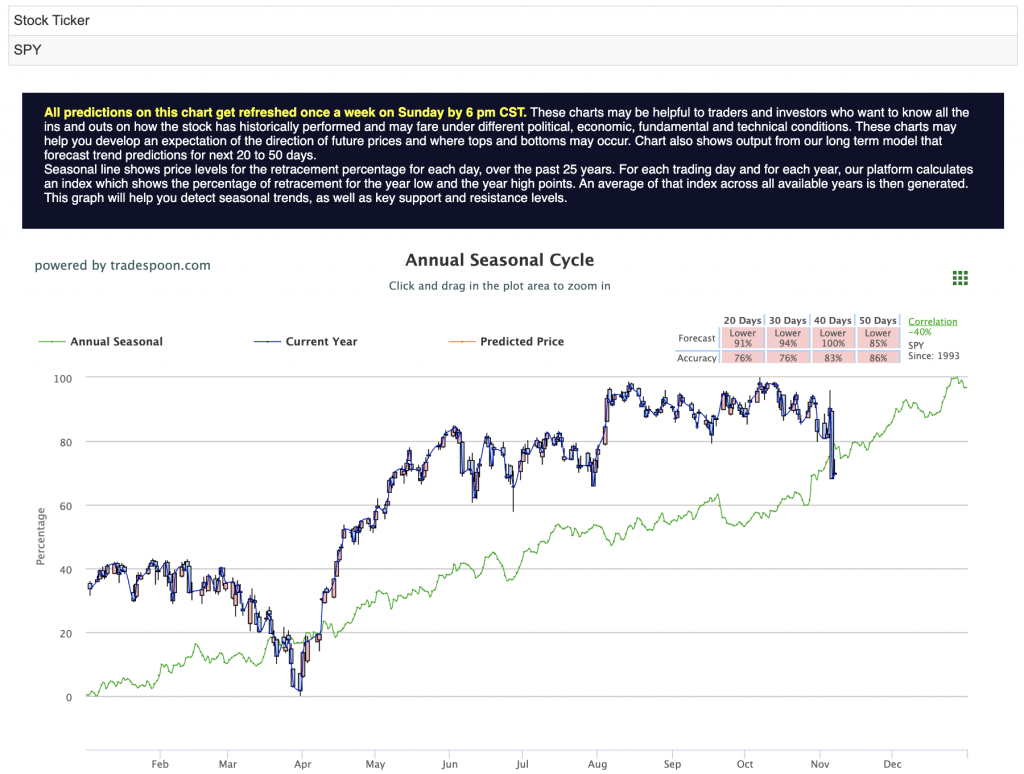
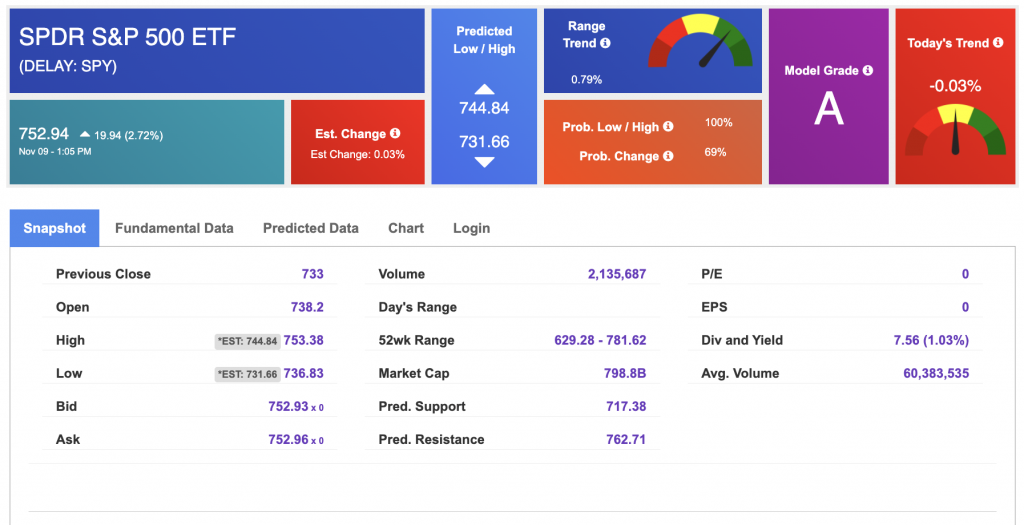
SPY’s breakdown below the previously identified 740–750 support region was a meaningful warning sign. Thursday’s decline carried the ETF to approximately $733, before Friday’s modest stabilization and Monday’s more convincing recovery. With SPY moving back above the 740–750 region during Monday’s session, that area once again becomes a critical level to monitor. Holding above it would help strengthen the recovery, while additional progress toward 760–775 would provide further evidence of improving momentum. Conversely, another failure near 740, followed by a breakdown toward 730, could bring the 720–725 support region back into focus.
The most important immediate catalyst is Tuesday’s October Consumer Price Index report. Inflation has remained stubbornly elevated, and investors are increasingly concerned that stronger economic activity, tariffs, and energy costs could keep price pressures above the Federal Reserve’s comfort zone. Current FactSet estimates point to headline inflation of approximately 4.0% year-over-year, compared with September’s 3.7%, while core inflation is expected near 2.8%. A reading above expectations could place renewed upward pressure on Treasury yields and force investors to reconsider the outlook for monetary policy.
Friday’s employment report reinforced those concerns. The U.S. economy added 165,000 jobs in October, substantially exceeding expectations, while the unemployment rate held near 4.1%. Although a resilient labor market is encouraging from an economic perspective, it also reduces the urgency for the Federal Reserve to ease financial conditions. At its October meeting, the Fed maintained its benchmark interest-rate range at 3.75%–4.00%, with two policymakers favoring an increase. The combination of persistent inflation and stronger employment leaves open the possibility that interest rates could remain elevated longer than investors had anticipated.
Treasury yields will therefore remain a central influence on equities. The 10-year yield continues to trade within the broader 4.5%–5.5% range we have been monitoring, recently hovering around 4.8%–4.9%. Higher yields create competition for stocks, increase financing costs, and place particular pressure on companies whose valuations depend heavily on future earnings growth. This week’s Treasury auctions, including the 10-year note auction Tuesday and 30-year bond auction Thursday, will provide additional insight into investor demand for government debt.
Artificial intelligence remains another major source of both opportunity and uncertainty. The long-term demand for computing capacity, semiconductor technology, cloud infrastructure, and data centers remains substantial. Amazon’s latest results offered a compelling example, with AWS revenue increasing approximately 39% year-over-year. Yet the same report illustrated the financial burden associated with this expansion, as enormous infrastructure investments contributed to a substantial decline in free cash flow.
That distinction is increasingly important. Investors are no longer rewarding AI spending simply because it is large or ambitious. They want evidence that capital expenditures are translating into sustainable revenue growth, stronger margins, and ultimately attractive returns on invested capital. Companies capable of demonstrating those results may continue to command premium valuations, while businesses relying on aggressive financing or distant profitability assumptions could remain vulnerable.
Nvidia has also become a separate source of uncertainty. The company’s board announced an independent investigation following reports that CEO Jensen Huang had been targeted by a foreign intelligence effort. Nvidia emphasized that it has no reason to believe company secrets or national security were compromised, but the situation has added another layer of concern around one of the market’s most influential technology companies. The broader AI trade may recover, but developments involving its industry leaders can still influence sentiment across semiconductors and growth stocks.
Energy markets are providing some relief to investors. Oil prices moved sharply lower Monday as comments from President Trump reduced expectations of imminent additional military action against Iran, while diplomatic efforts remained under discussion. Lower crude prices could help ease inflation expectations and reduce costs for transportation, manufacturing, and consumers. Nevertheless, the underlying conflict remains unresolved, and renewed geopolitical tensions could quickly reverse that trend. Tariffs and international trade uncertainty add another complication for businesses already navigating elevated financing and operating costs.
Corporate earnings will also help determine whether the market’s rebound has staying power. CoreWeave reports Tuesday, offering another look at demand for AI computing infrastructure and the economics of building that capacity. Cisco Systems and Applied Materials follow Thursday, with investors closely monitoring enterprise technology spending, semiconductor equipment demand, order trends, and forward guidance. These reports will be particularly important in determining whether last week’s selling represented an excessive reaction or the beginning of a more meaningful reassessment of growth expectations.
Beyond Tuesday’s CPI release, Thursday brings weekly jobless claims, followed by Friday’s Producer Price Index. Together, these reports should provide a clearer picture of whether inflation is becoming more persistent, whether labor market conditions are beginning to change, and how much flexibility the Federal Reserve may have at its December policy meeting.
My expectation is that volatility will remain elevated as investors digest these developments. Monday’s rebound is a constructive development, and there are signs that the recent selling may have created opportunities in certain high-quality companies. However, the market still needs to demonstrate improving breadth, sustained buying interest, and greater stability in bond yields before we can become more confident that the correction has run its course.
I remain optimistic about the market’s longer-term potential, but optimism must be supported by discipline. The immediate priority is determining whether SPY can firmly reestablish the 740–750 region as support and build momentum toward higher levels. A constructive inflation report, stabilizing yields, and encouraging corporate guidance would strengthen the case for a renewed advance. A disappointing combination of inflation and earnings news could quickly bring downside risks back into focus.
This remains a stock picker’s market. Companies with strong balance sheets, improving earnings, attractive valuations, and measurable returns on investment should be better positioned to navigate the current environment. With volatility elevated and macroeconomic uncertainty likely to persist, selective positioning, disciplined risk management, and careful attention to technical levels remain essential.
The bullish outlook is still intact, but the market has more work to do before the next leg higher can begin.
Please share this Tradespoon Market Commentary with your friends.



Comments Off on


Tradespoon Tools make finding winning trades in minute as easy as 1-2-3.
Our simple 3 step approach has resulted in an average return of almost 20% per trade!