 Save Big on Commissions ($0.65 per Contract)
CLICK HERE TO LEARN MORE
Save Big on Commissions ($0.65 per Contract)
CLICK HERE TO LEARN MORE
RoboStreet – U.S. stocks are trading near all-time highs as stronger-than-expected jobs data, resilient AI and technology earnings, and renewed investor confidence continue to support the rally. But with Iran tensions, oil volatility, tariffs, higher-for-longer interest rate risk, and rising unemployment concerns still shaping market sentiment, investors face a critical question.
The market continues to do something impressive: it is climbing through uncertainty.
That has been the theme of the week. U.S. equities are trading near all-time highs, the Nasdaq recently pushed above a major milestone, volatility remains contained with the VIX around 17, and investors continue to buy strength even as the macro backdrop remains far from simple.
And remember, we’re not talking about day trading here. I’m looking for 50-100% gains within the next 3 months, so my weekly updates are timely enough for you to act.
On the surface, this looks like a market that wants to go higher. Underneath the surface, it is a market still dealing with meaningful crosscurrents: war-related tension near Iran and the Strait of Hormuz, oil-price volatility, tariff uncertainty, sticky inflation risk, a Federal Reserve that remains hesitant to cut rates, and signs that the labor market is resilient but not without pressure.
That combination creates a tricky setup. The trend remains bullish, but the market is not risk-free. Strength should be respected, but so should the possibility of sharper pullbacks if oil spikes again, rates move higher, or unemployment indicators begin to weaken more meaningfully.
This week’s market action was driven by three major forces: stronger-than-expected jobs data, ongoing geopolitical uncertainty, and another round of earnings-driven leadership from technology and AI-linked stocks.
The April jobs report gave investors a reason to believe the U.S. economy is still holding up. The economy added 115,000 jobs, beating expectations, while unemployment held steady at 4.3%. That is not a blowout number, but it was strong enough to calm some recession fears and reinforce the idea that the labor market remains durable.
At the same time, the report also complicates the Federal Reserve picture. A stronger labor market gives the Fed less urgency to cut rates. That matters because investors have been looking for confirmation that inflation is cooling enough and growth is slowing enough to justify easier policy. Instead, the market is getting a mixed message: the economy is resilient, but not weak enough to force the Fed’s hand.
That is why rates remain such an important part of the story. The 10-year Treasury yield continues to trade in a volatile range between roughly 3.6% and 4.5%. When yields ease, growth stocks and AI leaders tend to benefit. When yields move higher, valuations become harder to justify, especially for stocks already priced for perfection.
For now, the market has been able to absorb rate volatility because earnings momentum remains strong. But that balance is not guaranteed. If rates remain higher for longer while unemployment indicators continue to tick up, the market may begin to question how much growth is still priced in.
Geopolitics added another layer of uncertainty. Tensions tied to Iran and the Strait of Hormuz kept energy markets on edge throughout the week. Any disruption near that region matters because the Strait of Hormuz is one of the world’s most important oil chokepoints. When headlines suggest escalation, oil prices can move quickly higher. That raises inflation concerns, pressures consumers, and makes the Fed’s job harder. When headlines suggest de-escalation, oil prices ease, yields can settle down, and equities tend to recover.
That risk-on, risk-off pattern was clear this week. The market sold off when oil and geopolitical fears intensified, then rebounded when investors saw signs that the situation might stabilize. This is one of the reasons volatility can remain contained one day and then suddenly reappear the next. The market is not ignoring risk. It is simply choosing to look past it when earnings and liquidity provide enough support.
Technology and AI remain the strongest sources of support.
Apple helped reinforce confidence in mega-cap leadership, while chip stocks and AI infrastructure names continued to attract capital. Investors are still willing to pay for companies tied to durable demand, cloud infrastructure, data centers, automation, and artificial intelligence. That theme remains one of the strongest engines behind the broader rally.
But even within technology, selectivity is becoming more important. Not every strong earnings report is being rewarded. Some high-growth names are still vulnerable if expectations are too elevated. That is an important lesson for this stage of the rally. Investors are no longer simply buying every AI-related story. They are beginning to separate companies with sustainable earnings power from companies where too much optimism may already be priced in.
That is healthy, but it also means the market is becoming more demanding.
Corporate news added to the week’s volatility as well. Strong earnings reactions in some software and AI-related names showed that investors are still rewarding execution, while weaker guidance from other growth companies reminded the market that valuation discipline matters. IPO activity also picked up, a sign that risk appetite remains alive. When companies feel confident enough to come public and investors are willing to engage, it usually reflects a market environment that is still functioning well.
Global markets also supported the risk-on tone. Japan continued to show strength, while Korea’s market gained attention from AI-related momentum. That global participation matters because this rally is not just about U.S. mega-cap technology. AI spending, semiconductor demand, and infrastructure investment are becoming worldwide themes.
Still, the U.S. market remains the center of gravity. And right now, the message is clear: investors are still willing to buy stocks when earnings hold up, jobs remain stable, and oil does not spiral out of control.
Market sentiment remains bullish, but not euphoric.
That distinction is important. The VIX near 17 suggests investors are not aggressively hedging against a major downturn, but they are also not completely dismissing risk. There is still enough caution in the system to keep this rally from feeling overly complacent.
The strongest argument for the bulls is simple: the market continues to make progress despite a long list of concerns. Stocks are near record highs. Earnings are holding up. AI leadership remains intact. Jobs data is still resilient. Consumers are under pressure, but the economy has not broken. And every time the market has been tested recently, buyers have stepped back in.
That is not a weak market.
The strongest argument for caution is also clear. If oil prices spike again, inflation could remain sticky. If inflation stays sticky, the Fed may remain on hold longer than investors want. If rates stay elevated, high-valuation stocks become more vulnerable. And if unemployment indicators continue to tick higher, the market may have to start pricing in slower growth.
That is the tension right now.
The market wants to believe in a soft-landing environment where earnings stay strong, the Fed eventually cuts, AI keeps driving capital spending, and geopolitical shocks remain contained. That is still possible. But the path is narrow. It requires oil to remain manageable, rates to avoid a sharp move higher, and the labor market to cool gradually rather than break quickly.
For now, the bulls still have the advantage. But the next leg higher will likely require more than just optimism. It will require continued earnings strength, stable rates, and no major escalation in energy markets.
I remain in the bullish camp. The long-term trend remains intact, and the market continues to show real resilience. When stocks can trade near all-time highs despite geopolitical tension, tariff uncertainty, volatile oil, a cautious Fed, and rising concerns around unemployment, investors should pay attention. That kind of strength usually reflects institutional demand and confidence in future earnings power.
But I also believe this is a market that requires discipline.
The biggest risk remains higher-for-longer interest rates. If the Fed stays on hold because inflation remains sticky, and if unemployment indicators continue to move in the wrong direction, the market may become more vulnerable to sharp rotations and valuation resets. That does not mean the bull market is over. It means investors need to be selective.
SPY still has room to move higher if earnings momentum continues and macro risks remain contained. A rally toward the $740–$760 range remains possible over the next few months. On the downside, the $660–$680 area is the key support zone I would watch. As long as the market holds above that range and earnings remain resilient, the bullish case remains intact.
The playbook is straightforward: respect the trend, but do not chase blindly. Focus on quality. Favor companies with strong earnings, durable demand, pricing power, and exposure to long-term themes like AI, automation, infrastructure, and productivity. Avoid weak companies that are only moving because the indexes are strong.
This is still a bullish market, but it is a disciplined bullish market.
The market is climbing through uncertainty. That is encouraging. But near all-time highs, investors need to stay focused, selective, and prepared. The opportunity is still there, but so is the risk of fast reversals if oil, rates, or labor data begin to move against the rally.
For now, the trend favors the bulls. But the next phase of this market will likely reward investors who combine conviction with patience, and optimism with risk management.
And that is exactly where RoboInvestor proves its value. Built for a headline-sensitive, rangebound market, our flagship AI-driven advisory helps cut through Fed uncertainty, tariff chatter, geopolitical risk, and AI hype to focus on what matters most: statistically grounded setups and clear risk-reward opportunities. With RoboInvestor, investors can stay engaged, stay disciplined, and act with precision instead of reacting emotionally to every headline.
Every other weekend, you’ll receive the RoboInvestor newsletter—a concise, high-signal read with market context, technical outlooks, updates on open positions, and clear, actionable trade ideas so you’re prepared and confident heading into Monday’s open.
Explore our latest forecasts, trade signals, and live strategy sessions at Tradespoon.com. Navigate uncertainty with confidence—and position yourself ahead of the curve.
Whether you’re targeting blue-chip stocks, ETFs, commodities, or inverse ETFs, RoboInvestor offers a flexible, forward-looking approach tailored to today’s market conditions. Our model portfolio typically holds 12 to 25 carefully selected positions, and we’ve recently adopted an even more selective strategy—focused on quality, resilience, and opportunity.
Join us and take advantage of advanced AI technology to guide your investments with precision and confidence.
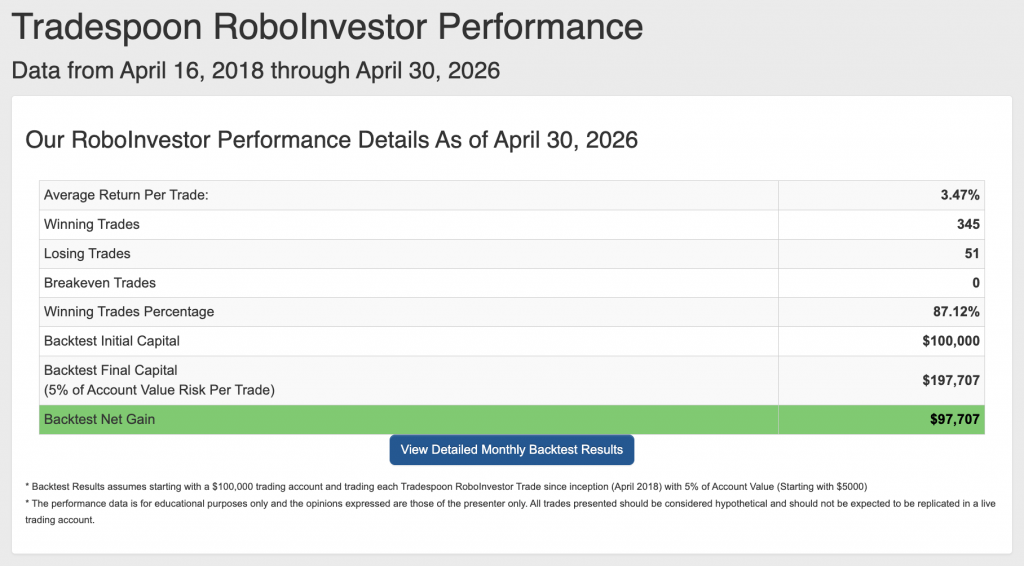
Our track record is one of the best in the retail advisory industry, with a Winning Trades Percentage of 87.12% since April 2018.
As we dive deeper into 2026, investors are stepping into a market that still feels deceptively calm on the surface—but increasingly reactive underneath. Tariff headlines are back in rotation, the Fed path is less predictable as inflation expectations tug both ways, and the economy is sending mixed signals as rates stay elevated and labor-market indicators begin to soften at the margins. Volatility remains contained, yet quick to spike around policy shifts and geopolitical developments, while earnings and forward guidance continue to do the heavy lifting for direction.
In this environment, a disciplined, insight-driven framework matters more than ever—one that cuts through the noise, respects the bond market’s influence, manages rate and employment risk, and helps you position proactively for the opportunities and pivots that tend to define the first quarter.
Whether you are a seasoned investor or just starting, our team is here to help you every step of the way. Don’t face the challenges of tomorrow alone–join RoboInvestor today and take your investing to the next level.
Stay alert, stay strategic—and trade smart.
And remember, we’re not talking about day trading here. I’m looking for 50-100% gains within the next 3 months, so my weekly updates are timely enough for you to act.
*Please note: RoboStreet is part of your free subscription service. It is not included in any paid Tradespoon subscription service. Vlad Karpel only trades his own personal money for paid subscription services. If you are a paid subscriber, please review your Premium Member Picks, ActiveTrader, MonthlyTrader, or RoboInvestor recommendations. If you are interested in receiving Vlad’s personal picks, please click here.
Please share this Tradespoon Market Commentary with your friends.



Comments Off on


Tradespoon Tools make finding winning trades in minute as easy as 1-2-3.
Our simple 3 step approach has resulted in an average return of almost 20% per trade!