 Special Offer: Try the 'Elite Trading Circle Membership' for ONLY $37!
CLICK HERE TO LEARN MORE
Special Offer: Try the 'Elite Trading Circle Membership' for ONLY $37!
CLICK HERE TO LEARN MORE
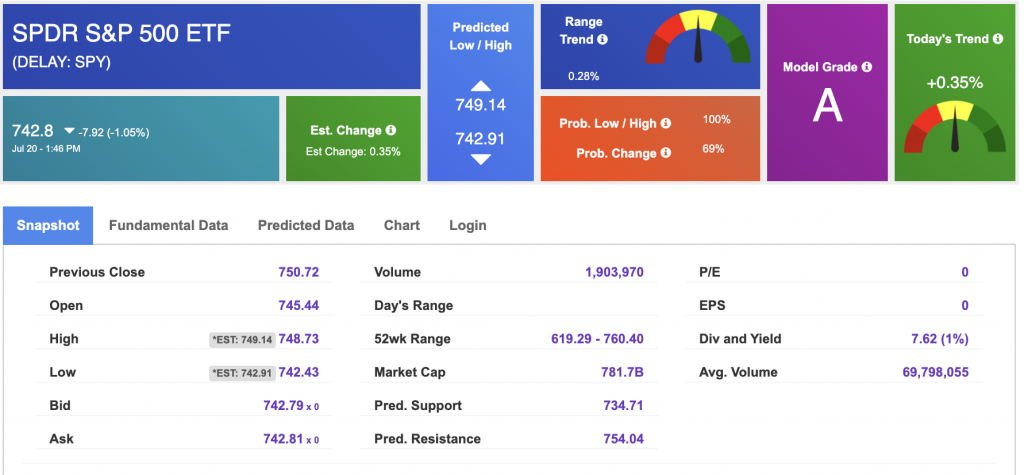
Markets are starting the week with technology and semiconductor stocks attempting to recover from last week’s sharp correction. At the same time, renewed U.S.–Iran tensions, elevated oil prices and rising Treasury yields continue to create a difficult backdrop for growth stocks.
Last week showed how quickly market sentiment can change. Softer inflation, resilient consumer spending and record bank profits reinforced the argument that the U.S. economy remains fundamentally sound. Those positives were ultimately overwhelmed by the breakdown of the U.S.–Iran ceasefire, another surge in crude oil and a selloff across the market’s most crowded semiconductor and artificial-intelligence trades.
The S&P 500 declined approximately 1.6% for the week, the Dow lost 0.9% and the Nasdaq fell 2.9%. Technology absorbed the heaviest damage, while energy benefited from higher crude prices. Despite the pullback, the S&P 500 remains approximately 9% higher for the year and only about 2% below its early-June record.
Stocks opened Monday with a modest rebound led by technology and semiconductor companies. Bargain hunting helped the Philadelphia Semiconductor Index recover after entering bear-market territory last week, while the broader market remained cautious ahead of major technology earnings.
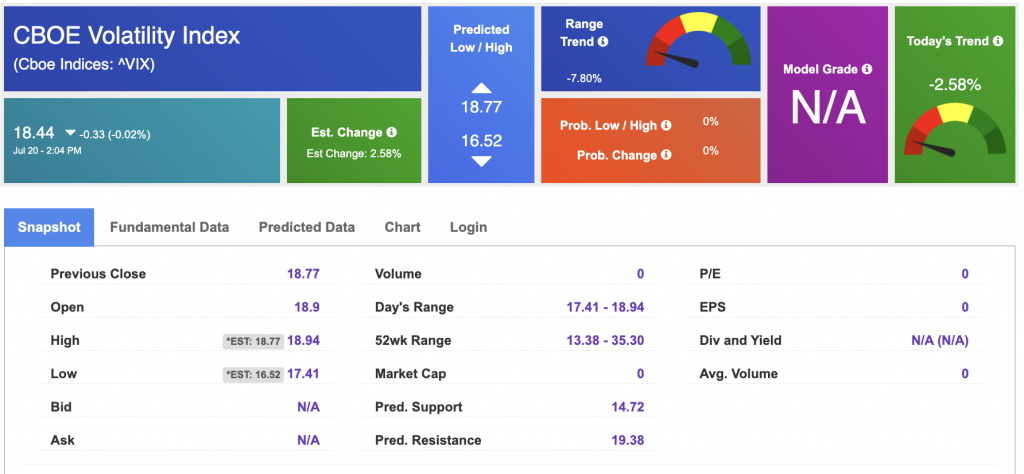
The VIX remains near 18, reflecting increased uncertainty without signaling outright panic. Investors are still willing to buy pullbacks, but they are becoming more demanding about valuations, earnings guidance and the ability of companies to convert AI spending into measurable revenue and profit growth.
This is no longer a market in which every technology stock rises together. Leadership is narrowing, expectations are elevated and companies must now deliver strong results, credible guidance and clear returns on capital spending.
Second-quarter earnings season began with powerful results from the largest U.S. banks. JPMorgan reported a record $21.2 billion quarterly profit, while Goldman Sachs, Bank of America, Citigroup, Wells Fargo and Morgan Stanley also benefited from stronger trading, underwriting and investment-banking activity.
The results suggest that corporate confidence, capital-market activity and dealmaking remain healthy. However, the relatively restrained stock reactions also demonstrated that good results are not always enough when expectations are already high.
Technology companies face an even more demanding standard. TSMC reported a 77% increase in quarterly profit last week, yet its shares declined as investors questioned whether AI infrastructure spending can continue expanding at its recent pace.
The Philadelphia Semiconductor Index fell approximately 10% last week and finished more than 20% below its June high. The sector remains sharply higher for the year, but the correction demonstrates how crowded positioning and aggressive valuations can produce major declines even when the underlying businesses remain strong.
The economic calendar is lighter than last week’s inflation-heavy schedule, making corporate earnings, oil prices and geopolitical developments the most likely market drivers.
Monday, July 20: The Conference Board’s Leading Economic Index declined 0.2% in June, partially reversing the previous two months of improvement. The coincident index still increased, suggesting that current economic activity remains positive even as forward-looking conditions remain uneven.
Wednesday, July 22: Alphabet, Tesla, IBM and Texas Instruments headline the week’s busiest earnings session. Alphabet will be watched for advertising growth, cloud demand, AI monetization and capital spending, while Tesla investors will focus on margins, deliveries, robotaxi development and future spending plans. Alphabet and IBM have confirmed Wednesday earnings calls, while Tesla is scheduled to report after the closing bell.
Thursday, July 23: Initial unemployment claims will provide the latest reading on layoffs and labor-market stability. RTX reports before the opening bell, while Intel reports after the close and should provide an important update on PC demand, foundry progress, AI products and the broader semiconductor cycle.
Friday, July 24: Preliminary manufacturing and services PMIs will offer an early look at July business activity, hiring and price pressures. June new-home sales will provide another test for the housing market, while American Express earnings should offer insight into consumer spending, credit quality and travel demand.
Investors will also remain focused on oil prices, shipping through the Strait of Hormuz and any signs of renewed ceasefire negotiations. These developments could have a larger immediate market impact than the scheduled economic reports.
Interest rates remain the market’s largest structural risk. Rising oil prices can push inflation expectations and Treasury yields higher, creating additional pressure on technology valuations and increasing borrowing costs throughout the economy.
The next Federal Reserve meeting is scheduled for July 28–29. This week’s labor, business-activity and housing data will help shape expectations, but the direction of oil prices may be equally important to the Fed’s inflation outlook.
The longer-term bullish case remains intact. Corporate profits are growing, consumers continue spending, layoffs remain limited and long-term AI investment remains a powerful source of economic activity.
However, investors should not expect every stock to participate equally. Strong companies can still decline when expectations become unrealistic, and crowded trades can correct sharply without ending the broader bull market.
I remain in the MARKET BULLISH camp. Over the next several months, I believe SPY can reach the $760–$780 area, while shorter-term support remains closer to $700–$720. Earnings growth, continued economic expansion and long-term AI investment continue to support the market, but the path higher is becoming more volatile and selective.
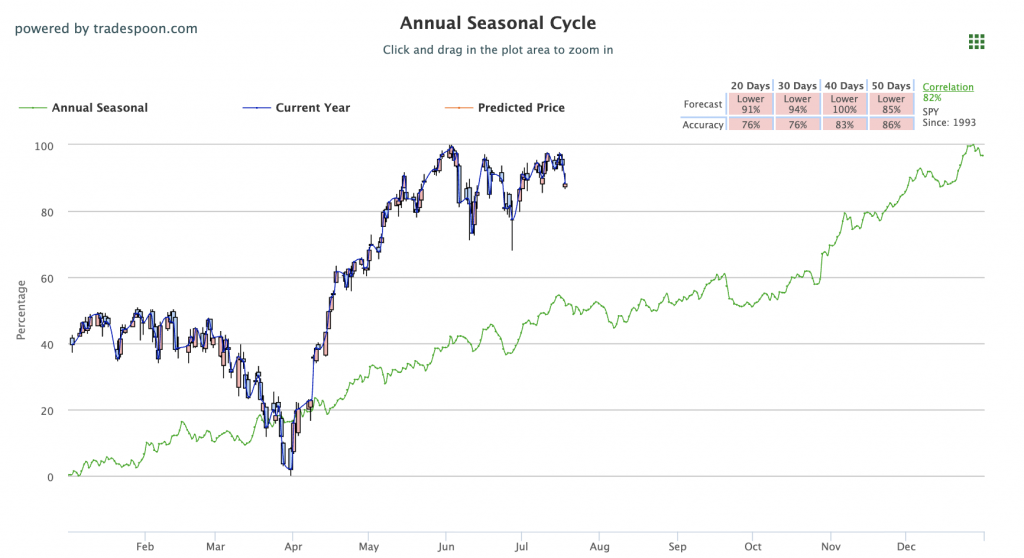
The bottom line is that the economy and earnings remain strong enough to support the bull market, but disciplined entries, timely exits and careful position sizing are becoming increasingly important. This week’s technology earnings should help determine whether the recent selloff created a healthy reset—or whether the market needs more time before beginning its next move higher.
West Texas Intermediate for Crude Oil delivery (CL.1) is priced at $83.76 per barrel, up 1.54%, at the time of publication.
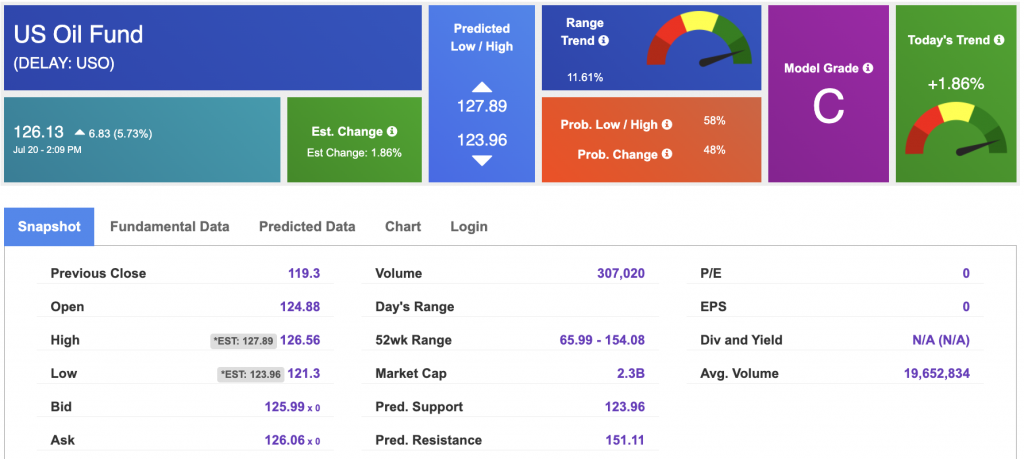
Looking at USO, a crude oil tracker, our 10-day prediction model shows mixed signals. The fund is trading at $126.13 at the time of publication. Prediction data is uploaded after the market close at 6 p.m., CST. Today’s data is based on market signals from the previous trading session.
The price for the Gold Continuous Contract (GC00) is down 0.21% at $4,010.10 at the time of publication.
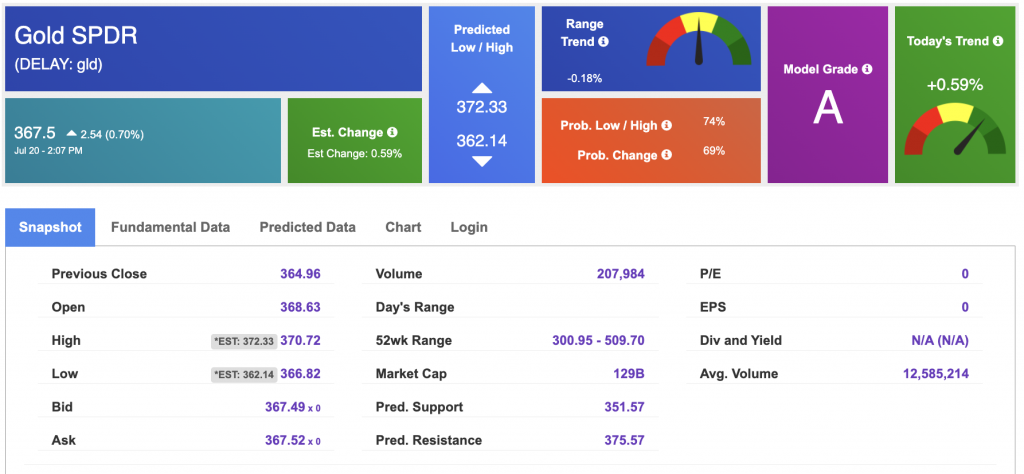
Using SPDR GOLD TRUST (GLD) as a tracker in our Stock Forecast Tool, the 10-day prediction window shows mixed signals. The gold proxy is trading at $367.5 at the time of publication. Vector signals show +0.59% for today. Prediction data is uploaded after the market close at 6 p.m., CST. Today’s data is based on market signals from the previous trading session.
The yield on the 10-year Treasury note is up at 4.601% at the time of publication.
The yield on the 30-year Treasury note is up at 5.119% at the time of publication.
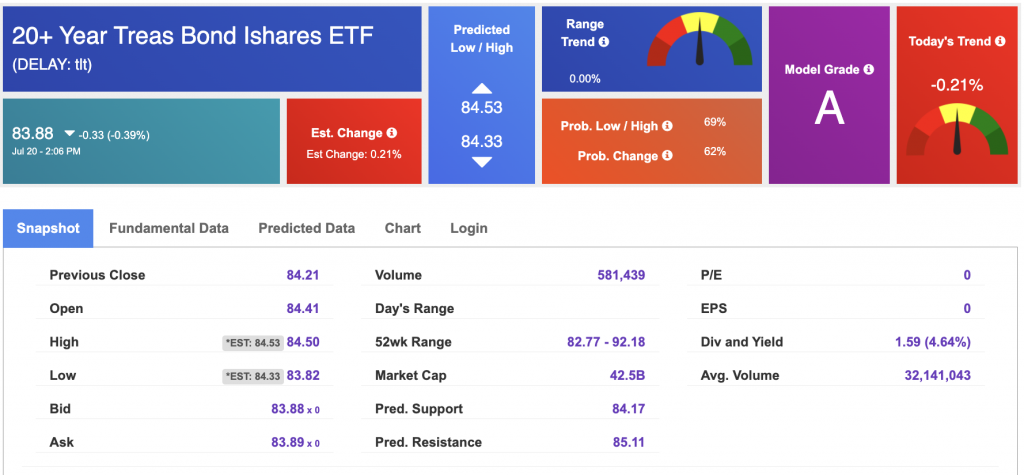
Using the iShares 20+ Year Treasury Bond ETF (TLT) as a proxy for bond prices in our Stock Forecast Tool, we see mixed signals in our 10-day prediction window. Prediction data is uploaded after the market close at 6 p.m., CST. Today’s data is based on market signals from the previous trading session.
The CBOE Volatility Index (^VIX) is priced at $18.44 at the time of publication, and our 10-day prediction window shows mixed signals. Prediction data is uploaded after the market close at 6 p.m., CST. Today’s data is based on market signals from the previous trading session.
Please share this Tradespoon Market Commentary with your friends.



Comments Off on


Tradespoon Tools make finding winning trades in minute as easy as 1-2-3.
Our simple 3 step approach has resulted in an average return of almost 20% per trade!