 Sign Up for One-on-One Coaching and get our Premium Membership FREE for 1 Year!
CLICK HERE TO APPLY
Sign Up for One-on-One Coaching and get our Premium Membership FREE for 1 Year!
CLICK HERE TO APPLY
RoboStreet – Stocks remain near record highs as the U.S.–Iran agreement, plunging oil prices, and continued AI strength support risk appetite. While a hawkish Fed, stubborn inflation, and early labor-market weakness remain key risks, we stay bullish with SPY targeting $760–$780.
U.S.–Iran progress has removed a major threat to markets, but hot inflation and the possibility of renewed rate hikes leave investors walking a narrow path near record highs.
U.S. stocks remain near all-time highs, with the VIX near 16, as investors balance falling oil prices and persistent enthusiasm for technology against a more hawkish Federal Reserve. The geopolitical picture has improved considerably, but inflation, interest rates, tariffs, earnings, and emerging labor-market weakness remain important risks.
The dominant positive catalyst this week was progress toward ending the war in Iran. The United States and Iran finalized a preliminary 14-point agreement designed to extend the ceasefire, reopen the Strait of Hormuz, reduce military tensions, and establish a framework for broader negotiations.
That progress produced an immediate market reaction. Oil, which had previously surged above $90 as the conflict disrupted energy flows, reversed sharply as the probability of a prolonged supply shock declined. WTI crude fell back into the mid-$70s, while Brent moved below $80.
This reversal is important because energy accounted for much of the recent acceleration in inflation. Lower oil prices can reduce transportation expenses, ease pressure on consumer budgets, improve corporate margins, and potentially prevent temporary energy inflation from spreading into the broader economy.
Airlines, industrial companies, consumer stocks, and other economically sensitive sectors benefited from the decline. Equities rallied strongly on Monday as investors began removing the geopolitical risk premium that had built up during the conflict.
The agreement is not a final peace treaty, however. Iran’s nuclear program, sanctions relief, regional security, and the full restoration of Strait of Hormuz traffic still require additional negotiations. Markets are pricing in meaningful de-escalation, which means any breakdown in implementation could quickly put upward pressure on oil and volatility again.
The geopolitical news has been encouraging, but the inflation data was not.
May CPI increased 0.5% from the previous month and 4.2% from one year earlier, its fastest annual pace in three years. Energy prices rose 3.9% and generated most of the monthly increase. Core CPI was more encouraging at 0.2% for the month, but remained 2.9% year over year.
Producer inflation was even more concerning. PPI rose 6.5% from a year earlier, its largest annual increase since late 2022. That indicates businesses are facing substantial cost pressures that could eventually be passed along to consumers.
The combination of hotter CPI and PPI reports changed market expectations dramatically. Investors entered the year looking for additional rate cuts. They are now considering whether the Fed could raise rates before year-end if inflation remains elevated.
The Fed held its benchmark rate at 3.50%–3.75% on Wednesday, as expected, but its message was decidedly hawkish. Policymakers emphasized that inflation progress has stalled, while the updated projections showed that several officials see the possibility of higher rates later this year.
And remember, we’re not talking about day trading here. I’m looking for 50-100% gains within the next 3 months, so my weekly updates are timely enough for you to act.
That does not guarantee another hike. The sharp decline in oil since the CPI reporting period could reduce inflation over the next several months. Nevertheless, the Fed has made it clear that it needs evidence—not simply forecasts—that inflation is returning toward its 2% objective.
The broader economic data continues to show impressive resilience. ISM Services reached 54.5, while ISM Manufacturing rose to 54.0, its strongest expansion in approximately four years. Factory orders increased 4.8%, private payrolls grew by 122,000, and job openings remained elevated at approximately 7.6 million.
Those numbers support the bullish case because they suggest economic demand remains intact. They also complicate the Fed’s job, however, because strong activity can keep wage growth and inflation elevated.
At the same time, unemployment indicators are beginning to tick higher. Initial jobless claims recently reached approximately 225,000, their highest level since December. That is not yet a recessionary signal, but it deserves attention.
The economy may be entering a period in which inflation remains too high for the Fed to ease while parts of the labor market gradually weaken. That is the risk behind the “higher for longer” interest-rate environment. If borrowing costs stay elevated while unemployment continues rising, consumer spending and corporate profitability could eventually come under pressure.
The 10-year Treasury yield continues to trade with significant volatility, moving within a broad 4.0%–4.8% range. It was recently near 4.4%, reflecting the tension between persistent inflation and improving geopolitical conditions.
A sustained move toward the upper end of that range would create a more difficult environment for stocks. Higher yields increase corporate financing costs and reduce the present value investors are willing to assign to future earnings, particularly in technology and other high-growth sectors.
If oil remains lower and upcoming inflation reports improve, yields could stabilize or move toward the lower end of the range. That would be supportive of equity valuations and could help broaden the rally beyond the largest technology companies.
The market’s appetite for growth remains visible in SpaceX’s historic public offering. The company raised approximately $75 billion at $135 per share, completing the largest IPO in history. Shares climbed roughly 20% in their Nasdaq debut and pushed the company’s valuation above $2 trillion.
SpaceX has experienced some profit-taking after its initial surge, but the offering still demonstrated the extraordinary amount of capital available for differentiated growth companies. It also reinforced enthusiasm surrounding the intersection of artificial intelligence, aerospace, communications, and advanced infrastructure.
Reports that OpenAI and Anthropic have also begun preparing for potential public offerings further illustrate the strength of the AI capital cycle. These offerings could attract enormous investor interest, but they could also absorb liquidity and test how much valuation expansion the market can support.
Corporate results and guidance remain equally important. Companies with credible AI exposure, expanding margins, and visible earnings growth continue to receive premium valuations. Businesses that miss expectations or reduce guidance are being punished much more aggressively, making this an increasingly selective market beneath the headline indexes.
I remain in the market-bullish camp.
SPY is trading around $747, and I believe the current rally can reach the $760–$780 area over the next few months. The long-term trend remains intact, supported by resilient economic growth, continued AI investment, strong corporate earnings, and improving geopolitical conditions.
The decline in oil is particularly constructive. If energy remains near current levels, headline inflation should begin to moderate, relieving pressure on consumers, corporate margins, and eventually the Federal Reserve.
For the near term, I am watching the $700–$720 area as the primary support zone for SPY. A pullback into that range would not automatically break the bullish thesis. Instead, it could create a healthier consolidation after a powerful advance. A sustained break below that area, particularly alongside rising unemployment and deteriorating earnings, would require a more defensive approach.
The two biggest risks remain unchanged: interest rates could stay higher for longer, and unemployment indicators are beginning to tick up. Tariffs also remain an inflationary wildcard because they can increase input costs just as businesses are already dealing with elevated producer prices.
For now, the market continues to absorb those risks. A VIX near 16 indicates investors are relatively calm, although it should not be interpreted as an absence of risk. With indexes near record highs and expectations elevated, even modest disappointments can produce sharp short-term moves.
The next several sessions could be volatile. Quadruple witching will create heavy derivatives volume around the June 19 expiration, potentially exaggerating otherwise routine price movements.
The Federal Reserve will release its annual bank stress-test results on June 24. Those results will be important for financial stocks because they can affect capital requirements, dividends, and share-repurchase plans.
The most important macro session arrives on June 25, when investors receive the third estimate of first-quarter GDP and May Personal Income and Outlays, including the PCE inflation index. PCE is the Fed’s preferred inflation measure and will provide the clearest test of whether the CPI acceleration was primarily an energy shock or evidence of a broader inflation problem.
If PCE cools while oil remains below $80, the market may begin reducing expectations for another rate hike. If PCE confirms that inflation is broadening, Treasury yields could rise and put the $700–$720 SPY support zone back into focus.
And that is exactly where RoboInvestor proves its value. Built for a headline-sensitive, rangebound market, our flagship AI-driven advisory helps cut through Fed uncertainty, tariff chatter, geopolitical risk, and AI hype to focus on what matters most: statistically grounded setups and clear risk-reward opportunities. With RoboInvestor, investors can stay engaged, stay disciplined, and act with precision instead of reacting emotionally to every headline.
Every other weekend, you’ll receive the RoboInvestor newsletter—a concise, high-signal read with market context, technical outlooks, updates on open positions, and clear, actionable trade ideas so you’re prepared and confident heading into Monday’s open.
Explore our latest forecasts, trade signals, and live strategy sessions at Tradespoon.com. Navigate uncertainty with confidence—and position yourself ahead of the curve.
Whether you’re targeting blue-chip stocks, ETFs, commodities, or inverse ETFs, RoboInvestor offers a flexible, forward-looking approach tailored to today’s market conditions. Our model portfolio typically holds 12 to 25 carefully selected positions, and we’ve recently adopted an even more selective strategy—focused on quality, resilience, and opportunity.
Join us and take advantage of advanced AI technology to guide your investments with precision and confidence.
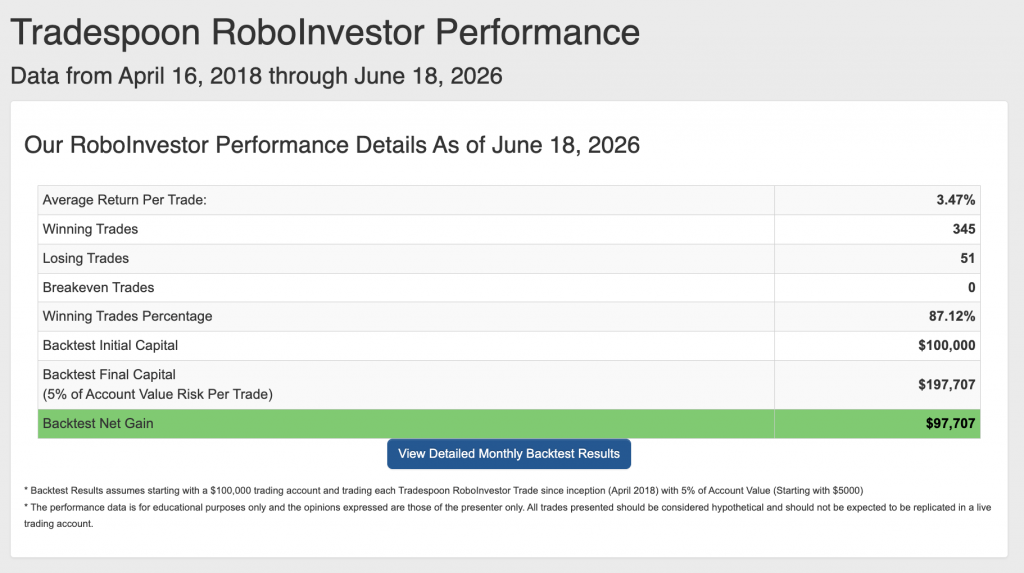
Our track record is one of the best in the retail advisory industry, with a Winning Trades Percentage of 87.12% since April 2018.
In this environment, a disciplined, insight-driven framework matters more than ever—one that cuts through the noise, respects the bond market’s influence, manages rate and employment risk, and helps you position proactively for the opportunities and pivots that tend to define the first quarter.
As we dive deeper into 2026, investors are stepping into a market that still feels deceptively calm on the surface—but increasingly reactive underneath. Tariff headlines are back in rotation, the Fed path is less predictable as inflation expectations tug both ways, and the economy is sending mixed signals as rates stay elevated and labor-market indicators begin to soften at the margins. Volatility remains contained, yet quick to spike around policy shifts and geopolitical developments, while earnings and forward guidance continue to do the heavy lifting for direction.
Whether you are a seasoned investor or just starting, our team is here to help you every step of the way. Don’t face the challenges of tomorrow alone–join RoboInvestor today and take your investing to the next level.
Stay alert, stay strategic—and trade smart.
And remember, we’re not talking about day trading here. I’m looking for 50-100% gains within the next 3 months, so my weekly updates are timely enough for you to act.
*Please note: RoboStreet is part of your free subscription service. It is not included in any paid Tradespoon subscription service. Vlad Karpel only trades his own personal money for paid subscription services. If you are a paid subscriber, please review your Premium Member Picks, ActiveTrader, MonthlyTrader, or RoboInvestor recommendations. If you are interested in receiving Vlad’s personal picks, please click here.
Please share this Tradespoon Market Commentary with your friends.



Comments Off on


Tradespoon Tools make finding winning trades in minute as easy as 1-2-3.
Our simple 3 step approach has resulted in an average return of almost 20% per trade!