 Save Big on Commissions ($0.65 per Contract)
CLICK HERE TO LEARN MORE
Save Big on Commissions ($0.65 per Contract)
CLICK HERE TO LEARN MORE
Markets are starting the week on much stronger footing as oil prices retreat, Treasury yields fall back below 5% and investors rotate aggressively into AI and semiconductor stocks. After last week’s battle with inflation, higher rates and the S&P 500’s 50-day moving average, the bulls are getting some much-needed relief—but several major tests remain ahead.
Last week, I said the three numbers I was watching most closely were 5% on the 10-year Treasury yield, $100 oil and the S&P 500’s 50-day moving average. As we begin a new week, all three are moving in a more favorable direction.
Stocks are sharply higher Monday, with technology once again leading the market. By late morning, the Nasdaq was up roughly 1.6%, the S&P 500 had gained about 1% and the Dow was higher by roughly 0.5%. Semiconductor and AI-related names were among the biggest winners, with Intel jumping double digits, AMD surging more than 9% and Meta rising sharply after an analyst price-target increase.
The catalyst is not simply another AI rally. The broader macro backdrop has improved considerably from where we were only a few trading sessions ago.
Oil is providing perhaps the most important relief. U.S. crude fell nearly 5% Monday to roughly $95.50 per barrel, while Brent retreated toward $100 as markets reacted to reports of improving Gulf exports and hopes that diplomatic discussions could reduce some of the pressure on global energy supplies. That is a major change from last week, when oil above $100 was reinforcing inflation fears and adding pressure to Treasury yields.
The bond market is responding as well. The 10-year Treasury yield has fallen back below 5%, trading near 4.96% Monday, after briefly moving above that psychological threshold last week. Lower oil prices are helping reduce some immediate inflation anxiety, and declining yields are giving growth stocks more room to breathe.
That combination—lower oil, lower yields and stronger technology shares—is exactly what the equity market needed after last week’s volatility.
The technical picture has also improved. The S&P 500 briefly broke below its 50-day moving average during last week’s selloff but subsequently recovered that level. Monday’s advance puts additional distance between the index and that important technical support zone, while bringing the market back within striking distance of its recent highs.
Risk appetite is showing up outside equities as well. Bitcoin has surged back toward and above $85,000, reaching its strongest level since January, while crypto-related equities are rallying alongside it. I do not use Bitcoin as a standalone market signal, but the move is another indication that investors are becoming more comfortable taking risk after last week’s defensive trading.
At the same time, it would be premature to assume that the inflation and interest-rate problem has disappeared.
The Federal Reserve raised rates last week to 3.75%–4.00%, and policymakers continue to emphasize that persistent inflation could require additional tightening. Futures markets continue to price meaningful odds of another increase this year, making every move in oil, Treasury yields and upcoming inflation data increasingly important. The Fed does not have to become aggressively restrictive for equities to feel pressure; simply keeping rates higher for longer can limit valuation expansion, particularly in expensive growth stocks.
That makes the continued strength in AI and semiconductors particularly important. The AI capital-spending cycle remains one of the primary engines supporting earnings growth, and Monday’s action shows investors are still willing to buy leading technology companies when concerns ease. AMD reached a $1 trillion market capitalization Monday, while Intel, Micron and other chip names participated in the rally.
Another major catalyst arrives Thursday when President Donald Trump and Chinese President Xi Jinping are scheduled to meet in Washington during Xi’s September 23–25 U.S. visit. Discussions are expected to include trade, tariffs, artificial intelligence and broader geopolitical issues. U.S. and Chinese officials have also been discussing possible reductions in tariffs affecting LNG and other goods, although those negotiations remain unfinished. Any concrete agreements—or signs that differences remain unresolved—could quickly affect technology, semiconductor, industrial and multinational stocks.
The economic calendar is relatively light this week compared with the Fed and inflation-heavy schedule we just completed, but there are still several reports worth watching:
The earnings calendar should also help answer an important question: how well are consumers and businesses absorbing higher borrowing costs and elevated prices? Costco, General Mills and Darden provide different windows into consumer behavior, while Paychex can offer useful information about employment trends among small and medium-sized businesses.
For me, the biggest takeaway Monday is that the market continues to demonstrate impressive resilience.
Last week brought a Fed rate hike, a 10-year Treasury yield above 5%, oil above $100 and another test of the S&P 500’s 50-day moving average. Yet rather than breaking down, equities absorbed that pressure and are now attempting to push higher again. Volatility has also retreated significantly from last week’s Fed-driven spike, with the VIX recently back around the 15 area.
I remain in the MARKET BULLISH camp.
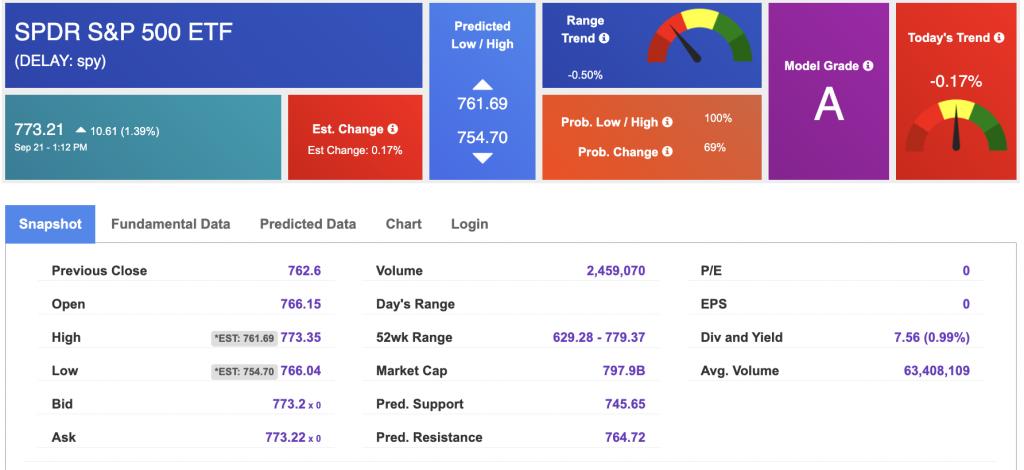
For SPY, I continue to believe the longer-term rally can eventually reach the $760–$780 area, while $700–$720 remains an important support zone over the next several months.
The short-term equation has become fairly straightforward. If oil can remain below $100, the 10-year Treasury yield stays below or around 5%, and the S&P 500 continues holding above its 50-day moving average, the bulls have an opportunity to regain momentum and challenge the recent highs.
The biggest risk remains the same: inflation forcing interest rates higher for longer. A renewed surge in oil or a sustained breakout in Treasury yields above 5% would quickly put pressure back on valuations and could trigger another test of technical support.
For now, however, Monday is delivering exactly the type of combination bulls wanted to see—falling oil, easing yields, improving technicals and renewed leadership from AI and semiconductors.
West Texas Intermediate for Crude Oil delivery (CL.1) is priced at $95.81 per barrel, down 4.48%, at the time of publication.
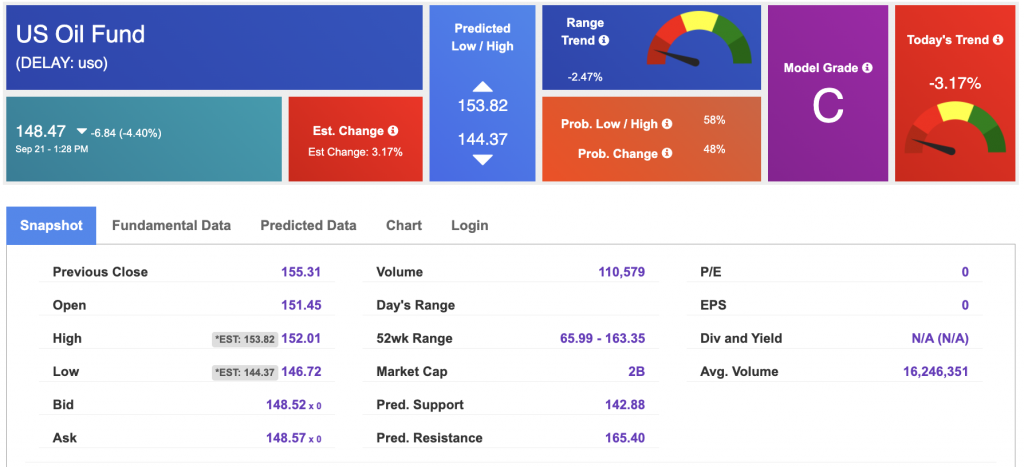
Looking at USO, a crude oil tracker, our 10-day prediction model shows mixed signals. The fund is trading at $148.47 at the time of publication. Prediction data is uploaded after the market close at 6 p.m., CST. Today’s data is based on market signals from the previous trading session.
The price for the Gold Continuous Contract (GC00) is down down 0.88% at $4,385.50 at the time of publication.
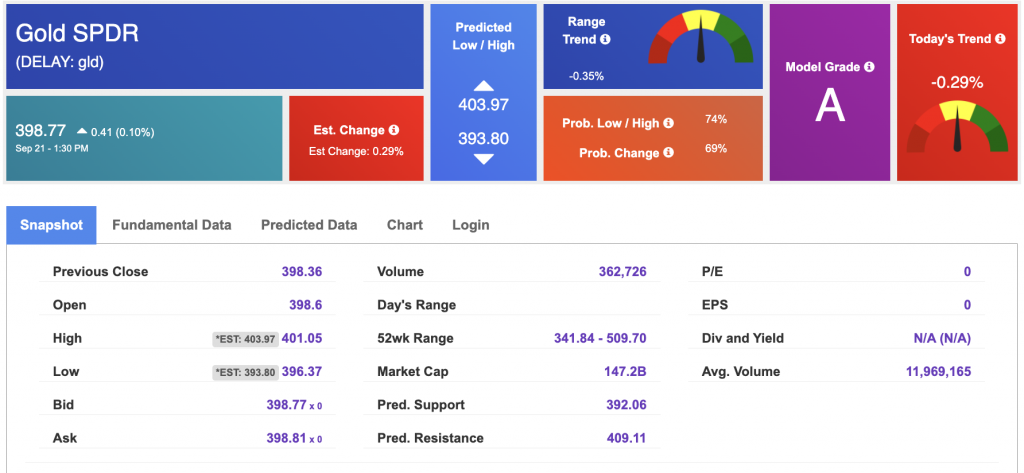
Using SPDR GOLD TRUST (GLD) as a tracker in our Stock Forecast Tool, the 10-day prediction window shows mixed signals. The gold proxy is trading at $398.77 at the time of publication. Vector signals show -0.29% for today. Prediction data is uploaded after the market close at 6 p.m., CST. Today’s data is based on market signals from the previous trading session.
The yield on the 10-year Treasury note is down at 4.967% at the time of publication.
The yield on the 30-year Treasury note is down at 5.297% at the time of publication.
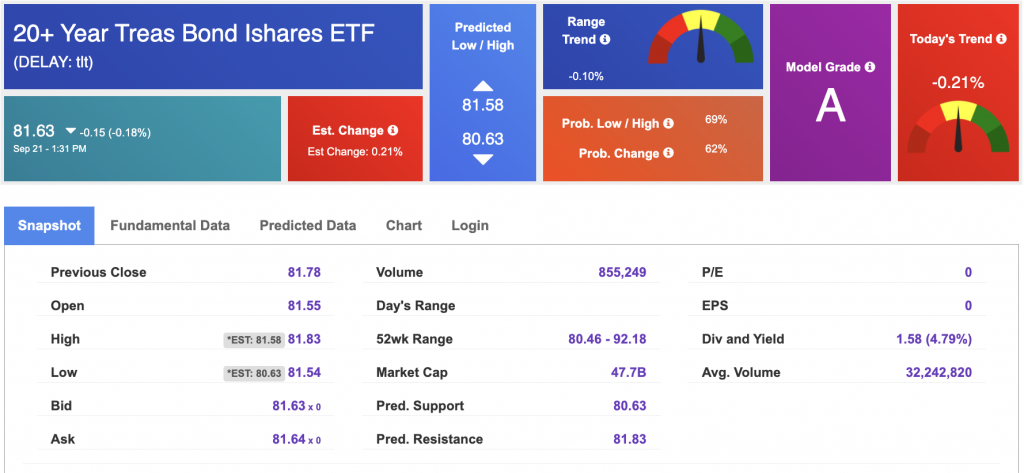
Using the iShares 20+ Year Treasury Bond ETF (TLT) as a proxy for bond prices in our Stock Forecast Tool, we see mixed signals in our 10-day prediction window. Prediction data is uploaded after the market close at 6 p.m., CST. Today’s data is based on market signals from the previous trading session.
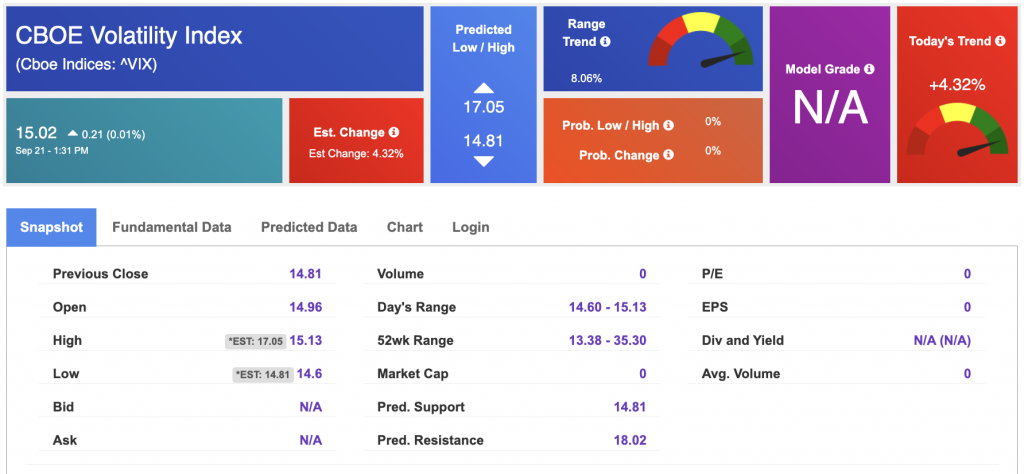
The CBOE Volatility Index (^VIX) is priced at $15.02 at the time of publication, and our 10-day prediction window shows mixed signals. Prediction data is uploaded after the market close at 6 p.m., CST. Today’s data is based on market signals from the previous trading session.
Please share this Tradespoon Market Commentary with your friends.



Comments Off on


Tradespoon Tools make finding winning trades in minute as easy as 1-2-3.
Our simple 3 step approach has resulted in an average return of almost 20% per trade!