 Special Offer: Try the 'Elite Trading Circle Membership' for ONLY $37!
CLICK HERE TO LEARN MORE
Monday Market Outlook | November 23, 2026
Wall Street is staging a dramatic recovery to begin Thanksgiving week, with technology stocks leading a powerful rebound following one of the most turbulent stretches of trading this year. Nvidia’s surprise decision to reinstate Jensen Huang as chief executive officer has reignited enthusiasm for artificial intelligence, sending shares soaring more than 30% and helping the Nasdaq advance approximately 7% during Monday’s session.
The rally follows a difficult week in which the S&P 500 declined approximately 8.6%, the Nasdaq Composite lost 10%, and the CBOE Volatility Index (VIX) surged above 35. Investors continue navigating elevated technology valuations, uncertainty surrounding AI profitability, persistent inflation, and increasingly hawkish Federal Reserve expectations.
Despite these challenges, I remain firmly in the MARKET BULLISH camp, although I anticipate continued near-term volatility. Monday’s rebound is encouraging, but with major indices recovering from important technical breakdowns and Wednesday’s critical inflation reports approaching, the market faces another significant test.
Nvidia’s Comeback Revives the AI Trade
Nvidia (NVDA) announced Monday that co-founder Jensen Huang would immediately return as president and chief executive officer following his departure earlier this month. The extraordinary leadership reversal restored investor confidence in the semiconductor giant, helping lift AI-linked stocks and reverse some of last week’s intense selling pressure.
The announcement follows Nvidia’s impressive fiscal third-quarter earnings, which showed revenue of $115.8 billion, representing 103% year-over-year growth, alongside fourth-quarter guidance of approximately $130 billion. Despite those exceptional results, shares initially struggled as investors weighed leadership uncertainty, elevated valuations, and concerns about the sustainability of massive AI infrastructure spending.
The rebound demonstrates that appetite for artificial intelligence remains substantial, but a lasting recovery will require more than improved sentiment. I will be closely monitoring whether semiconductor strength can broaden across the technology sector and whether investors begin responding more consistently to strong corporate fundamentals.
Anthropic’s Historic IPO Highlights AI Valuation Concerns
Last week’s historic public debut of Anthropic (ANT), the developer behind Claude, provided another important test of investor sentiment. The company priced its IPO at $83 per share, raising approximately $81.3 billion initially and becoming the largest IPO in history. Following the exercise of additional share options, total gross proceeds reached approximately $93.5 billion.
Shares opened at $111.50 Thursday but quickly surrendered much of their initial premium, closing at $97.17 before declining another 8.5% Friday to $88.91. The reversal highlights growing investor concerns about elevated AI valuations, enormous capital requirements, and whether long-term growth expectations can translate into sustainable profitability.
I continue to believe artificial intelligence represents one of the most significant long-term growth opportunities in the market. However, investors are becoming increasingly selective, favoring companies capable of converting technological innovation into measurable earnings growth and sustainable cash flow.
Federal Reserve Policy and Economic Data Remain in Focus
Federal Reserve policy continues to represent one of the biggest risks to the broader equity outlook. Minutes from the central bank’s October meeting reinforced concerns about persistent inflation and suggested additional tightening may be necessary. Markets are anticipating another 25-basis-point rate increase at the December 8–9 meeting, while the benchmark 10-year Treasury yield remains elevated near 5%.
My anticipated range for the 10-year yield remains 4.50%–5.50%, with higher-for-longer interest rates representing the primary risk to my bullish outlook. Elevated borrowing costs continue pressuring equity valuations, particularly among technology and growth companies whose earnings expectations extend further into the future.
Recent economic reports paint a resilient but uneven picture. October retail sales increased 0.2%, with core sales advancing 0.6%, while initial jobless claims of 203,000 pointed to labor market stability. Walmart (WMT) also exceeded earnings expectations and raised its outlook, providing an encouraging indication of consumer strength heading into the holiday season.
Inflation remains a concern, however, with October import prices rising 1.1%. Meanwhile, Monday’s preliminary November S&P Global Composite PMI declined to 54.6 from 55.9, reflecting moderating business activity. Manufacturing and services readings of 54.5 and 54.7 remained in expansion territory, suggesting the economy continues growing despite elevated rates.
Overall, resilient consumer spending, relatively stable employment, and strong corporate earnings remain supportive of the longer-term market outlook. The challenge will be whether these fundamentals can withstand restrictive monetary policy without a significant deterioration in economic growth.
Cybersecurity Consolidation Highlights Continued Technology Investment
Beyond Nvidia, CrowdStrike (CRWD) announced Monday an agreement to acquire Zscaler (ZS) in an all-stock transaction valued at approximately $43.9 billion. The proposed merger would combine CrowdStrike’s endpoint protection capabilities with Zscaler’s network security technologies, creating a more comprehensive cybersecurity platform.
The transaction underscores the growing importance of cybersecurity as businesses expand their investments in artificial intelligence, cloud infrastructure, and digital transformation. While integration and valuation risks remain, continued strategic investment suggests that important areas of the technology sector retain significant longer-term growth potential.
Looking Ahead: Wednesday’s Inflation Reports Take Center Stage
Thanksgiving week brings a shortened trading schedule but an unusually important economic calendar. Wednesday, November 25, will be the primary focus as investors digest several critical reports that could influence expectations ahead of December’s Federal Reserve meeting.
The most closely watched release will be October’s Personal Consumption Expenditures (PCE) inflation report, including the core reading preferred by the Federal Reserve. Investors will also receive personal income and spending figures, the second estimate of third-quarter GDP, October durable goods orders, and weekly initial jobless claims. The Fed’s Beige Book follows Wednesday afternoon, providing additional insight into regional economic activity and pricing pressures.
A cooler-than-expected inflation reading could strengthen the market’s recovery by easing pressure on Treasury yields and interest-rate expectations. Conversely, persistent inflation could renew concerns about further tightening and place additional pressure on technology valuations.
Corporate earnings will provide another important measure of economic resilience. Dell Technologies (DELL), HP (HPQ), and Analog Devices (ADI) will offer insight into technology and AI infrastructure demand, while Best Buy (BBY), Dollar Tree (DLTR), and other retailers will provide valuable information about consumer spending. Deere & Company (DE) will also report, offering perspective on industrial and equipment demand.
U.S. equity markets will be closed Thursday for Thanksgiving and will close early at 1:00 p.m. Eastern on Friday. Reduced holiday liquidity could amplify market reactions, particularly following Wednesday’s economic releases.
My Market Outlook: Bullish Longer Term, but Volatility Remains Elevated
Despite the recent correction, I remain in the MARKET BULLISH camp, supported by resilient corporate earnings, continued technological investment, and underlying economic strength. However, last week’s sharp selloff and elevated volatility demonstrate that the market remains vulnerable to additional downside before a more sustainable recovery develops.
From a technical perspective, major indices are attempting to recover important moving averages, including the closely watched 200-day moving average. Monday’s rebound represents an encouraging improvement in sentiment, but sustained buying pressure and stronger market breadth will be necessary to confirm stabilization.
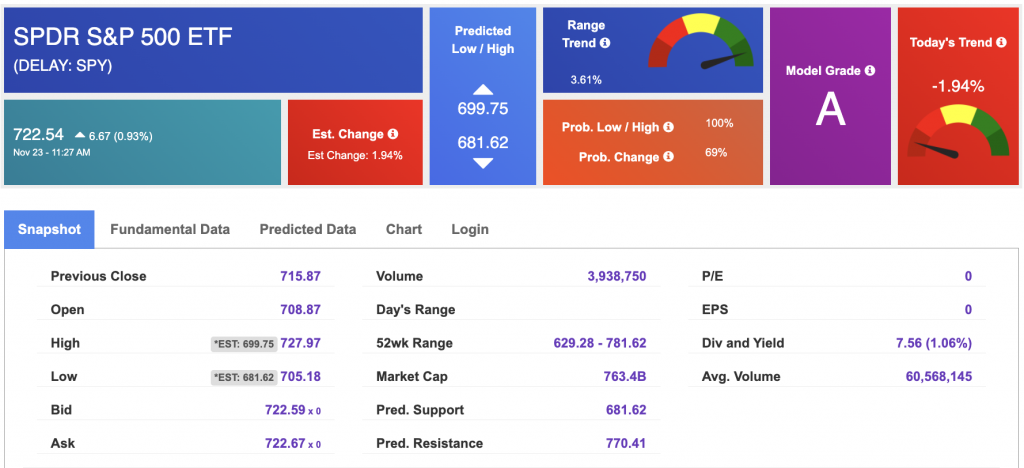
My broader SPY upside target remains 780–810 over the next several months, while I am monitoring the 700–740 region as important short-term support. A successful stabilization around these levels would support the possibility of renewed upward momentum, while a sustained breakdown below 700 would warrant reassessing the near-term outlook.
Volatility will also remain a central consideration. Following Friday’s surge above 35, I anticipate that the VIX could remain elevated in the upper 20s to low 30s as investors navigate inflation data, Fed expectations, and uncertainty surrounding technology valuations. A sustained decline in volatility, accompanied by stabilizing Treasury yields and improving semiconductor performance, would strengthen the bullish case.
The biggest risk remains interest rates staying higher for longer, particularly if inflation proves more persistent than anticipated. I will continue monitoring Treasury yields, semiconductor stocks, market breadth, and SPY’s ability to maintain key support levels as important indicators of the next significant market move.
In the meantime, I continue to favor a selective trading approach, utilizing both directional and market-neutral strategies depending on the opportunities identified by our models. Proper position sizing, disciplined risk management, and flexibility remain essential during periods of heightened uncertainty.
Nvidia’s extraordinary leadership reversal has delivered a powerful boost to Wall Street, but the challenges that drove last week’s correction remain unresolved. Elevated valuations, persistent inflation, higher interest rates, and uncertainty surrounding AI profitability will continue influencing market sentiment, even as corporate earnings and economic activity demonstrate resilience.
I remain optimistic about the longer-term outlook, maintaining my SPY target of 780–810, with the 700–740 region serving as an important near-term support zone. Wednesday’s inflation reports and the market’s ability to sustain Monday’s recovery will be critical in determining whether this rebound develops into a lasting advance.
For now, maintaining a bullish outlook while respecting near-term volatility and remaining selective with trading opportunities continues to be my preferred approach.
Please share this Tradespoon Market Commentary with your friends.



Comments Off on


Tradespoon Tools make finding winning trades in minute as easy as 1-2-3.
Our simple 3 step approach has resulted in an average return of almost 20% per trade!