 Are you a Long-Term Trader? Then take a look at our NEW RoboInvestor Service?
CLICK HERE TO LEARN MORE
Are you a Long-Term Trader? Then take a look at our NEW RoboInvestor Service?
CLICK HERE TO LEARN MORE
Markets are entering one of the most important weeks of the late summer with the long-term bullish trend still intact, but several of the assumptions supporting that rally about to face major tests. Stocks remain relatively close to record territory and volatility remains contained, yet elevated Treasury yields, geopolitical uncertainty, tariffs and lingering inflation concerns continue to complicate the outlook. Attention now turns toward an unusually powerful combination of Nvidia earnings, PCE inflation and Fed Chair Kevin Warsh’s Jackson Hole speech, which could provide investors with new information on the three forces that have done the most to shape this market: AI-driven earnings growth, inflation and interest rates.
Wall Street is beginning Monday on the defensive, with the pressure concentrated primarily in technology. The S&P 500 is down modestly while the Nasdaq is seeing greater weakness, as investors reduce exposure to semiconductor and AI-related stocks ahead of Nvidia’s highly anticipated earnings report. The Dow has been more resilient as strength in financials offsets some of the weakness elsewhere. Nvidia is trading lower ahead of Wednesday’s report, while several other semiconductor names are also under pressure.
For now, the weakness looks more like caution ahead of a potentially market-moving week than evidence of a fundamental change in trend. Major indices remain relatively close to record territory, corporate earnings have generally remained supportive and volatility is still subdued. However, with equity valuations elevated and several important catalysts approaching, investors have less room to ignore disappointing economic or corporate data than they did earlier in the rally.
The more significant warning continues to come from outside the stock market. Long-term Treasury yields remain elevated following last week’s sharp moves, oil and geopolitics remain unpredictable, and the market is still trying to determine whether inflation has cooled enough to prevent another extended period of restrictive monetary policy.
Treasury yields were arguably the most important market story last week, and they remain central to the outlook entering Monday. The 10-year Treasury finished last week near the upper portion of the broad range we have been monitoring, while the 30-year remained above 5%, keeping long-term borrowing costs at levels that deserve investors’ attention. Yields have eased somewhat to begin this week, providing stocks with modest relief, but one quieter session in bonds does not eliminate the larger concern.
The 10-year continues to move through the broad 4.0%–4.8% range we have been watching. As yields approach the upper end of that range, higher borrowing costs and higher discount rates become increasingly difficult for equity valuations to ignore. This is particularly important for technology and other long-duration growth companies, where a greater portion of their valuation depends on earnings expected further into the future.
Last week’s decision by the Treasury Department to expand long-duration bond buybacks demonstrated that policymakers are paying attention to liquidity and volatility in the Treasury market, but the underlying structural issues have not disappeared. Heavy government borrowing, fiscal concerns and uncertainty surrounding inflation continue to put pressure on the long end of the curve. That is why higher-for-longer interest rates remain one of the biggest risks to this bull market, even as the primary equity trend remains constructive.
Geopolitics also remain firmly in focus as the Trump administration intensifies its economic campaign against Iran. Treasury Secretary Scott Bessent announced additional measures aimed at further isolating Iran economically, including expanded sanctions and the threat of broader secondary sanctions. That creates another potential escalation point in a conflict that has already injected significant volatility into global energy markets.
Interestingly, oil has moved lower to begin the week, reversing some of the recent increase in energy prices. For the broader market, that is an encouraging development. One of the largest economic risks surrounding the Iran conflict has been the possibility that sustained increases in crude oil and refined-product prices eventually work their way through transportation, manufacturing and consumer costs just as the Federal Reserve is attempting to bring inflation sustainably back toward its target.
The risk has certainly not disappeared. The Strait of Hormuz remains strategically important to global energy supplies, and another escalation could quickly change the outlook for crude. But if oil prices can stabilize or continue moving lower, it would remove an important source of potential inflation pressure and give the Fed considerably more flexibility.
The centerpiece of the week arrives Wednesday, when investors will receive two important pieces of information: Nvidia’s earnings and the latest PCE inflation data. Together, they provide a useful test of both sides of the valuation equation. Nvidia will tell us more about the earnings and growth assumptions supporting technology valuations, while PCE could influence expectations for interest rates and the discount rate investors apply to those earnings.
Nvidia has become much more than another corporate earnings report. The company sits at the center of the enormous AI infrastructure investment cycle that has helped drive semiconductor stocks, technology shares and ultimately the broader market higher. The long-term AI investment story remains compelling, but expectations have also become extraordinarily high. Investors will therefore be watching not only headline earnings but also guidance, data-center demand, spending by major technology companies and any indication that the extraordinary pace of AI investment can continue.
At the same time, PCE will provide another look at whether inflation is continuing to move in the right direction. The ideal combination for markets would be strong AI demand alongside continued disinflation, which would support corporate earnings while reducing pressure on Treasury yields and monetary policy. A hotter-than-expected inflation report combined with disappointing AI guidance would create a much more difficult backdrop, particularly with valuations already elevated and long-term yields sitting near the upper end of their recent range.
After Wednesday’s major catalysts, attention will shift toward Jackson Hole and Fed Chair Kevin Warsh’s Friday remarks. Investors will be listening carefully for clues about how policymakers are interpreting inflation, elevated long-term Treasury yields and the appropriate path for interest rates as the economy moves through the second half of the year.
The Fed’s challenge remains increasingly delicate. Inflation has improved significantly from its highs, giving policymakers more flexibility, but officials cannot declare victory prematurely. Keeping policy restrictive for too long could eventually place greater pressure on consumers, housing, businesses and the labor market, while easing too quickly risks reigniting inflation. Tariffs, elevated government borrowing and geopolitical pressure on energy prices only make that balancing act more complicated.
This is why the combination of PCE and Jackson Hole matters so much. If inflation continues cooling and the Fed signals patience rather than additional tightening, long-term yields could stabilize and remove one of the largest obstacles facing equities. If inflation remains persistent and policymakers reinforce the possibility that rates must remain restrictive for considerably longer, the bond market could once again become the primary source of pressure on stocks.
Despite those risks, I remain in the MARKET BULLISH camp. The long-term equity trend remains intact, corporate earnings continue to provide support and the major indices remain relatively close to record territory. Monday’s technology weakness deserves attention, but at this stage it appears more consistent with investors reducing risk ahead of major catalysts than with a decisive deterioration in the broader market.
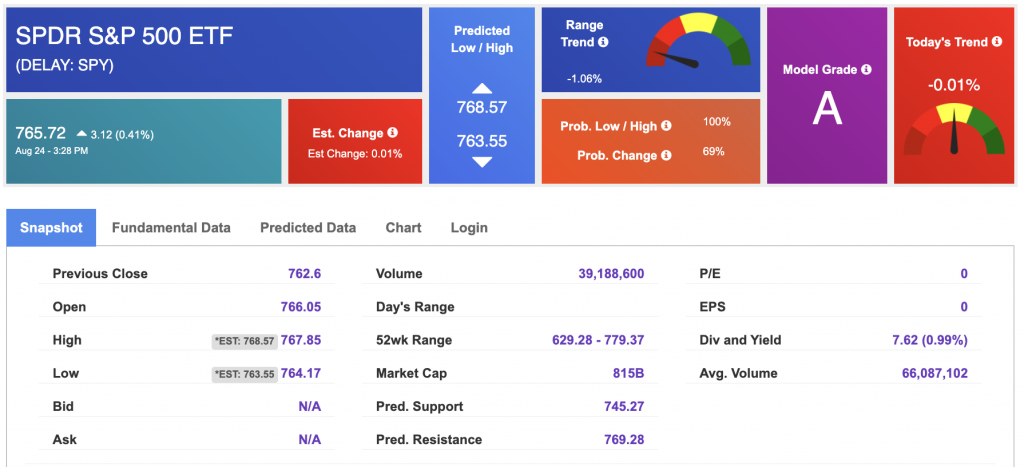
I continue to believe SPY can ultimately move toward the $760–$780 area, while $700–$720 remains an important support zone over the next several months. The biggest risk to that outlook continues to be interest rates. If the 10-year Treasury yield decisively breaks through the upper end of its recent range while inflation remains stubborn, valuations—particularly in technology—could face considerably greater pressure. Iran and oil remain another wildcard, while tariffs and fiscal concerns add additional sources of uncertainty.
There is also a constructive scenario that should not be overlooked. If oil continues moving lower, PCE shows further progress on inflation, Treasury yields stabilize and Nvidia confirms that AI demand remains exceptionally strong, several of the market’s biggest concerns could ease simultaneously. That combination would strengthen the argument that the current weakness is consolidation within a longer-term bull market and could give equities another opportunity to challenge their highs.
This week should therefore tell us considerably more about whether the fundamental pillars underneath the rally remain strong. Nvidia will test the AI and earnings story, PCE will test the inflation story, and Jackson Hole will test the interest-rate outlook. For now, the long-term trend remains bullish, but with yields elevated and expectations high, investors should remain disciplined rather than complacent as the market works through one of the most consequential stretches of the late summer.
Please share this Tradespoon Market Commentary with your friends.



Comments Off on


Tradespoon Tools make finding winning trades in minute as easy as 1-2-3.
Our simple 3 step approach has resulted in an average return of almost 20% per trade!