 Sign Up for One-on-One Coaching and get our Premium Membership FREE for 1 Year!
CLICK HERE TO APPLY
Sign Up for One-on-One Coaching and get our Premium Membership FREE for 1 Year!
CLICK HERE TO APPLY
RoboStreet – Stocks are testing their 50-day moving average as $100-plus oil, renewed inflation pressure and surging Treasury yields collide with a critical Federal Reserve decision. The long-term bull trend remains intact, but with the VIX climbing and rates threatening another breakout, Friday’s CPI and next week’s Fed meeting could determine whether buyers step back in—or this pullback has further to run.
The market is facing one of its more important tests of the past several months. After spending much of the summer near record territory, the S&P 500 has pulled back toward its 50-day moving average, while volatility has climbed back into the upper teens. The decline remains orderly rather than panicked, but the environment has clearly become more difficult as investors confront $100-plus oil, renewed inflation pressure, sharply higher Treasury yields and the possibility that the Federal Reserve could raise rates as soon as next week.
Despite those risks, I remain in the MARKET BULLISH camp. The long-term trend remains intact, corporate earnings continue to provide underlying support, and the U.S. economy has not shown the type of deterioration that would normally signal the end of a sustained bull market. However, the risk profile has changed. The biggest threat remains that interest rates stay higher for longer—or move even higher from current levels—as inflation proves more persistent than investors expected.
And remember, we’re not talking about day trading here. I’m looking for 50-100% gains within the next 3 months, so my weekly updates are timely enough for you to act.
The dominant market-moving story this week has been the latest escalation in the conflict with Iran and the resulting impact on global energy markets. Fighting around critical shipping routes has intensified, with attacks on vessels near the Strait of Hormuz and continued disruption to oil movement through one of the world’s most important energy corridors. Roughly one-fifth of global oil traditionally passes through the Strait, meaning even a partial or prolonged disruption can quickly tighten global supply expectations and raise prices.
That risk has become increasingly visible in the commodity markets. Brent crude surged above $105–$107 per barrel, while WTI moved back above $100, placing both benchmarks at levels that markets have not had to contend with for some time. Energy stocks have consequently been among the stronger areas of the market, while technology, consumer discretionary and other rate-sensitive groups have faced pressure.
The important point for investors is that this is no longer simply a geopolitical story. Higher crude prices filter through gasoline, diesel, transportation, manufacturing and eventually consumer prices. That creates a direct connection between Iran, oil, inflation, Treasury yields and Federal Reserve policy, and that chain has become one of the most important forces influencing stocks this week.
Thursday’s August Producer Price Index reinforced those concerns. Producer prices increased 0.4% for the month and 5.4% from a year earlier, with energy costs accounting for a significant portion of the increase. Diesel prices were particularly strong, while airline fares and hospital services also moved higher. Core inflation pressures were somewhat more contained, but the broader message remains that inflation is not moving smoothly back toward the Federal Reserve’s 2% target.
The rise in oil makes the outlook even more complicated because the Fed cannot directly control an energy shock, yet policymakers still have to respond if higher energy costs begin spreading into broader prices and inflation expectations. Following the PPI report, futures markets increased the implied probability of a 25-basis-point rate hike at the September 15–16 FOMC meeting to roughly 70%, although there remains meaningful disagreement over whether policymakers will ultimately move.
That represents an important shift in market psychology. Earlier this year, much of the debate centered on when the Fed might eventually begin easing again. Investors are now seriously considering whether persistent inflation and stronger energy prices could force another rate increase instead.
The bond market may be sending the clearest warning signal. The 10-year Treasury yield has climbed above 4.9% and is again approaching the psychologically important 5% level, while the 30-year yield has moved above 5.3%. These levels matter because higher Treasury yields raise borrowing costs throughout the economy and create a more demanding valuation environment for stocks, particularly technology and other long-duration growth companies.
The Treasury Department expanded its long-duration buyback operation to as much as $6 billion, triple the previous size, but the announcement did little to reverse the rise in yields. Investors remain focused on persistent inflation, heavy government financing requirements and the enormous supply of Treasury debt coming to market.
I continue to view the 10-year as trading within a broad 4.0%–5.0% range, but the market is now challenging the upper end of that range. That makes the next move especially important. A retreat in yields following softer inflation data could provide meaningful relief for equities, while a sustained move above 5% would represent a significantly more difficult backdrop for valuations and could increase pressure on the major averages.
Trade policy is creating another potential source of inflation at the same time energy prices are rising. The U.S.-Canada trade dispute escalated again this week, with new tariffs and retaliatory measures increasing costs on a range of goods. The broader market concern is not limited to one trading relationship. Tariffs can raise input costs, disrupt supply chains and make the Federal Reserve’s job more difficult if companies begin passing those higher expenses along to consumers.
Fiscal policy has also moved back into focus as investors pay closer attention to government borrowing and the long-term deficit outlook. New spending proposals have raised additional questions about how much debt the federal government may eventually need to issue. That concern becomes more important when inflation is already elevated, because investors may demand higher yields to absorb additional Treasury supply.
Taken together, oil, tariffs and fiscal spending represent three separate pressures that can keep inflation elevated and interest rates higher, even while economic growth remains reasonably resilient.
The market still has important positives working in its favor. Corporate earnings have generally remained supportive, AI investment continues at an extraordinary pace, and several of the largest technology companies continue to report strong demand for computing infrastructure, cloud services and artificial-intelligence applications.
Oracle reports after Thursday’s close, making its results another important test of the AI spending cycle. Investors will be watching cloud growth, backlog conversion, capital spending and management’s outlook for AI infrastructure demand. Strong numbers could reinforce the argument that the earnings side of the market remains healthy enough to offset some of the macro pressure coming from rates.
Apple also generated headlines this week with the launch of its first foldable iPhone, while Nvidia has faced renewed regulatory scrutiny surrounding its licensing and hiring arrangement with Groq. These individual stories matter, but the larger takeaway is that the AI and mega-cap technology theme remains a major source of earnings strength even as higher yields create a tougher valuation environment.
That tension between strong corporate fundamentals and a more hostile macro backdrop is one reason the current pullback deserves attention without automatically becoming a bearish signal.
The most important remaining event this week arrives Friday morning with the release of the August Consumer Price Index at 8:30 a.m. ET. Following Thursday’s PPI report and the sharp rise in oil prices, CPI carries considerably more weight than it might under normal circumstances.
A softer-than-expected reading could ease pressure on Treasury yields, reduce expectations for a September rate hike and potentially provide relief to technology and other growth sectors. A hotter number would reinforce the argument that inflation remains too persistent and could strengthen the case for additional Fed tightening.
Consumer inflation expectations will also matter when the University of Michigan releases its preliminary September sentiment survey later Friday morning. With gasoline and energy prices rising again, the Fed will be closely watching whether consumers begin expecting inflation to remain elevated for longer.
Attention will then turn almost immediately to next week’s September 15–16 Federal Reserve meeting. Wednesday will be particularly important because August retail sales are scheduled for release that morning, providing investors with a fresh look at consumer strength only hours before the Fed announces its policy decision.
The sequence is unusually important: Friday’s CPI will shape expectations, retail sales will provide the final major read on demand, and the Fed will then decide whether inflation has become serious enough to justify another rate increase. Housing starts, building permits and additional manufacturing data will follow later in the week, while decisions from other major global central banks will add another layer of potential volatility across bonds and currencies.
For now, I view the market as undergoing an important technical and macroeconomic test rather than experiencing a confirmed change in its long-term trend. The S&P 500’s move toward its 50-day moving average deserves close attention, particularly with the VIX back near the upper teens and Treasury yields threatening the top of their recent range. At the same time, economic activity remains resilient, layoffs remain relatively low, earnings continue to grow and corporate investment in artificial intelligence remains powerful.
My outlook therefore remains bullish, but increasingly selective and risk-aware. For SPY, I continue to believe the rally can ultimately reach the $760–$780 area, while the $700–$720 region remains important support over the next few months. The long-term trend remains intact unless economic conditions deteriorate materially or persistent inflation forces monetary policy substantially tighter.
The primary risk continues to be higher-for-longer interest rates, but that risk is now being amplified by $100-plus oil, geopolitical instability, tariffs and renewed inflation pressure. The difference between the current environment and the one investors faced earlier this summer is that these risks are beginning to converge at the same time.
That makes the next several sessions particularly important. Friday’s CPI will provide the first major test, and next week’s Federal Reserve decision will provide the next. If inflation begins cooling and Treasury yields retreat, the current pullback could ultimately become another opportunity within the broader bull trend. If inflation remains stubborn and the 10-year breaks decisively above 5%, the market may need to undergo a deeper reset before the next sustainable move higher.
And that is exactly where RoboInvestor proves its value. Built for a headline-sensitive, range-bound market, our flagship AI-driven advisory helps cut through Fed uncertainty, tariff chatter, geopolitical risk, and AI hype to focus on what matters most: statistically grounded setups and clear risk-reward opportunities. With RoboInvestor, investors can stay engaged, stay disciplined, and act with precision instead of reacting emotionally to every headline.
Every other weekend, you’ll receive the RoboInvestor newsletter—a concise, high-signal read with market context, technical outlooks, updates on open positions, and clear, actionable trade ideas so you’re prepared and confident heading into Monday’s open.
Explore our latest forecasts, trade signals, and live strategy sessions at Tradespoon.com. Navigate uncertainty with confidence—and position yourself ahead of the curve.
Whether you’re targeting blue-chip stocks, ETFs, commodities, or inverse ETFs, RoboInvestor offers a flexible, forward-looking approach tailored to today’s market conditions. Our model portfolio typically holds 12 to 25 carefully selected positions, and we’ve recently adopted an even more selective strategy—focused on quality, resilience, and opportunity.
Join us and take advantage of advanced AI technology to guide your investments with precision and confidence.
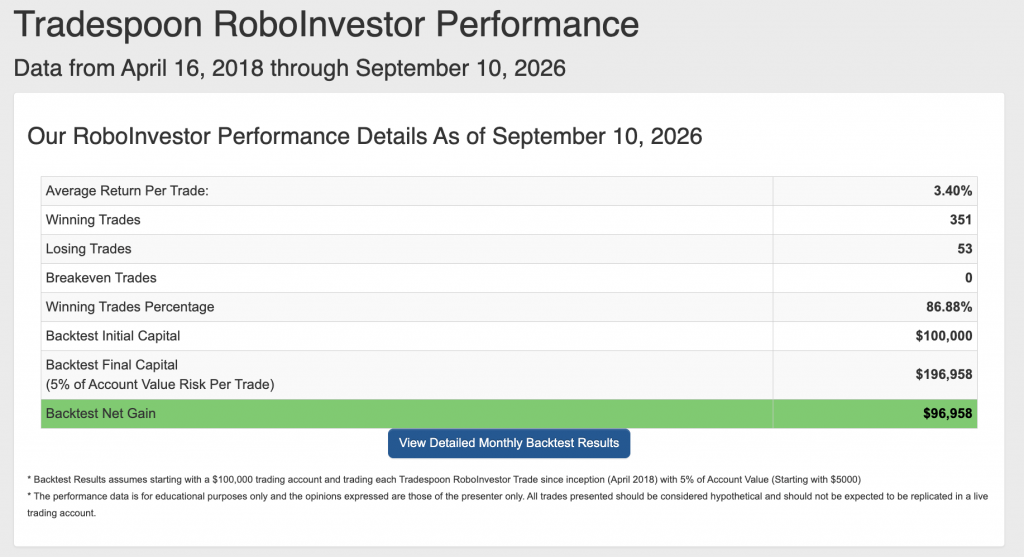
Our track record is one of the best in the retail advisory industry, with a Winning Trades Percentage of 86.88% since April 2018.
In this environment, a disciplined, insight-driven framework matters more than ever—one that cuts through the noise, respects the bond market’s influence, manages rate and employment risk, and helps you position proactively for the opportunities and pivots that tend to define the first quarter.
As we move through the second half of 2026, investors continue navigating a market that appears calm on the surface but remains highly sensitive beneath it. Geopolitical developments in the Middle East, shifting tariff policy, and an uncertain Federal Reserve path continue to influence investor sentiment as inflation gradually cools, but interest rates remain elevated. Meanwhile, economic data has become more mixed, with the labor market showing signs of moderation while corporate earnings continue to demonstrate remarkable resilience.
Whether you are a seasoned investor or just starting, our team is here to help you every step of the way. Don’t face the challenges of tomorrow alone–join RoboInvestor today and take your investing to the next level.
Stay alert, stay strategic—and trade smart.
And remember, we’re not talking about day trading here. I’m looking for 50-100% gains within the next 3 months, so my weekly updates are timely enough for you to act.
*Please note: RoboStreet is part of your free subscription service. It is not included in any paid Tradespoon subscription service. Vlad Karpel only trades his own personal money for paid subscription services. If you are a paid subscriber, please review your Premium Member Picks, ActiveTrader, MonthlyTrader, or RoboInvestor recommendations. If you are interested in receiving Vlad’s personal picks, please click here.
Please share this Tradespoon Market Commentary with your friends.



Comments Off on


Tradespoon Tools make finding winning trades in minute as easy as 1-2-3.
Our simple 3 step approach has resulted in an average return of almost 20% per trade!