 Are you a Long-Term Trader? Then take a look at our NEW RoboInvestor Service?
CLICK HERE TO LEARN MORE
Are you a Long-Term Trader? Then take a look at our NEW RoboInvestor Service?
CLICK HERE TO LEARN MORE
RoboStreet – Stocks remain near record territory as AI leadership returns, volatility stays contained, and investors continue to look through mixed economic data. The long-term trend remains intact, but next week’s CPI, PPI, retail sales, and consumer sentiment reports could decide whether this rally extends or pauses.
U.S. markets reopened after the July 3–4 holiday weekend with a cautiously bullish tone. The VIX is near 16, major indexes remain close to all-time highs, and investors continue to rotate back into artificial intelligence, semiconductors, communication services, financials, and consumer discretionary names. The Dow pushed into fresh record territory this week, while the Nasdaq and S&P 500 regained momentum after late-June profit-taking.
The dominant market theme remains the rebound in AI and technology. After recent pressure tied to valuation concerns, investors stepped back into the AI trade, with chip stocks and semiconductor supply-chain names leading the move. Broadcom, AMD, and other AI-linked leaders helped restore momentum, showing that the market’s most important growth theme remains alive. As long as capital continues flowing into chips, cloud infrastructure, power demand, data centers, and AI hardware, the broader market has a powerful leadership group supporting the rally.
And remember, we’re not talking about day trading here. I’m looking for 50-100% gains within the next 3 months, so my weekly updates are timely enough for you to act.
That leadership received another boost from SK Hynix’s massive U.S. listing. The South Korean memory-chip leader launched a roughly $28 billion Nasdaq ADR deal tied directly to the AI infrastructure boom, with Reuters reporting strong demand from major investors. SK Hynix is a key player in high-bandwidth memory, one of the most important components behind advanced AI systems, and the listing has become a major sentiment test for global AI demand. Strong appetite for the deal reinforces the idea that institutions still want exposure to the companies powering the AI buildout.
The macro data, however, was more mixed. The labor market cooled sharply, with June nonfarm payrolls rising only 57,000 and unemployment at 4.2%. That is a clear slowdown and shows why investors are watching job-market deterioration more closely. At the same time, the market interpreted the weaker jobs data as reducing pressure for aggressive near-term Fed rate hikes. That is the balance driving stocks right now: slower labor data is a risk for growth, but it can also give the Fed more reason to remain patient.
Manufacturing and services data also painted a mixed but still constructive picture. The ISM Manufacturing PMI came in at 53.3, showing expansion but softer momentum than the prior month. New orders remained positive, but manufacturing employment stayed in contraction, which fits the broader theme of a cooling labor market. The ISM Services PMI came in at 54.0, also still expansionary, with business activity and new orders cooling modestly while the employment index returned to expansion at 51.2. That combination supports the soft-landing argument: growth is not collapsing, but it is no longer overheating.
Consumer data remains one of the weaker parts of the story. Confidence is still subdued, job availability concerns are rising, and the University of Michigan’s June sentiment reading remained well below year-ago levels despite improving from May. That matters because the consumer has carried much of the economy through higher rates, inflation, and tariff uncertainty. If consumer confidence continues to weaken, the market may become more sensitive to retail sales, credit conditions, and earnings guidance from consumer-facing companies.
The Fed remains the biggest risk to the rally. Minutes from the June meeting showed policymakers still focused on inflation, and the market continues to debate whether the next major Fed move will be patience, a pause, or another hike later this year. The problem is that inflation risks have not disappeared. Tariffs, oil prices, Middle East tensions, AI-driven power demand, and elevated service costs can all keep price pressure sticky. The market wants a patient Fed, but the Fed still needs proof that inflation is moving in the right direction.
That is why next week is so important. CPI is scheduled for Tuesday, followed by PPI on Wednesday, retail sales on Thursday, and preliminary University of Michigan consumer sentiment on Friday. CPI and PPI will be the biggest tests because inflation is the swing factor for both bonds and stocks. If inflation cools, the market can continue leaning into the soft-landing narrative. If inflation runs hot, Treasury yields could push higher again and pressure high-multiple growth stocks.
Treasury yields remain volatile, with the 10-year yield still trading in a wide range between roughly 4.0% and 4.8%. That range is critical. When yields ease, stocks can rally on the idea that growth remains intact and the Fed can stay patient. When yields spike, the market becomes more selective, and expensive technology names become more vulnerable. For now, yields have not broken the bullish trend, but they remain one of the clearest risks on the board.
Oil and geopolitics also remain in focus. Crude inventories rose this week, while gasoline and distillate stocks fell, showing a mixed energy backdrop. Iran-related developments, tariff headlines, and Middle East tensions have not derailed the market, but they continue to shape inflation expectations. A sharp oil move higher would quickly bring energy-driven inflation fears back into the conversation. A calmer oil market gives stocks more room to extend the rally.
Earnings are another key piece of the puzzle. Corporate earnings season is winding down, but technology and AI-linked companies continue to drive a large share of profit growth. That is good for index-level performance, but it also means leadership remains concentrated. When AI earnings are strong, the market can push higher. When the AI trade pauses, the broader index can look more fragile beneath the surface.
I remain in the market-bullish camp. The long-term trend is intact, volatility remains contained, and leadership has rotated back into the strongest parts of the market. SPY still has room to rally toward the $760–$780 area over the next few months if earnings hold up, inflation cools, and rates remain contained. Short-term support sits closer to the $700–$720 range, which remains the key zone to watch if volatility returns.
The setup is bullish, but not risk-free. Higher-for-longer rates, rising unemployment indicators, sticky inflation, oil shocks, tariffs, and softer consumer confidence can still create pullbacks. Investors should stay selective, avoid chasing extended moves blindly, and focus on quality leadership. In this market, the trend still favors the bulls, but discipline matters more than ever.
And that is exactly where RoboInvestor proves its value. Built for a headline-sensitive, rangebound market, our flagship AI-driven advisory helps cut through Fed uncertainty, tariff chatter, geopolitical risk, and AI hype to focus on what matters most: statistically grounded setups and clear risk-reward opportunities. With RoboInvestor, investors can stay engaged, stay disciplined, and act with precision instead of reacting emotionally to every headline.
Every other weekend, you’ll receive the RoboInvestor newsletter—a concise, high-signal read with market context, technical outlooks, updates on open positions, and clear, actionable trade ideas so you’re prepared and confident heading into Monday’s open.
Explore our latest forecasts, trade signals, and live strategy sessions at Tradespoon.com. Navigate uncertainty with confidence—and position yourself ahead of the curve.
Whether you’re targeting blue-chip stocks, ETFs, commodities, or inverse ETFs, RoboInvestor offers a flexible, forward-looking approach tailored to today’s market conditions. Our model portfolio typically holds 12 to 25 carefully selected positions, and we’ve recently adopted an even more selective strategy—focused on quality, resilience, and opportunity.
Join us and take advantage of advanced AI technology to guide your investments with precision and confidence.
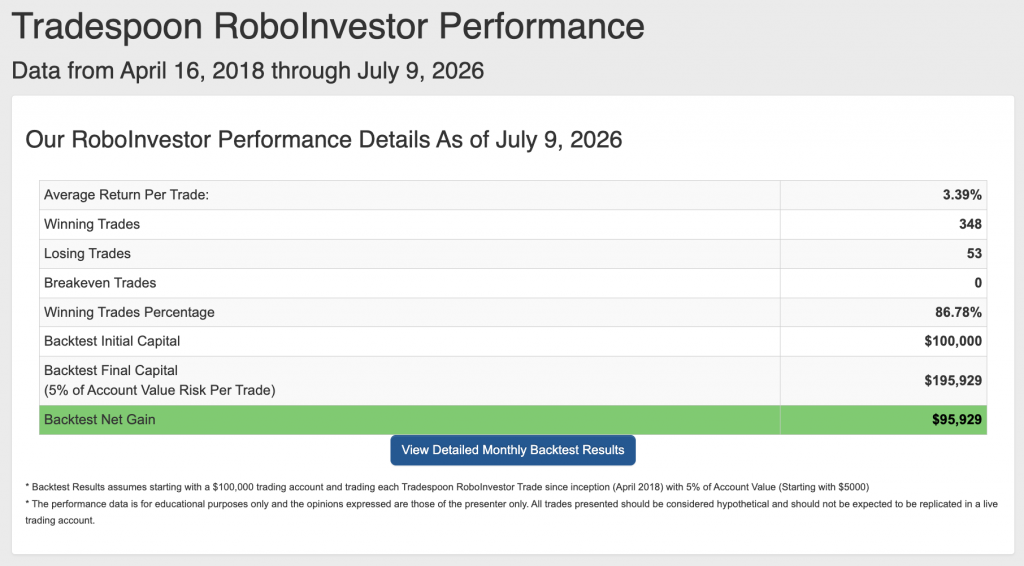
Our track record is one of the best in the retail advisory industry, with a Winning Trades Percentage of 86.78% since April 2018.
In this environment, a disciplined, insight-driven framework matters more than ever—one that cuts through the noise, respects the bond market’s influence, manages rate and employment risk, and helps you position proactively for the opportunities and pivots that tend to define the first quarter.
As we dive deeper into 2026, investors are stepping into a market that still feels deceptively calm on the surface—but increasingly reactive underneath. Tariff headlines are back in rotation, the Fed path is less predictable as inflation expectations tug both ways, and the economy is sending mixed signals as rates stay elevated and labor-market indicators begin to soften at the margins. Volatility remains contained, yet quick to spike around policy shifts and geopolitical developments, while earnings and forward guidance continue to do the heavy lifting for direction.
Whether you are a seasoned investor or just starting, our team is here to help you every step of the way. Don’t face the challenges of tomorrow alone–join RoboInvestor today and take your investing to the next level.
Stay alert, stay strategic—and trade smart.
And remember, we’re not talking about day trading here. I’m looking for 50-100% gains within the next 3 months, so my weekly updates are timely enough for you to act.
*Please note: RoboStreet is part of your free subscription service. It is not included in any paid Tradespoon subscription service. Vlad Karpel only trades his own personal money for paid subscription services. If you are a paid subscriber, please review your Premium Member Picks, ActiveTrader, MonthlyTrader, or RoboInvestor recommendations. If you are interested in receiving Vlad’s personal picks, please click here.
Please share this Tradespoon Market Commentary with your friends.



Comments Off on


Tradespoon Tools make finding winning trades in minute as easy as 1-2-3.
Our simple 3 step approach has resulted in an average return of almost 20% per trade!