 Save Big on Commissions ($0.65 per Contract)
CLICK HERE TO LEARN MORE
Wall Street is on edge as Nvidia’s leadership shakeup, stubborn inflation, Fed uncertainty, tariffs, and escalating Iran tensions fuel fresh volatility. AI earnings, rising oil prices, and the midterm fallout are adding to the pressure, but the bulls aren’t backing down. With markets testing key technical levels, is another breakout ahead or a deeper correction?
Wall Street continues to navigate a challenging environment as investors digest the fallout from the midterm elections, escalating tensions with Iran, persistent inflation, tariff uncertainty, and renewed questions surrounding artificial intelligence spending. While volatility has returned to equity markets, the broader long-term bullish trend remains intact.
The latest market developments have introduced another layer of uncertainty, particularly following the sudden resignation of Nvidia CEO Jensen Huang. Combined with hotter-than-expected inflation data and rising Treasury yields, the leadership shakeup has created additional pressure on technology stocks and the broader market.
And remember, we’re not talking about day trading here. I’m looking for 50-100% gains within the next 3 months, so my weekly updates are timely enough for you to act.
Despite these headwinds, the market has demonstrated resilience, with investors continuing to seek opportunities amid sharp rotations between technology, energy, and other sectors.
The biggest development this week came from Nvidia, where longtime CEO Jensen Huang resigned effective immediately amid a board investigation. Chief Financial Officer Colette Kress has stepped in as interim CEO as the company searches for a permanent replacement.
Nvidia shares experienced significant selling pressure following the announcement, initially dropping by double digits before recovering a substantial portion of their losses.
The development comes at a sensitive time for the artificial intelligence industry. Investors have already been questioning the sustainability of massive capital expenditures, rising financing requirements, and the eventual returns on AI infrastructure investments.
Nvidia remains central to the AI investment cycle, and any disruption to its leadership raises questions about future growth, strategic direction, and investor confidence. However, the underlying demand for advanced computing infrastructure remains significant.
Attention now turns to Nvidia’s upcoming earnings report on November 17, which could provide important insight into the strength of AI demand and the company’s outlook under new leadership.
Inflation continues to be one of the most significant risks facing financial markets.
October’s Consumer Price Index increased 0.4% month over month, exceeding expectations of 0.3%. The reading reinforced concerns that inflationary pressures remain persistent, particularly as elevated energy costs and tariffs continue to affect the economy.
The stronger inflation data has increased expectations that the Federal Reserve will raise interest rates again in December. A 25-basis-point increase remains the leading scenario, although policymakers have indicated that a larger increase may be warranted if price pressures continue.
Treasury yields have reacted accordingly, with the benchmark 10-year yield remaining volatile and moving toward the upper portion of its recent trading range.
The 10-year Treasury yield continues to fluctuate within a broad 4.50%–5.50% range, reflecting uncertainty surrounding inflation, economic growth, and future monetary policy.
Higher borrowing costs remain a significant concern, particularly for technology companies and other growth-oriented businesses that depend on favorable financing conditions.
Despite concerns surrounding Nvidia and elevated technology valuations, recent earnings reports suggest that demand for artificial intelligence infrastructure remains strong.
CoreWeave delivered encouraging third-quarter results, reporting approximately $3.66 billion in revenue and raising its full-year revenue and operating income guidance. Shares rallied sharply following the announcement, helping fuel a broader recovery across AI infrastructure and semiconductor stocks.
However, the company’s substantial capital spending and financing costs highlight a continuing challenge for the industry: translating extraordinary revenue growth into sustainable profitability and positive cash flow.
Investors are increasingly distinguishing between companies demonstrating measurable financial returns and those relying heavily on borrowing or aggressive spending projections.
This selective approach could create significant opportunities while also contributing to continued volatility across the technology sector.
The aftermath of the U.S. midterm elections continues to influence investor expectations.
Democratic victories in Congress have raised the possibility of increased regulatory scrutiny of artificial intelligence, data centers, corporate taxation, and energy consumption. At the same time, divided government and existing political constraints could limit the scope of major legislative changes.
Geopolitical tensions involving Iran remain another important source of uncertainty.
Oil prices have experienced significant swings as investors react to shifting diplomatic signals and developments in the Middle East. Any prolonged disruption to energy supplies could further complicate the inflation outlook and reinforce expectations that interest rates will remain elevated.
Tariffs add another layer of pressure by increasing costs for businesses and consumers, potentially limiting the Federal Reserve’s flexibility.
Together, these developments create a challenging backdrop, even as corporate earnings and underlying economic activity continue to provide support.
The CBOE Volatility Index (VIX) is trading around 18, reflecting an environment of heightened uncertainty but not extreme market panic.
Major equity indexes are also navigating important technical levels, including their 50-day moving averages. These levels could play a critical role in determining the market’s next directional move.
I remain in the bullish camp on the broader equity market.
Although short-term corrections and sharp price swings are likely to continue, I believe the longer-term upward trend remains intact.
I remain bullish on the market’s longer-term prospects, with the SPDR S&P 500 ETF (SPY) potentially rallying toward $780–$810 over the next several months, supported by resilient corporate earnings, continued AI investment, and underlying economic strength. While persistent inflation, elevated interest rates, and near-term volatility remain key risks, the broader bullish trend remains intact.
On the downside, I am monitoring $740–$750 as initial support, with the broader $720–$740 range serving as a critical support zone should selling pressure intensify.
The primary risk to this bullish outlook remains the possibility that interest rates stay higher for longer than investors currently anticipate. Persistent inflation, rising energy prices, and continued Treasury market volatility could delay a sustained advance.
Nevertheless, periods of heightened volatility often create opportunities for disciplined investors.
With earnings season continuing, the Federal Reserve evaluating its next policy move, and geopolitical uncertainty remaining elevated, investors should prepare for additional volatility while keeping the broader market trend in perspective.
And that is exactly where RoboInvestor proves its value. Built for a headline-sensitive, range-bound market, our flagship AI-driven advisory helps cut through Fed uncertainty, tariff chatter, geopolitical risk, and AI hype to focus on what matters most: statistically grounded setups and clear risk-reward opportunities. With RoboInvestor, investors can stay engaged, stay disciplined, and act with precision instead of reacting emotionally to every headline.
Every other weekend, you’ll receive the RoboInvestor newsletter—a concise, high-signal read with market context, technical outlooks, updates on open positions, and clear, actionable trade ideas so you’re prepared and confident heading into Monday’s open.
Explore our latest forecasts, trade signals, and live strategy sessions at Tradespoon.com. Navigate uncertainty with confidence—and position yourself ahead of the curve.
Whether you’re targeting blue-chip stocks, ETFs, commodities, or inverse ETFs, RoboInvestor offers a flexible, forward-looking approach tailored to today’s market conditions. Our model portfolio typically holds 12 to 25 carefully selected positions, and we’ve recently adopted an even more selective strategy—focused on quality, resilience, and opportunity.
Join us and take advantage of advanced AI technology to guide your investments with precision and confidence.
Our track record is one of the best in the retail advisory industry, with a Winning Trades Percentage of 87.04% since April 2018.
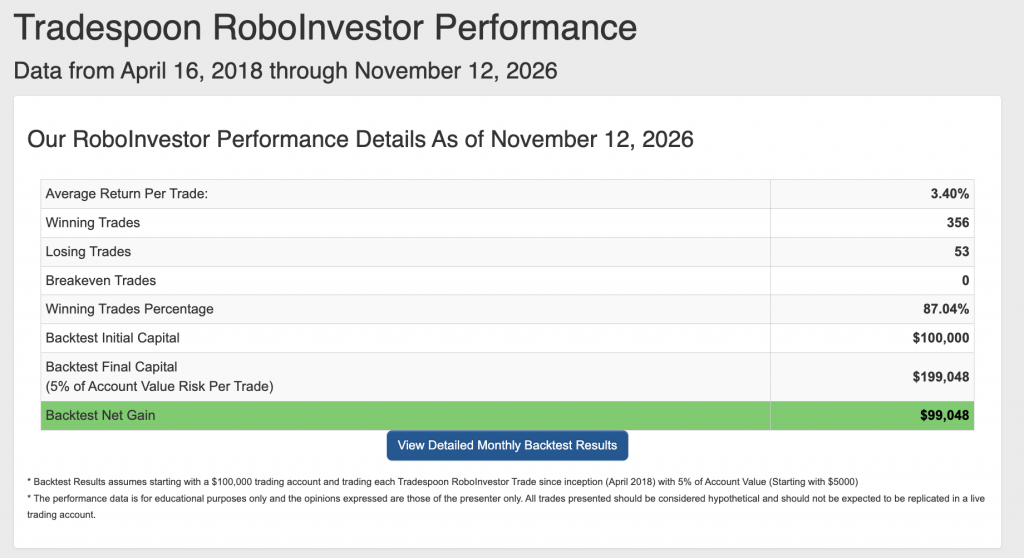
In this environment, a disciplined, insight-driven framework matters more than ever—one that cuts through the noise, respects the bond market’s influence, manages rate and employment risk, and helps you position proactively for the opportunities and pivots that tend to define the first quarter.
As we move through Q4 of 2026, investors continue navigating a market that appears calm on the surface but remains highly sensitive beneath it. Geopolitical developments in the Middle East, shifting tariff policy, and an uncertain Federal Reserve path continue to influence investor sentiment as inflation gradually cools, but interest rates remain elevated. Meanwhile, economic data has become more mixed, with the labor market showing signs of moderation while corporate earnings continue to demonstrate remarkable resilience.
Whether you are a seasoned investor or just starting, our team is here to help you every step of the way. Don’t face the challenges of tomorrow alone–join RoboInvestor today and take your investing to the next level.
Stay alert, stay strategic—and trade smart.
And remember, we’re not talking about day trading here. I’m looking for 50-100% gains within the next 3 months, so my weekly updates are timely enough for you to act.
*Please note: RoboStreet is part of your free subscription service. It is not included in any paid Tradespoon subscription service. Vlad Karpel only trades his own personal money for paid subscription services. If you are a paid subscriber, please review your Premium Member Picks, ActiveTrader, MonthlyTrader, or RoboInvestor recommendations. If you are interested in receiving Vlad’s personal picks, please click here.
Please share this Tradespoon Market Commentary with your friends.



Comments Off on


Tradespoon Tools make finding winning trades in minute as easy as 1-2-3.
Our simple 3 step approach has resulted in an average return of almost 20% per trade!