 Special Offer: Try the 'Elite Trading Circle Membership' for ONLY $37!
CLICK HERE TO LEARN MORE
RoboStreet – Wall Street faced renewed pressure this week as hotter inflation, elevated oil prices, and uncertainty surrounding the Fed weighed on stocks despite strong corporate earnings. With AI stocks under pressure and volatility rising, investors are watching key support levels for clues about the market’s next move.
For much of this year, investors have been willing to look past geopolitical tensions, rising interest rates, and concerns about inflation as long as corporate earnings remained strong and the artificial intelligence boom continued delivering growth. This week, that confidence has been tested.
Stocks have come under renewed selling pressure as hotter inflation data, elevated energy prices, and mounting questions about AI infrastructure spending have forced investors to reconsider the outlook for interest rates. The S&P 500 and Nasdaq suffered their steepest one-day declines since July on Wednesday, with technology and semiconductor stocks leading the retreat.
And remember, we’re not talking about day trading here. I’m looking for 50-100% gains within the next 3 months, so my weekly updates are timely enough for you to act.
The timing is particularly important. Third-quarter earnings season is getting underway, the Federal Reserve faces another major policy decision later this month, and the ongoing war involving Iran continues to threaten global energy supplies. Add persistent tariff uncertainty and volatile Treasury yields, and investors have several reasons to become more defensive.
Despite these challenges, I remain in the bullish camp. I believe the longer-term market trend remains intact, but the path higher is unlikely to be smooth. The coming weeks will be especially important in determining whether the current pullback becomes a more substantial correction or creates another opportunity for investors.
Inflation returned to center stage Wednesday after September’s Consumer Price Index came in hotter than expected. Headline inflation accelerated to 3.7% annually, while core inflation, which excludes food and energy, also exceeded forecasts.
The report immediately raised concerns that the Federal Reserve may need to increase interest rates again rather than move toward a more accommodative policy environment.
Thursday’s economic data reinforced those fears. Producer prices jumped sharply in September, suggesting businesses continue to face substantial cost pressures. Retail sales also exceeded expectations, although much of the strength came from higher gasoline spending rather than a broad acceleration in consumer demand.
The situation is complicated by the ongoing conflict involving Iran and instability across the Middle East. Attacks on shipping near the Strait of Hormuz, disruptions to regional energy infrastructure, and uncertainty surrounding global oil exports have helped keep Brent crude above $100 per barrel.
Efforts to ease supply constraints, including temporary relief involving Russian diesel shipments, have offered some support, but energy markets remain vulnerable to further geopolitical disruptions.
Tariffs represent another potential source of inflationary pressure. Businesses already dealing with higher transportation, financing, and energy costs must also navigate import duties and supply-chain uncertainty. These pressures can affect profit margins, consumer prices, and ultimately the Federal Reserve’s ability to bring inflation under control.
This leaves policymakers facing an increasingly difficult balancing act. Additional rate hikes could help restrain inflation but risk slowing economic growth, while maintaining current policy could allow price pressures to persist.
The Fed’s next meeting on October 27–28 will therefore be a major catalyst. Investors are watching closely for any indication of how much longer restrictive monetary policy may be necessary.
Treasury yields remain central to this discussion. The 10-year yield has experienced significant volatility, trading within a broader range of approximately 4.5% to 5.5%. Although yields retreated from their recent highs as investors sought safety during the equity selloff, borrowing costs remain elevated enough to create headwinds for growth stocks and corporate investment.
The opening days of earnings season have provided an interesting contrast to the increasingly cautious market environment.
Major financial institutions, including JPMorgan, Goldman Sachs, Citigroup, Wells Fargo, Bank of America, and Morgan Stanley, have begun releasing their third-quarter results. Trading activity and certain banking operations have remained resilient, but results have been uneven, with investors also focusing on credit quality, financing costs, and the outlook for consumer spending.
Goldman Sachs benefited from strong trading activity, while JPMorgan delivered higher revenue but fell short of profit expectations. Bank of America also faced selling pressure following disappointing results and a substantial regulatory charge.
The broader message is that corporate America continues to demonstrate resilience, but investors are becoming less forgiving of earnings disappointments. That shift has been even more apparent in technology.
Concerns about the enormous capital expenditures required to build AI infrastructure have pressured companies tied to data centers, cloud computing, and semiconductor equipment. Oracle, CoreWeave, and other AI-related names experienced particularly sharp declines as investors questioned the financial returns on massive infrastructure investments.
Higher interest rates amplify those concerns. Companies relying heavily on borrowing to finance future growth face rising funding costs, making investors more sensitive to balance sheets, cash flow, and profitability.
At the same time, the underlying demand for advanced semiconductor technology remains impressive. Taiwan Semiconductor reported another record quarter Thursday, with profits surging nearly 69% from a year earlier, reinforcing the strength of demand for advanced chips.
This distinction is important. Weakness in AI-related stocks does not necessarily mean the artificial intelligence investment cycle is ending. Rather, investors are beginning to differentiate between businesses generating sustainable earnings and those depending on aggressive growth assumptions.
The recent selling pressure has brought the major indexes back toward their 50-day moving averages, making this an important technical area to monitor.
The CBOE Volatility Index (VIX) has been trading in the mid-to-upper teens, around the 16–17 area, reflecting increasing caution but not the kind of widespread fear typically associated with a major market breakdown.
My broader outlook remains bullish, although I expect volatility to continue as investors navigate earnings, inflation, and the upcoming Fed decision.
For the SPDR S&P 500 ETF (SPY), I believe the rally can eventually extend toward the $780–$810 range over the next several months, provided the broader economic expansion remains intact and corporate earnings continue to support valuations.
On the downside, I am watching the $740–$750 area as an important support zone if selling pressure intensifies.
A sustained recovery above the 50-day moving average, accompanied by improving market breadth and moderating volatility, would help reinforce the bullish outlook. Conversely, a breakdown below key support would suggest the correction has further to run.
For now, I view the pullback as a reason to become more selective rather than abandon the longer-term uptrend.
Periods of market uncertainty can create opportunities, but they also increase the importance of disciplined trade selection and risk management.
Using Tradespoon’s Stock Forecast Toolbox, traders can evaluate potential price targets, identify favorable entry points, and assess downside risk before entering new positions.
With inflation, corporate earnings, and Federal Reserve policy driving rapid changes in market sentiment, having a systematic process can help traders avoid emotional decisions and remain focused on higher-probability opportunities.
The market is approaching another important stretch as third-quarter earnings accelerate and investors prepare for the Federal Reserve’s next policy decision.
Next week brings housing starts and building permits, offering an important look at how elevated borrowing costs are affecting construction activity and the broader housing market. Weekly jobless claims will also provide insight into whether the labor market remains resilient.
Corporate earnings will continue to dominate headlines, with major reports expected from Netflix, Tesla, GE Aerospace, and other market leaders. Investors will be paying close attention not only to quarterly performance but also to management guidance, capital spending plans, and expectations for the remainder of the year.
Beyond next week, the October 27–28 Federal Reserve meeting and the subsequent GDP and inflation releases could help determine the direction of Treasury yields and equities heading into November.
I remain cautiously bullish on the market’s intermediate- and longer-term outlook. Economic growth remains resilient, corporate earnings continue to provide support, and the longer-term investment opportunities surrounding artificial intelligence and technological innovation have not disappeared.
However, persistent inflation, high interest rates, geopolitical instability, and tariff uncertainty remain legitimate risks.
The key will be whether the market can maintain support near its 50-day moving average, whether volatility remains contained, and whether earnings growth proves strong enough to overcome a more restrictive interest rate environment.
I believe the longer-term trend remains intact, with SPY potentially reaching $780–$810 over the next several months. Until conditions improve, I will continue focusing on disciplined positioning, protecting capital, and identifying opportunities where strong fundamentals align with improving technical conditions.
The bull market may be facing another test, but I do not believe its long-term opportunity has disappeared.
And that is exactly where RoboInvestor proves its value. Built for a headline-sensitive, range-bound market, our flagship AI-driven advisory helps cut through Fed uncertainty, tariff chatter, geopolitical risk, and AI hype to focus on what matters most: statistically grounded setups and clear risk-reward opportunities. With RoboInvestor, investors can stay engaged, stay disciplined, and act with precision instead of reacting emotionally to every headline.
Every other weekend, you’ll receive the RoboInvestor newsletter—a concise, high-signal read with market context, technical outlooks, updates on open positions, and clear, actionable trade ideas so you’re prepared and confident heading into Monday’s open.
Explore our latest forecasts, trade signals, and live strategy sessions at Tradespoon.com. Navigate uncertainty with confidence—and position yourself ahead of the curve.
Whether you’re targeting blue-chip stocks, ETFs, commodities, or inverse ETFs, RoboInvestor offers a flexible, forward-looking approach tailored to today’s market conditions. Our model portfolio typically holds 12 to 25 carefully selected positions, and we’ve recently adopted an even more selective strategy—focused on quality, resilience, and opportunity.
Join us and take advantage of advanced AI technology to guide your investments with precision and confidence.
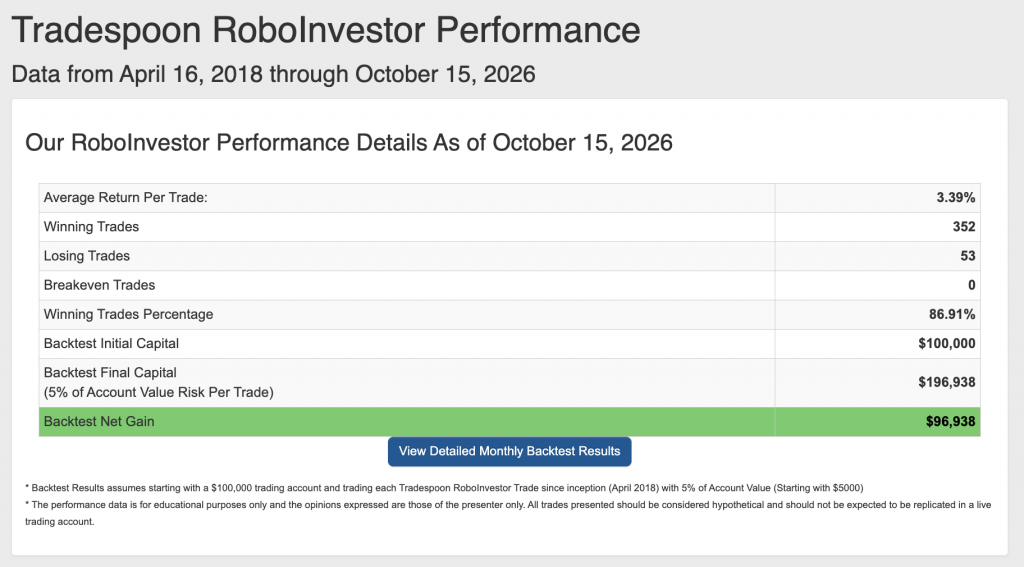
Our track record is one of the best in the retail advisory industry, with a Winning Trades Percentage of 86.91% since April 2018.
In this environment, a disciplined, insight-driven framework matters more than ever—one that cuts through the noise, respects the bond market’s influence, manages rate and employment risk, and helps you position proactively for the opportunities and pivots that tend to define the first quarter.
As we move through the Q4 of 2026, investors continue navigating a market that appears calm on the surface but remains highly sensitive beneath it. Geopolitical developments in the Middle East, shifting tariff policy, and an uncertain Federal Reserve path continue to influence investor sentiment as inflation gradually cools, but interest rates remain elevated. Meanwhile, economic data has become more mixed, with the labor market showing signs of moderation while corporate earnings continue to demonstrate remarkable resilience.
Whether you are a seasoned investor or just starting, our team is here to help you every step of the way. Don’t face the challenges of tomorrow alone–join RoboInvestor today and take your investing to the next level.
Stay alert, stay strategic—and trade smart.
And remember, we’re not talking about day trading here. I’m looking for 50-100% gains within the next 3 months, so my weekly updates are timely enough for you to act.
*Please note: RoboStreet is part of your free subscription service. It is not included in any paid Tradespoon subscription service. Vlad Karpel only trades his own personal money for paid subscription services. If you are a paid subscriber, please review your Premium Member Picks, ActiveTrader, MonthlyTrader, or RoboInvestor recommendations. If you are interested in receiving Vlad’s personal picks, please click here.
Please share this Tradespoon Market Commentary with your friends.



Comments Off on


Tradespoon Tools make finding winning trades in minute as easy as 1-2-3.
Our simple 3 step approach has resulted in an average return of almost 20% per trade!