 Sign Up for One-on-One Coaching and get our Premium Membership FREE for 1 Year!
CLICK HERE TO APPLY
Sign Up for One-on-One Coaching and get our Premium Membership FREE for 1 Year!
CLICK HERE TO APPLY
Markets are starting the week under renewed pressure as investors shift their focus from last week’s inflation reports to Wednesday’s Federal Reserve decision. Friday’s rebound offered some relief, but the underlying macro risks remain firmly in place. On Monday, the 10-year Treasury yield breached 5%, crude oil surged again, and weakness across AI and semiconductor stocks added another layer of volatility.
The move in the 10-year is especially important. I have continued to view yields within a broad 4.0%-5.0% range, and the market is now testing the upper boundary. A brief move above 5% does not automatically change the longer-term equity trend, but a sustained breakout would be more significant. Higher yields raise borrowing costs throughout the economy while making Treasuries more competitive with stocks, particularly pressuring expensive technology and growth valuations.
Energy markets are making the Fed’s job more difficult.
Oil jumped again Monday following renewed disruptions to Middle Eastern energy infrastructure, including damage affecting Saudi Arabia’s strategic East-West Pipeline. Brent crude pushed toward $109 per barrel, while WTI traded above $103, extending the sharp advance seen last week.
The market impact extends well beyond energy stocks. Higher crude feeds into gasoline, transportation, manufacturing and other input costs, potentially pressuring both consumers and corporate margins while slowing progress on inflation.
That makes the relationship between oil, inflation and interest rates one of the most important forces in the market right now.
The U.S. dollar has also strengthened as investors respond to rising yields, geopolitical uncertainty and expectations for tighter monetary policy. Together, higher yields, a stronger dollar and elevated energy prices represent a meaningful tightening in financial conditions.
Everything now leads to Wednesday.
The Federal Reserve concludes its September meeting Wednesday afternoon, with expectations leaning toward a 25-basis-point rate increase. Investors will also receive updated economic projections covering inflation, growth, unemployment and the expected path of future interest rates.
The key question is not simply whether the Fed hikes once. Markets want to know whether policymakers see this as a limited adjustment or the beginning of a longer tightening cycle.
That distinction could determine the next major move in stocks and bonds.
A more aggressive Fed outlook, combined with oil above $100 and the 10-year holding above 5%, would create a much more difficult environment for equity valuations. On the other hand, if policymakers convince investors that inflation can be contained without a prolonged series of hikes, Treasury yields could stabilize and give stocks some room to recover.
Before the Fed decision, August retail sales will be released Wednesday morning.
The report will provide another important look at whether consumers are beginning to feel the effects of higher fuel prices, persistent inflation and elevated borrowing costs. Strong spending would reinforce the idea that the economy remains resilient, but it could also give the Fed more room to keep rates elevated.
Later in the week, investors will also receive housing, labor and manufacturing data, offering additional clues about whether higher rates are beginning to slow the economy.
Technology is also drawing attention after AI and semiconductor stocks came under pressure Monday.
Nvidia and other chipmakers declined after several prominent AI executives called for slowing the pace of frontier AI development because of safety concerns. The move pressured the Nasdaq and semiconductor complex, although other sectors held up better.
For now, I view this as something to monitor rather than evidence that the broader AI investment cycle has ended. Corporate spending on AI infrastructure remains substantial, but after such a strong run, elevated valuations can make these stocks vulnerable to sharp corrections whenever sentiment changes.
The most important number on my screen this week is the 10-year Treasury yield around 5%. If yields retreat following the Fed meeting, one of the market’s largest current headwinds could begin to ease. If they establish themselves decisively above 5%, equities may need to adjust to a meaningfully higher cost of capital.
Oil is the second major variable. With Brent near $109, additional disruptions in the Middle East could quickly increase inflation concerns again.
Finally, I am watching market breadth. If weakness remains concentrated in AI and semiconductor stocks while other sectors hold support, the current environment may simply represent rotation and consolidation. If selling broadens while yields and oil continue climbing, the short-term setup would become more defensive.
Despite the increase in volatility, I remain in the MARKET BULLISH camp.
The long-term trend remains intact, supported by corporate profitability, continued economic resilience and heavy investment in artificial intelligence and technology infrastructure. Corrections and periods of consolidation are normal within longer-term bull markets.
The biggest risk to that outlook remains interest rates staying higher for longer.
That risk is becoming more visible as the 10-year tests 5%, oil remains above $100 and inflation continues to pressure the Federal Reserve.
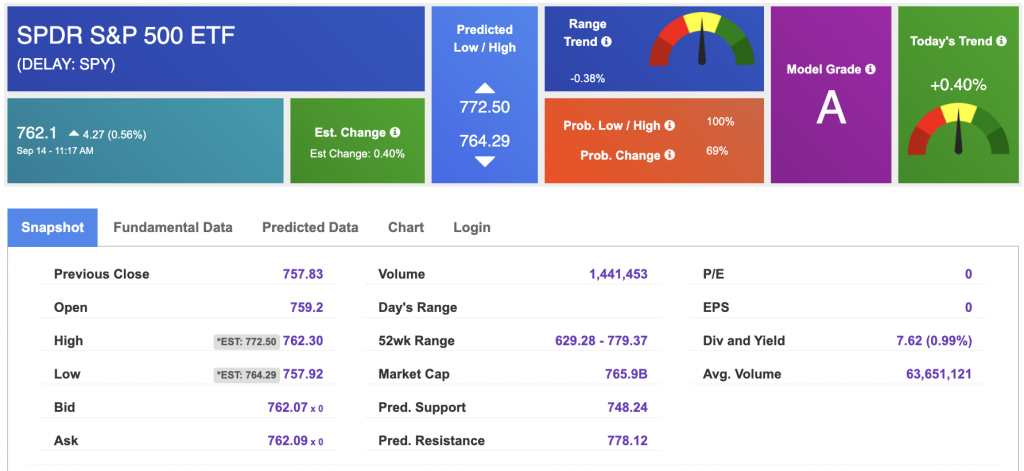
For SPY, I continue to believe the broader rally can support the $760-$780 area, while $700-$720 remains the key support zone over the next few months.
Wednesday’s Fed decision could determine the next important move.
If Treasury yields stabilize, oil begins to retreat and the Fed delivers a credible message that inflation can be contained without seriously damaging growth, the broader bullish trend should remain intact.
If oil continues higher, the 10-year moves decisively above 5% and the Fed signals that additional tightening will be necessary, the market could experience a deeper period of consolidation.
For now, I remain bullish while respecting the short-term risks.
The long-term trend remains intact, but this week puts the market’s biggest vulnerability directly under the microscope: higher interest rates for longer.
West Texas Intermediate for Crude Oil delivery (CL.1) is priced at $103. 10 per barrel, up 3.02%, at the time of publication.
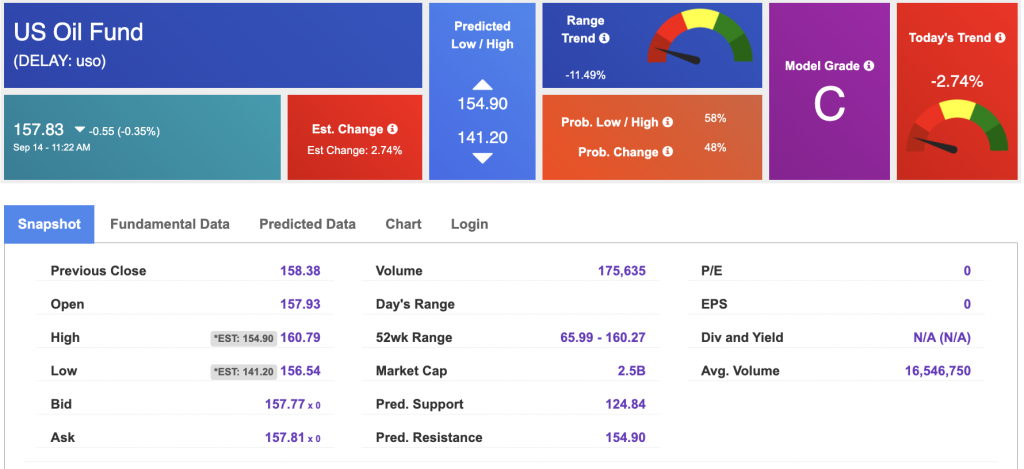
Looking at USO, a crude oil tracker, our 10-day prediction model shows mixed signals. The fund is trading at $157.83 at the time of publication. Prediction data is uploaded after the market close at 6 p.m., CST. Today’s data is based on market signals from the previous trading session.
The price for the Gold Continuous Contract (GC00) is down down 1.53% at $4,340.30 at the time of publication.
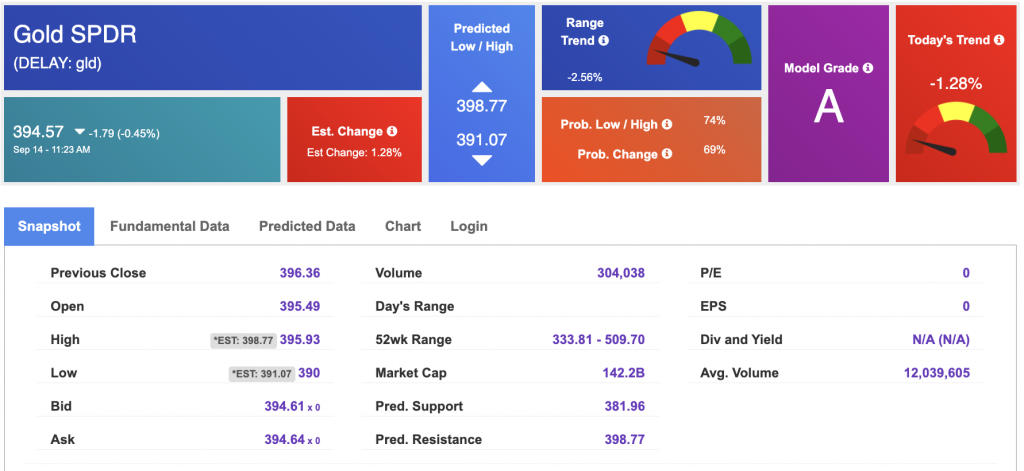
Using SPDR GOLD TRUST (GLD) as a tracker in our Stock Forecast Tool, the 10-day prediction window shows mixed signals. The gold proxy is trading at $394.52 at the time of publication. Vector signals show -1.28% for today. Prediction data is uploaded after the market close at 6 p.m., CST. Today’s data is based on market signals from the previous trading session.
The yield on the 10-year Treasury note is down at 4.952% at the time of publication.
The yield on the 30-year Treasury note is down at 5.322% at the time of publication.
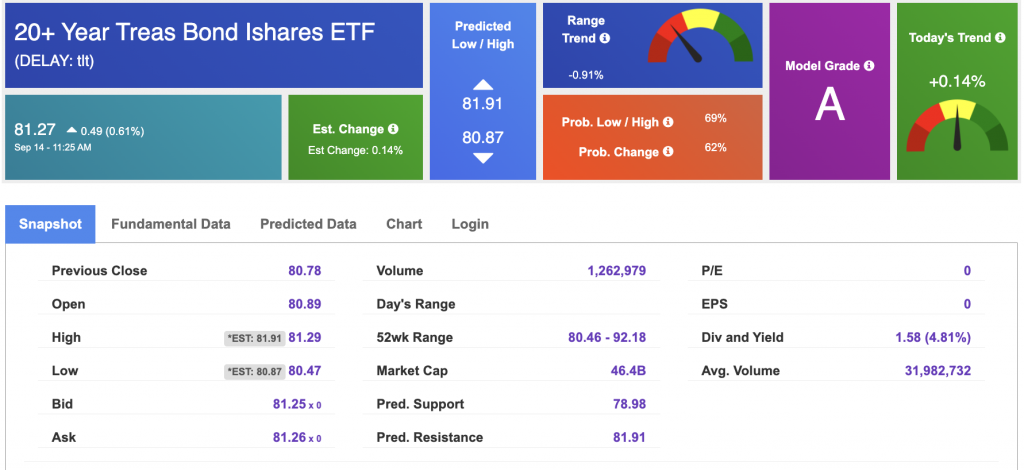
Using the iShares 20+ Year Treasury Bond ETF (TLT) as a proxy for bond prices in our Stock Forecast Tool, we see mixed signals in our 10-day prediction window. Prediction data is uploaded after the market close at 6 p.m., CST. Today’s data is based on market signals from the previous trading session.
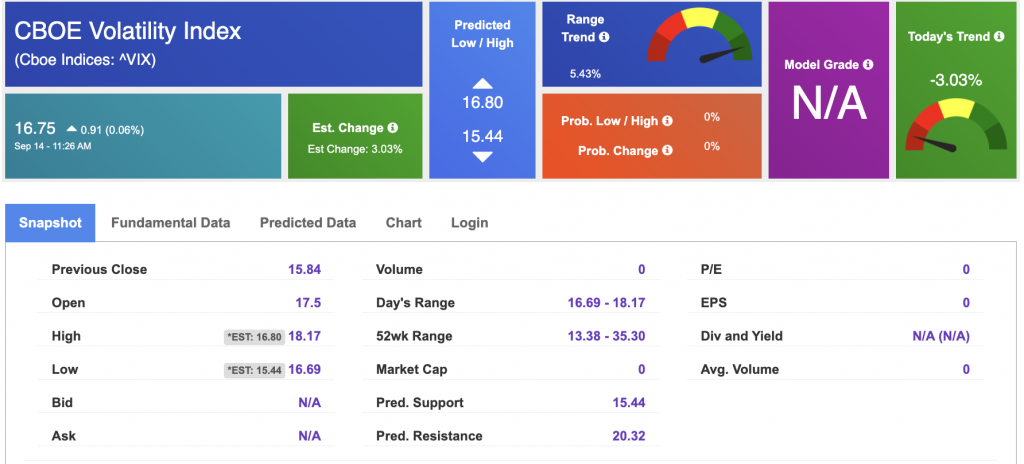
The CBOE Volatility Index (^VIX) is priced at $16.75 at the time of publication, and our 10-day prediction window shows mixed signals. Prediction data is uploaded after the market close at 6 p.m., CST. Today’s data is based on market signals from the previous trading session.
Please share this Tradespoon Market Commentary with your friends.



Comments Off on


Tradespoon Tools make finding winning trades in minute as easy as 1-2-3.
Our simple 3 step approach has resulted in an average return of almost 20% per trade!