 Special Offer: Try the 'Elite Trading Circle Membership' for ONLY $37!
CLICK HERE TO LEARN MORE
Special Offer: Try the 'Elite Trading Circle Membership' for ONLY $37!
CLICK HERE TO LEARN MORE
RoboStreet – SPY is testing its 50-day moving average as rising oil prices, volatile Treasury yields and concerns over AI spending collide ahead of next week’s Fed decision.
Markets spent the week absorbing three powerful and often conflicting forces: a more divided Federal Reserve, renewed fighting between the United States and Iran, and sharply different reactions to Big Tech earnings. The result was another volatile stretch in which Treasury yields, oil prices and artificial-intelligence spending became the market’s dominant swing factors.
The VIX is trading near 18, reflecting elevated uncertainty without signaling outright panic. SPY is testing an important area near its 50-day moving average, while the 10-year Treasury yield continues to move within a broad 4.0%–4.8% range. That leaves the market vulnerable to sharp headline-driven moves, but the longer-term trend remains intact.
The Federal Reserve kept the federal funds rate unchanged at 3.50%–3.75% on Wednesday, marking its fifth consecutive hold. The decision itself was widely expected, but the unusually divided vote caught investors’ attention. Three Federal Open Market Committee members preferred a quarter-point rate increase, signaling that concerns about inflation remain significant inside the central bank.
Chair Kevin Warsh offered limited clarity about whether policymakers are prepared to tighten further. With inflation still above the Fed’s target and energy prices adding new uncertainty, investors were left questioning how long rates may need to remain restrictive.
And remember, we’re not talking about day trading here. I’m looking for 50-100% gains within the next 3 months, so my weekly updates are timely enough for you to act.
The bond market reacted aggressively. Long-term Treasury yields surged, with the 30-year yield moving above 5.2% and reaching its highest level in nearly two decades. Rising yields quickly pressured equity valuations, especially in technology and other growth-oriented sectors.
The Dow fell approximately 2.2% on Wednesday, while the S&P 500 declined roughly 1.5% and the Nasdaq lost about 1.7%. Industrials and technology led the selling, while energy shares held up better because of higher crude prices.
Stocks partially recovered Thursday as buyers stepped into the weakness, but elevated long-term yields remain a serious headwind. The market received the rate hold investors expected, but not the reassurance they wanted.
Oil prices experienced another dramatic geopolitical reversal this week.
Crude initially declined as renewed diplomatic discussions between the United States and Iran reduced fears of an immediate supply disruption. That relief faded after Iranian attacks on U.S. forces and subsequent American retaliation renewed concerns about a broader conflict.
Oil prices jumped sharply as investors once again considered the possibility of disruptions to production and critical shipping routes. Energy shares benefited, particularly during Wednesday’s broader market decline, but the increase in crude also reinforced fears that inflation could remain elevated.
This relationship remains critical for the market. Higher oil prices increase transportation, manufacturing and consumer costs. That can slow economic growth while simultaneously making it more difficult for the Fed to lower rates.
Tariffs represent an additional source of inflation uncertainty. New duties affecting a wide range of imported products could raise costs for businesses and consumers, placing further pressure on margins and complicating the Fed’s inflation fight.
For now, oil remains highly sensitive to every military and diplomatic headline. A credible ceasefire could quickly remove part of the geopolitical premium, while additional escalation could push crude higher and place renewed pressure on stocks and bonds.
Big Tech earnings produced a sharp divide between companies demonstrating visible returns from artificial-intelligence investment and those still asking investors to accept heavy spending today for potential growth in the future.
Microsoft delivered the week’s strongest earnings response. The company reported better-than-expected results, strong cloud growth and clearer evidence that its AI products are generating revenue. Azure’s annual revenue run rate surpassed $100 billion, while adoption of paid Copilot products helped strengthen the case that Microsoft’s AI spending is translating into commercial demand.
Microsoft shares surged Thursday, helping the Nasdaq and semiconductor stocks rebound from earlier weakness.
Meta received the opposite reaction. The company reported a steep decline in free cash flow as spending on data centers and AI infrastructure accelerated. Softer guidance and plans for continued heavy capital expenditures increased concerns that costs are rising faster than visible returns. Meta shares fell approximately 8%–10%.
The two reports highlight the market’s evolving approach to the AI trade. Investors are not abandoning artificial intelligence, but they are becoming far more selective. Companies must now demonstrate that massive investments can produce measurable revenue, earnings and cash flow.
Semiconductor stocks had already faced pressure earlier in the week because of competition from China, data-center financing concerns and elevated valuations. Microsoft’s results eased some of those fears, but the broader debate over AI spending is far from resolved.
Apple and Amazon were scheduled to report after Thursday’s closing bell, providing additional tests of consumer demand, cloud growth, margins and AI investment.
Thursday’s economic data offered some support to the market rebound.
Second-quarter GDP expanded at an annualized rate of approximately 1.5%, down from the first quarter and below the economy’s recent pace. The softer headline reduced immediate concerns that the economy is overheating, although underlying consumer spending and private demand remained relatively resilient.
June PCE inflation also came in close to expectations. Headline prices declined approximately 0.1% for the month but remained about 3.7% higher than one year ago. Core inflation showed modest monthly improvement but continued to run above the Fed’s long-term target.
The reports presented a mixed picture. Economic growth is slowing, but not collapsing. Inflation is easing in some areas, but energy prices, tariffs and service-sector costs could prevent a smooth return to the Fed’s 2% target.
Consumer confidence also weakened during July, with households expressing greater concern about job availability and the broader economic outlook. Weekly jobless claims remain relatively low, but signs of gradual labor-market cooling will place even greater importance on next week’s employment report.
Next week features several reports capable of moving interest rates and changing expectations for the Fed’s next decision.
Monday brings the ISM Manufacturing Index, where investors will focus on new orders, employment and prices paid. Tuesday’s JOLTS report will provide an updated look at job openings, hiring and worker confidence.
ISM Services arrives Wednesday and could be especially important because service-sector prices remain one of the Fed’s biggest inflation concerns. Thursday will feature productivity, unit labor costs and weekly jobless claims.
The July Employment Situation report arrives Friday and will likely be the week’s most important event. Payroll growth, unemployment, wage inflation and revisions to prior months could determine the next major move in Treasury yields and expectations for a potential September rate increase.
Earnings will also remain active. Palantir reports Monday, followed by Caterpillar, Pfizer and AMD on Tuesday. Uber and Disney are scheduled for Wednesday. AMD’s results will be closely watched for additional evidence about AI-chip demand, data-center spending and competition.
I remain in the MARKET BULLISH camp. The primary risk is that interest rates remain higher for longer, particularly if oil prices, tariffs and wage pressures keep inflation above the Federal Reserve’s target.
SPY is currently trading near its 50-day moving average, making this an important technical test. Holding that level would support the argument that the current volatility is a normal consolidation within a larger uptrend. A sustained break below it could lead to a deeper short-term pullback and another test of support.
Over the next few months, I believe the SPY rally can reach the $760–$780 range. Short-term support remains in the $700–$720 area.
The long-term trend remains intact, but the market is becoming increasingly selective. Investors are rewarding companies that can produce real earnings growth and demonstrate returns on AI investment, while punishing those that rely on distant promises or excessive spending.
The market does not need every risk to disappear. It needs oil prices to stabilize, inflation to continue cooling and earnings growth to remain strong enough to offset elevated interest rates. Until those questions are resolved, traders should expect volatility around the 50-day moving average and remain disciplined with position size, entry price and risk management.
And that is exactly where RoboInvestor proves its value. Built for a headline-sensitive, range-bound market, our flagship AI-driven advisory helps cut through Fed uncertainty, tariff chatter, geopolitical risk, and AI hype to focus on what matters most: statistically grounded setups and clear risk-reward opportunities. With RoboInvestor, investors can stay engaged, stay disciplined, and act with precision instead of reacting emotionally to every headline.
Every other weekend, you’ll receive the RoboInvestor newsletter—a concise, high-signal read with market context, technical outlooks, updates on open positions, and clear, actionable trade ideas so you’re prepared and confident heading into Monday’s open.
Explore our latest forecasts, trade signals, and live strategy sessions at Tradespoon.com. Navigate uncertainty with confidence—and position yourself ahead of the curve.
Whether you’re targeting blue-chip stocks, ETFs, commodities, or inverse ETFs, RoboInvestor offers a flexible, forward-looking approach tailored to today’s market conditions. Our model portfolio typically holds 12 to 25 carefully selected positions, and we’ve recently adopted an even more selective strategy—focused on quality, resilience, and opportunity.
Join us and take advantage of advanced AI technology to guide your investments with precision and confidence.
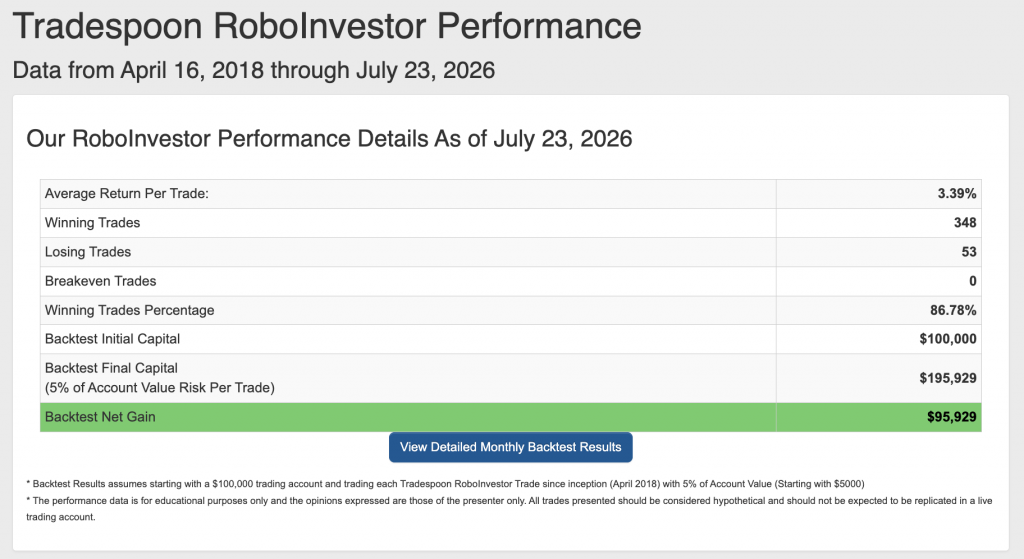
Our track record is one of the best in the retail advisory industry, with a Winning Trades Percentage of 86.78% since April 2018.
In this environment, a disciplined, insight-driven framework matters more than ever—one that cuts through the noise, respects the bond market’s influence, manages rate and employment risk, and helps you position proactively for the opportunities and pivots that tend to define the first quarter.
As we dive deeper into 2026, investors are stepping into a market that still feels deceptively calm on the surface—but increasingly reactive underneath. Tariff headlines are back in rotation, the Fed path is less predictable as inflation expectations tug both ways, and the economy is sending mixed signals as rates stay elevated and labor-market indicators begin to soften at the margins. Volatility remains contained, yet quick to spike around policy shifts and geopolitical developments, while earnings and forward guidance continue to do the heavy lifting for direction.
Whether you are a seasoned investor or just starting, our team is here to help you every step of the way. Don’t face the challenges of tomorrow alone–join RoboInvestor today and take your investing to the next level.
Stay alert, stay strategic—and trade smart.
And remember, we’re not talking about day trading here. I’m looking for 50-100% gains within the next 3 months, so my weekly updates are timely enough for you to act.
*Please note: RoboStreet is part of your free subscription service. It is not included in any paid Tradespoon subscription service. Vlad Karpel only trades his own personal money for paid subscription services. If you are a paid subscriber, please review your Premium Member Picks, ActiveTrader, MonthlyTrader, or RoboInvestor recommendations. If you are interested in receiving Vlad’s personal picks, please click here.
Please share this Tradespoon Market Commentary with your friends.



Comments Off on


Tradespoon Tools make finding winning trades in minute as easy as 1-2-3.
Our simple 3 step approach has resulted in an average return of almost 20% per trade!