 Special Offer: Try the 'Elite Trading Circle Membership' for ONLY $37!
CLICK HERE TO LEARN MORE
Special Offer: Try the 'Elite Trading Circle Membership' for ONLY $37!
CLICK HERE TO LEARN MORE
RoboStreet – Treasury yields are at 24-year highs, oil is back above $100, and inflation pressure is refusing to disappear. Yet AI spending, earnings and the labor market remain resilient. With SPY testing its 50-day moving average and Friday’s jobs report looming, Wall Street is entering a critical Q4 test — and the long-term bullish trend is still intact.
Markets are beginning the fourth quarter with investors confronting one of the most difficult combinations of the year: Treasury yields at multi-decade highs, crude oil back above $100, persistent inflation pressure and an unresolved geopolitical backdrop, all while economic growth and spending tied to artificial intelligence remain surprisingly resilient.
That tension has kept stocks volatile this week and is likely to remain the dominant theme heading into Friday’s employment report.
And remember, we’re not talking about day trading here. I’m looking for 50-100% gains within the next 3 months, so my weekly updates are timely enough for you to act.
The biggest obstacle remains the bond market. The 10-year Treasury yield briefly climbed near 5.34% Thursday, its highest level since April 2002, following one of the worst quarters for Treasuries in decades. The 10-year continues to trade inside an unusually wide range of approximately 4.5% to 5.5%, and movements within that range have become one of the most important short-term drivers for equities.
When investors can earn more than 5% from government bonds, stocks face a considerably higher hurdle. Rising yields increase borrowing costs throughout the economy and compress the valuations investors are willing to assign to future earnings. That pressure has been particularly visible in rate-sensitive areas of the market, including financials, utilities, housing and portions of the consumer sector.
Technology has held up considerably better because investors continue to see strong earnings growth and structural demand surrounding artificial intelligence.
That divergence has helped prevent the broader market from breaking down even as the macro environment has become more challenging.
Energy prices have become another major complication.
Brent crude climbed back above $100 per barrel this week after Chinese refiners suspended most October fuel exports in an effort to prioritize domestic supply. The move comes with the conflict involving Iran still unresolved, meaning the geopolitical premium embedded in global oil prices has not disappeared.
The importance of oil extends well beyond energy stocks.
Higher crude prices eventually flow through transportation, manufacturing and consumer costs. That creates another potential source of inflation at exactly the time the Federal Reserve is trying to determine whether price pressures have cooled enough to pause its tightening cycle.
Oil, inflation and interest rates are therefore increasingly connected.
If crude remains above $100, inflation expectations could remain elevated. Persistent inflation increases the likelihood that monetary policy remains restrictive. Higher expected rates then place additional upward pressure on Treasury yields, creating another headwind for equities.
That feedback loop represents one of the largest risks to our bullish market outlook.
This week’s inflation data initially provided some relief.
Wednesday’s PCE report showed underlying inflation running below expectations, temporarily reducing expectations for another Federal Reserve rate increase in October. Markets are now leaning toward a pause at the upcoming meeting, although another increase later this year remains very much in the conversation.
That relief did not last long.
Thursday’s ISM manufacturing report showed that manufacturing activity continues to expand, but the prices-paid component jumped sharply and reached its highest level since May. That immediately revived concerns that higher energy, tariff and input costs could prevent inflation from falling smoothly toward the Federal Reserve’s target. The market reaction was revealing.
Investors initially attempted to rally on softer inflation data, but rising Treasury yields and the renewed oil move quickly overwhelmed that optimism. The Federal Reserve therefore faces an increasingly complicated decision.
The Fed raised rates by 25 basis points at its September meeting, bringing the federal funds target range to 3.75%–4.00%. Policymakers must now balance evidence that inflation is gradually improving against an economy that remains relatively firm, a tight labor market and new inflation pressure coming from energy and manufacturing costs.
Our biggest macroeconomic risk remains the possibility that interest rates stay higher for longer than equity investors currently expect.
Importantly, this is not yet an economic contraction story.
Initial jobless claims fell to approximately 197,000 this week, marking another very low reading and demonstrating that businesses have not begun laying off workers in large numbers.
That makes Friday’s employment report particularly important.
A moderate payroll number accompanied by controlled wage growth would likely be the most favorable scenario for equities. It would suggest that the economy continues to expand without creating significantly more inflation pressure and could give the Federal Reserve additional justification to pause in October.
An unexpectedly strong employment report presents a more complicated scenario. Strong growth is normally good for stocks, but in the current environment another hot labor report could push Treasury yields even higher as investors price additional Federal Reserve tightening.
This is one of those unusual periods when good economic news can initially be interpreted negatively by the market.
The major offset to these macroeconomic concerns continues to come from artificial intelligence.
Micron delivered another strong indication this week that demand for AI infrastructure remains intact. The company’s fiscal fourth-quarter results exceeded expectations, while management provided an optimistic outlook surrounding data-center and high-bandwidth memory demand.
Micron shares had already gained dramatically this year, so the stock’s muted reaction following earnings does not necessarily indicate disappointment. The more important takeaway is that spending on AI infrastructure continues to translate into real corporate revenue and demand.
Software provided another source of strength. Accenture surged following a strong outlook, lifting several software companies along with it, while Alphabet also received attention following the introduction of its latest Gemini artificial-intelligence model.
Constellation Energy moved higher after announcing a long-term power agreement with Amazon, providing another example of how AI and data-center expansion are spreading into electricity generation and infrastructure.
These developments matter because technology and AI-related earnings have become the principal counterweight to higher interest rates.
Investors are increasingly demanding actual revenue, cash flow and earnings growth from AI investments rather than simply rewarding companies for announcing AI initiatives. So far, several of the industry’s largest players continue to deliver enough growth to keep the broader technology trade intact.
The broader market is now approaching an important technical area.
SPY has moved back toward its 50-day moving average while the VIX remains around 16. That suggests investors are becoming more cautious, but we are still well below the volatility levels normally associated with market panic or a major trend reversal.
The VIX will be especially important to monitor around Friday’s jobs report and the next Federal Reserve meeting.
A sustained move above the recent volatility range combined with SPY breaking below technical support would represent a more meaningful warning. Conversely, stabilization in Treasury yields and oil could quickly allow buyers to return, particularly if earnings remain strong.
We remain in the MARKET BULLISH camp.
Our longer-term trend remains intact, and we believe an SPY rally can ultimately reach the $780–$810 area over the next several months.
In the short term, we are watching the $740–$750 area as an important support zone.
That gives us a reasonably defined framework.
As long as SPY continues holding major support and the economy avoids a meaningful deterioration, we continue to favor the primary bullish trend. A pullback toward support could create opportunities rather than automatically signaling the end of the rally.
At the same time, the current environment demands disciplined risk management. Treasury yields above 5%, oil above $100 and the possibility of additional Federal Reserve tightening create substantially more downside volatility than investors experienced earlier in the cycle.
The market remains caught between two powerful forces.
On one side, the economy is still growing, the labor market remains firm, corporate earnings remain resilient and artificial-intelligence investment continues to produce significant demand across technology, semiconductors, software, energy and infrastructure.
On the other side, investors are dealing with an unresolved war involving Iran, $100-plus oil, tariffs, persistent inflation and Treasury yields trading at levels not seen in more than two decades.
For now, neither side has decisively won.
That is why Friday’s jobs report carries additional importance. Investors will be looking beyond the headline payroll number and focusing on wage growth, unemployment and what the report ultimately means for Federal Reserve policy.
A cooling-but-stable labor market could allow Treasury yields to settle and give equities another opportunity to move higher. Another round of unexpectedly hot data could reinforce the higher-for-longer narrative and test the market’s ability to absorb yields above 5%.
We continue to believe the long-term bullish trend remains intact.
But as we begin the fourth quarter, the path toward our $780–$810 SPY target is unlikely to be straight.
The next phase of the rally will depend on whether earnings growth—particularly from AI and technology—can remain strong enough to overcome the increasingly expensive cost of money.
For now, we are watching $740–$750 as support, $780–$810 as the longer-term upside objective, the 10-year Treasury’s 4.5%–5.5% range, crude oil above $100 and the VIX near 16.
Those levels should help determine whether the fourth quarter begins with another extension of the bull market or a deeper test of support first.
And that is exactly where RoboInvestor proves its value. Built for a headline-sensitive, range-bound market, our flagship AI-driven advisory helps cut through Fed uncertainty, tariff chatter, geopolitical risk, and AI hype to focus on what matters most: statistically grounded setups and clear risk-reward opportunities. With RoboInvestor, investors can stay engaged, stay disciplined, and act with precision instead of reacting emotionally to every headline.
Every other weekend, you’ll receive the RoboInvestor newsletter—a concise, high-signal read with market context, technical outlooks, updates on open positions, and clear, actionable trade ideas so you’re prepared and confident heading into Monday’s open.
Explore our latest forecasts, trade signals, and live strategy sessions at Tradespoon.com. Navigate uncertainty with confidence—and position yourself ahead of the curve.
Whether you’re targeting blue-chip stocks, ETFs, commodities, or inverse ETFs, RoboInvestor offers a flexible, forward-looking approach tailored to today’s market conditions. Our model portfolio typically holds 12 to 25 carefully selected positions, and we’ve recently adopted an even more selective strategy—focused on quality, resilience, and opportunity.
Join us and take advantage of advanced AI technology to guide your investments with precision and confidence.
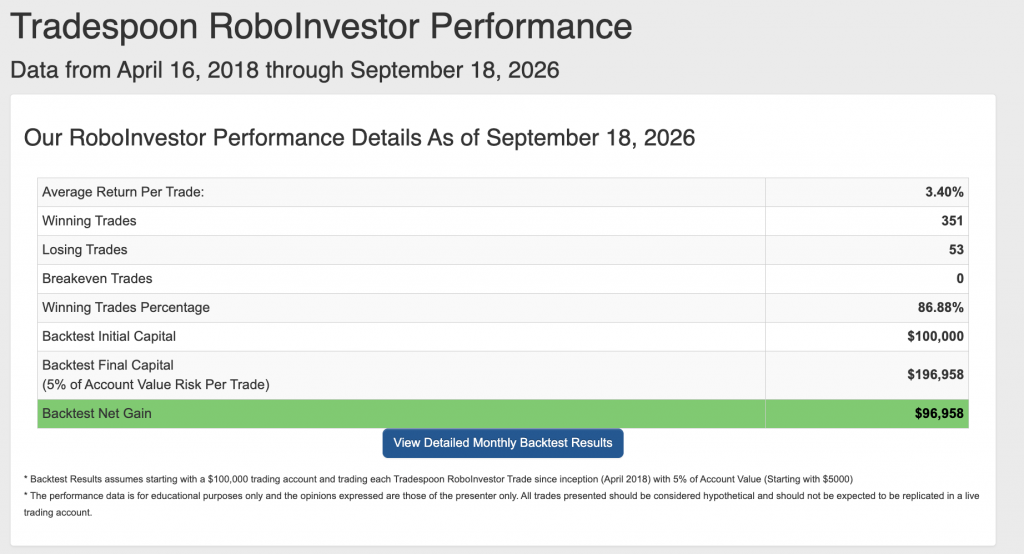
Our track record is one of the best in the retail advisory industry, with a Winning Trades Percentage of 86.88% since April 2018.
In this environment, a disciplined, insight-driven framework matters more than ever—one that cuts through the noise, respects the bond market’s influence, manages rate and employment risk, and helps you position proactively for the opportunities and pivots that tend to define the first quarter.
As we move through the second half of 2026, investors continue navigating a market that appears calm on the surface but remains highly sensitive beneath it. Geopolitical developments in the Middle East, shifting tariff policy, and an uncertain Federal Reserve path continue to influence investor sentiment as inflation gradually cools, but interest rates remain elevated. Meanwhile, economic data has become more mixed, with the labor market showing signs of moderation while corporate earnings continue to demonstrate remarkable resilience.
Whether you are a seasoned investor or just starting, our team is here to help you every step of the way. Don’t face the challenges of tomorrow alone–join RoboInvestor today and take your investing to the next level.
Stay alert, stay strategic—and trade smart.
And remember, we’re not talking about day trading here. I’m looking for 50-100% gains within the next 3 months, so my weekly updates are timely enough for you to act.
*Please note: RoboStreet is part of your free subscription service. It is not included in any paid Tradespoon subscription service. Vlad Karpel only trades his own personal money for paid subscription services. If you are a paid subscriber, please review your Premium Member Picks, ActiveTrader, MonthlyTrader, or RoboInvestor recommendations. If you are interested in receiving Vlad’s personal picks, please click here.
Please share this Tradespoon Market Commentary with your friends.



Comments Off on


Tradespoon Tools make finding winning trades in minute as easy as 1-2-3.
Our simple 3 step approach has resulted in an average return of almost 20% per trade!