 Save Big on Commissions ($0.65 per Contract)
CLICK HERE TO LEARN MORE
Save Big on Commissions ($0.65 per Contract)
CLICK HERE TO LEARN MORE
RoboStreet – SPY is testing its 50-day moving average as rising oil prices, volatile Treasury yields and concerns over AI spending collide ahead of next week’s Fed decision.
Markets entered the week balancing two very different forces. Corporate earnings continued to show underlying economic strength, particularly across technology and artificial intelligence, but the escalating conflict between the United States and Iran pushed oil prices sharply higher and revived concerns about inflation, interest rates and global economic growth.
By Thursday, those concerns had become difficult for investors to ignore. Brent crude briefly moved above $100 per barrel as attacks on energy shipping routes raised the possibility of a more serious supply disruption. At the same time, Alphabet and Tesla sold off following their quarterly reports, pulling technology stocks lower and pushing the broader market back toward an important technical test.
And remember, we’re not talking about day trading here. I’m looking for 50-100% gains within the next 3 months, so my weekly updates are timely enough for you to act.
The VIX is now trading near 18, reflecting increased uncertainty without signaling outright panic. SPY is trading near its 50-day moving average, while the technology-heavy Nasdaq has experienced greater pressure as investors reconsider valuations, capital spending and the possibility that interest rates remain elevated for longer.
The expanding conflict in the Middle East remains the market’s most immediate risk. Continued U.S. strikes on Iranian targets, Iranian retaliation and attacks on Saudi oil tankers in the Red Sea have placed both the Strait of Hormuz and the Bab el-Mandeb shipping route under greater scrutiny.
Brent crude surged approximately 7% on Thursday and briefly crossed $100 per barrel, while WTI moved above $90. Oil has now risen more than $25 from its early-July levels, creating a new inflation problem for businesses, consumers and the Federal Reserve.
Higher energy prices affect nearly every part of the economy. Airlines face higher fuel costs, transportation expenses increase, manufacturers pay more to move products, and consumers have less discretionary income after filling their gas tanks. Energy companies can benefit from higher crude prices, but a sustained oil shock would create significant pressure across consumer discretionary, industrial, transportation and retail stocks.
The key question is whether oil’s move reflects a temporary geopolitical premium or the beginning of an actual supply disruption. A ceasefire or improvement in shipping conditions could quickly remove part of the premium, while additional attacks on tankers or energy infrastructure could push prices even higher.
The latest CPI and PPI reports were encouraging, but they were released before the latest surge in oil prices. June CPI declined 0.4% from the previous month and increased 3.5% from one year earlier. Core CPI was unchanged for the month and rose 2.6% year over year.
Producer prices also declined 0.3% in June, although headline PPI remained 5.5% higher than one year earlier. That combination showed that near-term price pressures were improving, but inflation had not been completely defeated.
The concern is that much of the improvement came from lower energy prices. If oil remains near $90 to $100 per barrel, inflation could begin rising again during the second half of the summer. Tariffs introduce another source of potential price pressure by increasing the cost of imported goods, materials and components.
This is why interest rates remain the most important risk to the bullish market outlook. The 10-year Treasury yield continues to trade within a broad range of approximately 4.0% to 4.8%, but it has recently moved toward the upper end of that range. A sustained move above 4.8% would create additional pressure on technology stocks, housing, consumer borrowing, and other interest-rate-sensitive areas of the market.
Corporate earnings remain strong in many areas, but the market is becoming less willing to reward companies for growth alone. Investors increasingly want to see that spending on artificial intelligence, data centers, robotics and new infrastructure is producing sufficient earnings and free cash flow.
Alphabet reported a strong quarter, with revenue increasing 24% to $119.8 billion. Google Cloud revenue jumped 82% to $24.8 billion, showing that enterprise demand for AI infrastructure and cloud computing remains exceptionally strong.
Despite those results, Alphabet shares fell as the company increased its planned capital spending to between $195 billion and $205 billion. Investors focused on the cost of expanding AI capacity and questioned how quickly that spending would translate into higher profits and cash flow.
Tesla faced similar concerns. Revenue growth remained solid, but earnings missed expectations, operating margins remained under pressure and heavy spending produced negative free cash flow. The stock declined sharply as investors weighed Tesla’s current profitability against its long-term spending on artificial intelligence, robotics, autonomous vehicles and manufacturing capacity.
These reports do not mean the AI investment cycle is ending. Instead, they show that investors are applying a higher standard. Companies must now demonstrate not only that AI is driving demand, but that their spending can generate attractive and sustainable returns.
Next week will provide one of the most important clusters of market-moving events this summer. The Federal Reserve begins its two-day meeting on Tuesday, July 28, with its policy decision and press conference scheduled for Wednesday, July 29.
The Fed must now balance softer recent inflation readings against higher oil prices, tariff-related uncertainty and a labor market that remains relatively resilient. Even if policymakers leave rates unchanged, their comments regarding energy prices and future rate increases could have a significant impact on Treasury yields and equity valuations.
Thursday will bring the advance estimate of second-quarter GDP along with June personal income, consumer spending and the Fed’s preferred PCE inflation measure. Those reports will give investors a clearer picture of economic growth and whether inflation was continuing to improve before the latest oil spike.
The Employment Cost Index arrives Friday and will provide another important measure of wage inflation. The report is particularly relevant because persistent wage growth could make the Fed even more reluctant to lower rates.
Big Tech earnings will also remain at the center of the market. Microsoft and Meta report Wednesday, followed by Amazon and Apple on Thursday. Investors will focus heavily on cloud growth, AI revenue, capital-spending guidance, operating margins and free cash flow after Alphabet’s results raised the bar for the entire sector.
I remain in the MARKET BULLISH camp. The long-term trend remains intact, and I believe the SPY rally can eventually reach the $760 to $780 range over the next few months.
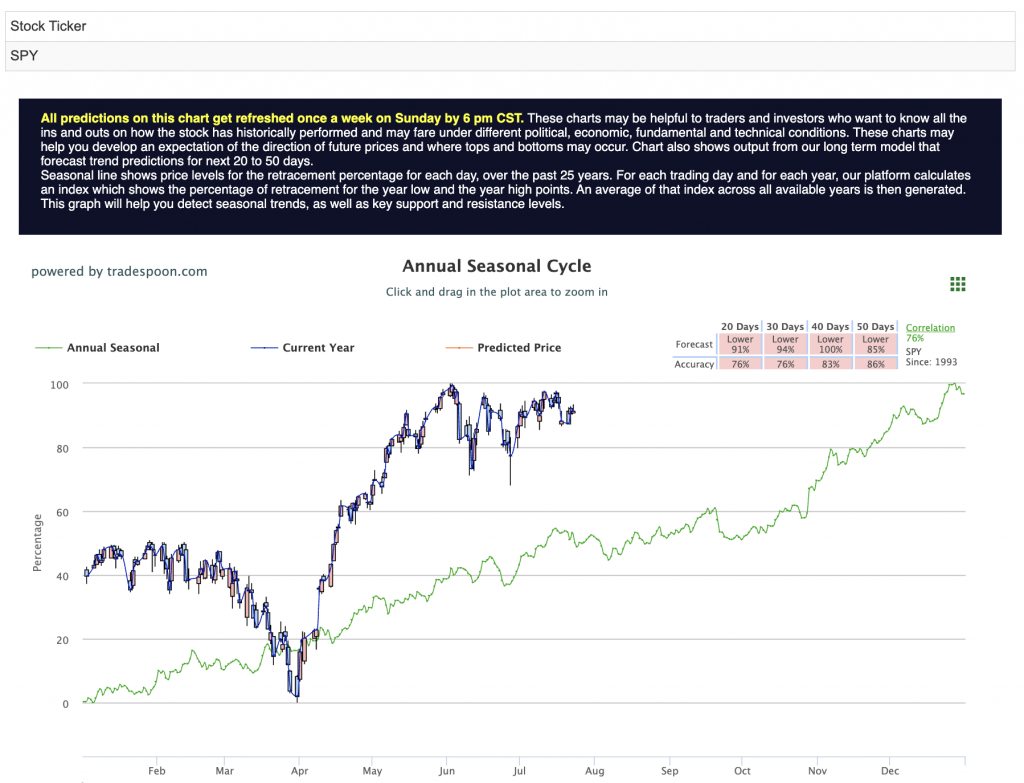
At the same time, the market is entering a more volatile and selective period. SPY is testing its 50-day moving average, the VIX is near 18 and several leading technology stocks are under pressure. The immediate risk is that higher oil prices keep inflation elevated and force interest rates to remain higher for longer.
I am watching the $700 to $720 area as important short-term support for SPY. Holding above that zone would preserve the broader bullish structure, even if the market experiences additional volatility or consolidation along the way.
The energy sector should remain near the top of traders’ watchlists next week as the conflict with Iran continues to create significant volatility in the global oil market. Brent crude briefly moved above $100 per barrel Thursday, while WTI climbed above $92 after attacks affecting two critical shipping routes intensified concerns about global supply disruptions.
The Energy Select Sector SPDR Fund, $XLE, provides exposure to major oil and gas producers as well as energy equipment and services companies. That makes it one of the most direct ways to monitor whether elevated crude prices are translating into sustained strength across the U.S. energy sector.
Higher oil prices can improve revenue, cash flow and refining margins for energy companies, especially when producers maintain disciplined capital spending. TotalEnergies offered an early example of that trend this week, reporting a 67% increase in quarterly profit as higher crude prices and stronger refining margins boosted results.
Energy remains a headline?driven trade. As XLE shows, the sector is still highly sensitive to geopolitical developments—any ceasefire, reopening of shipping lanes, or increase in available supply can quickly strip away part of oil’s risk premium. Conversely, continued disruptions in the Strait of Hormuz or Red Sea could keep crude prices elevated and sustain rotation into energy stocks.
Rather than chasing strength after a sharp oil spike, traders should watch XLE pullbacks for signs of durability: orderly retracements, improving relative strength, and evidence that energy names can hold gains even when the broader market pauses. Inventory data, Middle East developments, and guidance from major producers will be key catalysts.
With technology under pressure, Treasury yields rising, and investors looking for sectors that can benefit from an inflation?leaning environment, energy could offer opportunities next week—but entry discipline and risk management matter more than usual in a market driven by headlines.
The broader rally does not require every macro headline to improve. It does require oil to stabilize, Treasury yields to stay below the top of their recent range, and corporate earnings to justify current valuations.
For now, the long?term trend remains constructive, but this is not an environment for chasing every move. Investors should stay selective, manage position sizes, and focus on companies with strong earnings, healthy cash flow, and clear catalysts. Next week’s Fed meeting, inflation data, and Big Tech earnings will determine whether the current test of the 50?day moving average becomes a buying opportunity—or the start of a deeper correction.
And that is exactly where RoboInvestor proves its value. Built for a headline-sensitive, range-bound market, our flagship AI-driven advisory helps cut through Fed uncertainty, tariff chatter, geopolitical risk, and AI hype to focus on what matters most: statistically grounded setups and clear risk-reward opportunities. With RoboInvestor, investors can stay engaged, stay disciplined, and act with precision instead of reacting emotionally to every headline.
Every other weekend, you’ll receive the RoboInvestor newsletter—a concise, high-signal read with market context, technical outlooks, updates on open positions, and clear, actionable trade ideas so you’re prepared and confident heading into Monday’s open.
Explore our latest forecasts, trade signals, and live strategy sessions at Tradespoon.com. Navigate uncertainty with confidence—and position yourself ahead of the curve.
Whether you’re targeting blue-chip stocks, ETFs, commodities, or inverse ETFs, RoboInvestor offers a flexible, forward-looking approach tailored to today’s market conditions. Our model portfolio typically holds 12 to 25 carefully selected positions, and we’ve recently adopted an even more selective strategy—focused on quality, resilience, and opportunity.
Join us and take advantage of advanced AI technology to guide your investments with precision and confidence.
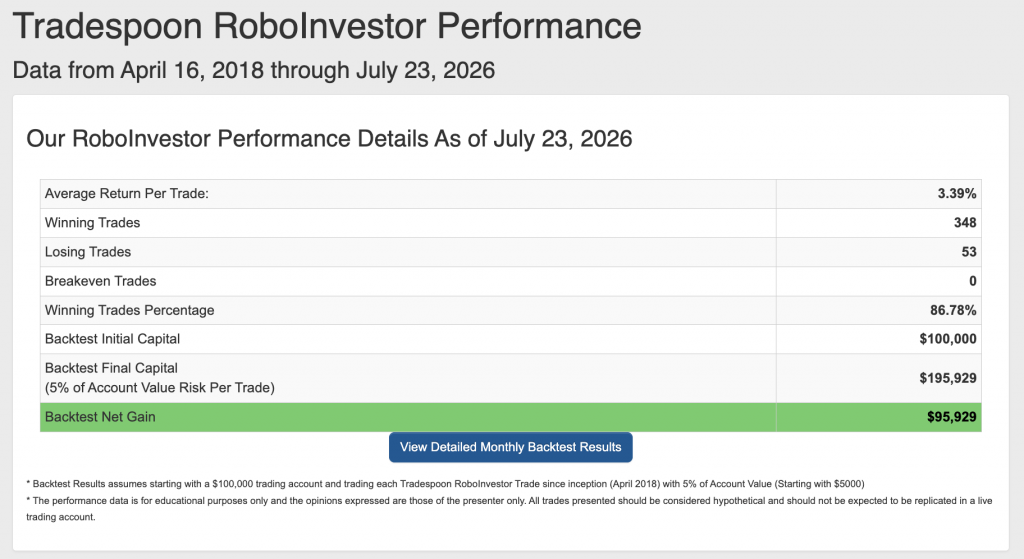
Our track record is one of the best in the retail advisory industry, with a Winning Trades Percentage of 86.78% since April 2018.
In this environment, a disciplined, insight-driven framework matters more than ever—one that cuts through the noise, respects the bond market’s influence, manages rate and employment risk, and helps you position proactively for the opportunities and pivots that tend to define the first quarter.
As we dive deeper into 2026, investors are stepping into a market that still feels deceptively calm on the surface—but increasingly reactive underneath. Tariff headlines are back in rotation, the Fed path is less predictable as inflation expectations tug both ways, and the economy is sending mixed signals as rates stay elevated and labor-market indicators begin to soften at the margins. Volatility remains contained, yet quick to spike around policy shifts and geopolitical developments, while earnings and forward guidance continue to do the heavy lifting for direction.
Whether you are a seasoned investor or just starting, our team is here to help you every step of the way. Don’t face the challenges of tomorrow alone–join RoboInvestor today and take your investing to the next level.
Stay alert, stay strategic—and trade smart.
And remember, we’re not talking about day trading here. I’m looking for 50-100% gains within the next 3 months, so my weekly updates are timely enough for you to act.
*Please note: RoboStreet is part of your free subscription service. It is not included in any paid Tradespoon subscription service. Vlad Karpel only trades his own personal money for paid subscription services. If you are a paid subscriber, please review your Premium Member Picks, ActiveTrader, MonthlyTrader, or RoboInvestor recommendations. If you are interested in receiving Vlad’s personal picks, please click here.
Please share this Tradespoon Market Commentary with your friends.



Comments Off on


Tradespoon Tools make finding winning trades in minute as easy as 1-2-3.
Our simple 3 step approach has resulted in an average return of almost 20% per trade!