 Special Offer: Try the 'RoboInvestor Membership' for ONLY $37!
CLICK HERE TO LEARN MORE
Special Offer: Try the 'RoboInvestor Membership' for ONLY $37!
CLICK HERE TO LEARN MORE
RoboStreet – After days of tension tied to the war involving Iran, elevated oil prices, tariff uncertainty, and fresh questions around inflation and interest rates, investors finally got a reason to step back into risk. The result was a powerful relief rally. But underneath that move, the broader message stayed the same: this market may have gained some breathing room, yet it is still far from clear of the pressures that have been driving volatility.
This week, the market revolved around one central question: was the latest rally the beginning of a more durable recovery, or simply a sharp relief bounce inside a still-fragile environment? Nearly every major move came back to the war involving Iran, the path of oil prices, shifting rate expectations, and a market trying to decide whether it can trust this calmer tone.
And remember, we’re not talking about day trading here. I’m looking for 50-100% gains within the next 3 months, so my weekly updates are timely enough for you to act.
Early in the week, investors stayed cautious as tensions in the Middle East kept the risk of a broader energy shock front and center. Oil surged as traders worried about the possibility of deeper disruption tied to the Strait of Hormuz, and stocks struggled to find stable footing. The tone was nervous, headline-driven, and highly reactive. Then, as news broke of a two-week ceasefire and a potential reopening of key shipping channels, the mood changed quickly. Stocks surged, oil pulled back sharply, and the market staged a broad relief rally as investors rushed back into risk.
That rally was powerful, but it did not resolve the bigger issue. What the market received was relief, not certainty. Even after the strongest part of the move, the broader backdrop remained unsettled. Oil may have come off its highs, but energy markets are still sensitive to any sign that the ceasefire could weaken or that shipping disruptions could return. That matters because the entire market knows higher oil prices would quickly feed back into inflation expectations, pressure consumer sentiment, and complicate the Federal Reserve’s position all over again.
That is what makes this environment so difficult to read. On one hand, investors want to believe the worst geopolitical fears have eased enough to keep the economic expansion intact. On the other hand, inflation has not gone away, interest rates remain volatile, and the Fed still does not have the kind of flexibility that would normally support a clean and sustained breakout higher in equities. The market is trying to price in a soft landing, but it is doing so while carrying a heavy geopolitical premium and growing anxiety around sticky prices.
The macro data only reinforced that tension. Inflation remains firm enough to keep policymakers cautious, while labor data is soft enough to remind investors that growth is no longer cruising at full speed. That is a difficult combination. If inflation stays elevated, the Fed cannot move too quickly toward easing. But if employment indicators continue to weaken, the economy becomes more vulnerable to any external shock. This is the kind of setup that creates a market with upside potential, but not much room for error.
Rate expectations shifted throughout the week for exactly that reason. As oil prices pulled back from their highs, traders warmed again to the idea that the Fed could still find room to cut later this year. But that optimism remains highly conditional. Any renewed jump in energy prices or hotter inflation data could quickly force that view to change. The 10-year yield continues to reflect that uncertainty, staying volatile in a wide range between 3.6% and 4.50%. That is not the behavior of a market with conviction. It is the behavior of a market still searching for stable footing.
Earnings also played an important role in shaping the tone. Delta was one of the week’s most closely watched names, and the reaction reflected the mixed nature of this market. Investors were encouraged by the company’s results and by the idea that easing fuel pressures could help margins, but the broader read-through was not as simple as one strong airline report. What Delta really showed was that companies are still operating in a highly unpredictable environment, where energy costs, macro uncertainty, and consumer resilience all remain in flux. In that sense, Delta became a symbol of this entire market: capable of surprising to the upside, but still exposed to forces well beyond management’s control.
The same was true in other parts of the tape. Tech and AI-related names rallied hard as the ceasefire news fueled optimism around global stability and lower rates. Semiconductors, growth stocks, and high-beta names quickly attracted buyers. But again, that move looked more like a release of pressure than a full reset in leadership. When markets are coming off elevated fear and volatility, the strongest rebounds often happen first in the most beaten-up or most rate-sensitive areas. That does not always mean the coast is clear. Sometimes it simply means positioning had become too defensive.
That is an important distinction right now, especially with the VIX still around 20 and the major indexes trading near their 50-day moving averages. Those are not conditions that suggest complete calm or broad technical strength. They suggest a market in decision mode. Investors have stepped back in, but they have not fully committed. The tape has improved, but it has not yet proven that it can absorb geopolitical risk, sticky inflation, tariff uncertainty, and earnings pressure all at once.
Tariffs remain another meaningful variable in the background. While the war story dominated headlines, trade policy continues to add uncertainty to the inflation picture and to the business outlook more broadly. Markets can handle one major macro overhang more easily than three or four at the same time. Right now, investors are juggling the possibility of renewed conflict, the risk of higher-for-longer interest rates, a still-uncertain tariff backdrop, and signs that unemployment indicators are beginning to tick higher. That is why I do not think this is the kind of market to chase emotionally.
I remain in the market-neutral camp. Momentum has deteriorated, even though the long-term trend is still intact. The biggest risk is still that rates remain elevated longer than investors want, while the labor market gradually weakens underneath the surface. That combination can eventually squeeze valuations, especially if the market gets ahead of itself in pricing a best-case outcome.
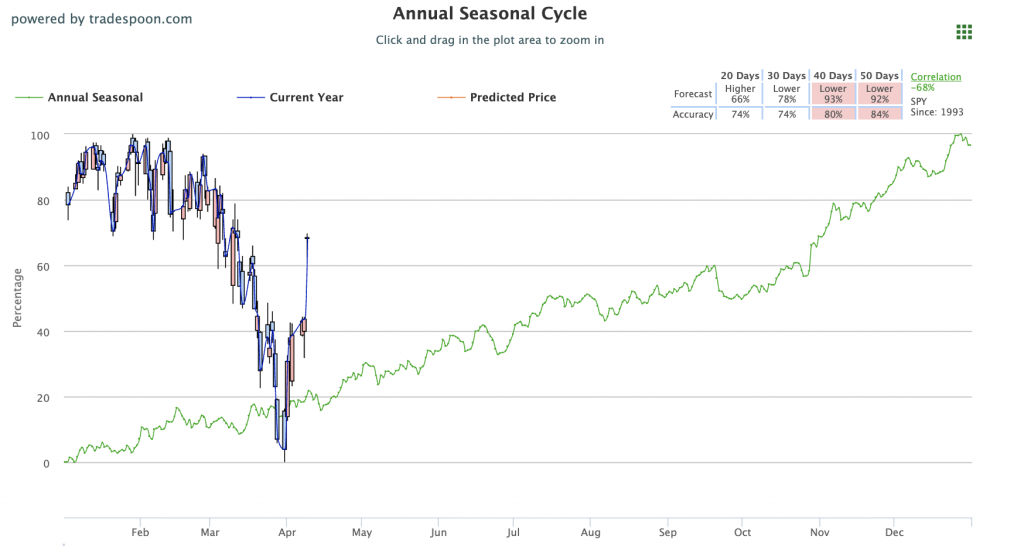
At the same time, I do not think the long-term structure has broken down. If inflation cools enough, if yields remain contained, and if geopolitical tensions continue to ease rather than flare back up, I still believe the SPY can work its way toward the 680 to 700 range over the next few months. But that path is unlikely to be smooth, and I think support in the 620 to 650 zone remains critical. That is the area that needs to hold if this market is going to maintain its broader bullish structure while working through short-term instability.
To me, the biggest takeaway from this week is that the market is still highly sensitive to any shift in the macro narrative. It was eager to rally on better geopolitical news, which tells you there is still demand on the sidelines and still an appetite for risk when the pressure eases. But it is equally clear that the deeper issues have not disappeared. Inflation is still sticky. The Fed is still constrained. Yields are still volatile. And geopolitical risk has cooled, but it has not been eliminated.
That is why discipline matters here more than excitement. This is a better market than it was a few days ago, but it is not yet a market that deserves blind confidence. The rally was real, but so are the risks. For now, I think the right posture is balanced, selective, and patient. Let the market prove that this move has staying power before assuming the all-clear has arrived.
That’s exactly where RoboInvestor proves its value. Built for a rangebound, headline-sensitive tape, our flagship AI-driven advisory helps you cut through shutdown noise, tariff chatter, and AI hype to focus on what matters: statistically grounded setups and the clearest risk-reward opportunities. With RoboInvestor, you can stay invested, stay disciplined, and act with precision instead of reacting to every headline.
Every other weekend, you’ll receive the RoboInvestor newsletter—a concise, high-signal read with market context, technical outlooks, updates on open positions, and clear, actionable trade ideas so you’re prepared and confident heading into Monday’s open.
Explore our latest forecasts, trade signals, and live strategy sessions at Tradespoon.com. Navigate uncertainty with confidence—and position yourself ahead of the curve.
Whether you’re targeting blue-chip stocks, ETFs, commodities, or inverse ETFs, RoboInvestor offers a flexible, forward-looking approach tailored to today’s market conditions. Our model portfolio typically holds 12 to 25 carefully selected positions, and we’ve recently adopted an even more selective strategy—focused on quality, resilience, and opportunity.
Join us and take advantage of advanced AI technology to guide your investments with precision and confidence.
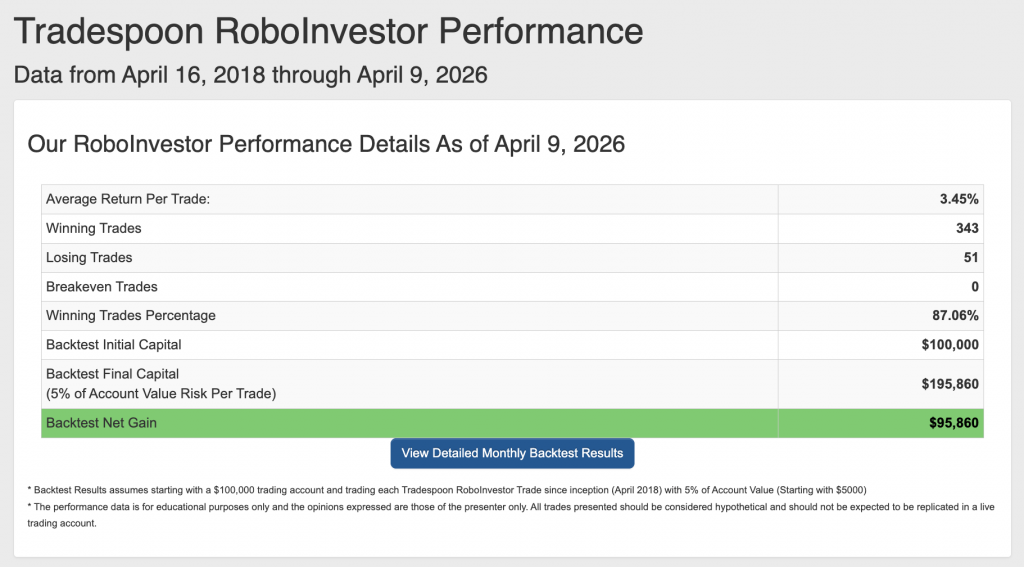
Our track record is one of the best in the retail advisory industry, with a Winning Trades Percentage of 87.11% since April 2018.
As we dive deeper into 2026, investors are stepping into a market that still feels deceptively calm on the surface—but increasingly reactive underneath. Tariff headlines are back in rotation, the Fed path is less predictable as inflation expectations tug both ways, and the economy is sending mixed signals as rates stay elevated and labor-market indicators begin to soften at the margins. Volatility remains contained, yet quick to spike around policy shifts and geopolitical developments, while earnings and forward guidance continue to do the heavy lifting for direction.
In this environment, a disciplined, insight-driven framework matters more than ever—one that cuts through the noise, respects the bond market’s influence, manages rate and employment risk, and helps you position proactively for the opportunities and pivots that tend to define the first quarter.
Whether you are a seasoned investor or just starting, our team is here to help you every step of the way. Don’t face the challenges of tomorrow alone–join RoboInvestor today and take your investing to the next level.
Stay alert, stay strategic—and trade smart.
And remember, we’re not talking about day trading here. I’m looking for 50-100% gains within the next 3 months, so my weekly updates are timely enough for you to act.
*Please note: RoboStreet is part of your free subscription service. It is not included in any paid Tradespoon subscription service. Vlad Karpel only trades his own personal money for paid subscription services. If you are a paid subscriber, please review your Premium Member Picks, ActiveTrader, MonthlyTrader, or RoboInvestor recommendations. If you are interested in receiving Vlad’s personal picks, please click here.
Please share this Tradespoon Market Commentary with your friends.



Comments Off on


Tradespoon Tools make finding winning trades in minute as easy as 1-2-3.
Our simple 3 step approach has resulted in an average return of almost 20% per trade!