 Special Offer: Try the 'SpreadTrader Membership' for ONLY $37!
CLICK HERE TO LEARN MORE
Special Offer: Try the 'SpreadTrader Membership' for ONLY $37!
CLICK HERE TO LEARN MORE
RoboStreet – Weekly Market News & Sentiment: Dow Breaks 50,000 as Nasdaq Softens, Strong Labor Data Delays Rate-Cut Hopes, Tariff Rhetoric Adds Trade Risk, AI Spending Concerns Pressure Growth Stocks, and the 10-Year Yield Anchors a Market in Consolidation
The market delivered a week that, at first glance, appeared constructive. The S&P 500 and Dow Jones Industrial Average pushed to fresh all-time highs early in the period, with the Dow briefly trading above the psychologically significant 50,000 level. Yet beneath those headline numbers, the internal structure of the market told a more nuanced story. Momentum has begun to fade, leadership is rotating, and volatility is reasserting itself in subtle but meaningful ways.
And remember, we’re not talking about day trading here. I’m looking for 50-100% gains within the next 3 months, so my weekly updates are timely enough for you to act.
The Nasdaq lagged as technology stocks struggled to sustain prior gains. Growth names, particularly those tied to AI and cloud infrastructure, felt pressure as interest rates firmed. Meanwhile, capital rotated into value-oriented and defensive segments of the market, allowing the broader indices to hold up even as the underlying tone softened.
The 10-year Treasury yield remains one of the most important variables. It continues to trade within a volatile but defined range between 3.6% and 4.35%. Each move toward the upper end of that range compresses growth valuations and challenges the sustainability of high-multiple equities. The VIX hovered near 20 throughout the week, signaling elevated caution without tipping into panic. Major indices are currently trading near their 50-day moving averages, reinforcing the idea that this is a consolidation phase rather than a decisive breakout or breakdown.
The most influential macro catalyst remains the labor market. January’s nonfarm payrolls report, though released earlier, continued to shape price action this week. The addition of 256,000 jobs, coupled with steady unemployment at 4.1% and firm wage growth, forced investors to reassess the pace and magnitude of potential Federal Reserve rate cuts in 2026. Expectations for aggressive easing have been dialed back. Treasury yields responded accordingly, climbing meaningfully before stabilizing. Growth stocks felt the pressure immediately, while financials and select industrials showed relative resilience.
Trade policy developments added another layer of uncertainty. The administration reaffirmed its intention to proceed with tariffs on Canada, Mexico, and China unless concessions are made, while also signaling potential friction with the European Union and India. Although markets did not react with panic, cyclical and trade-sensitive sectors experienced bouts of weakness. The dollar strengthened during risk-off episodes, and intraday volatility spiked several times as investors recalibrated expectations.
At the corporate level, earnings season reinforced how selective this market has become. Strong headline numbers were no longer sufficient to support valuations if forward guidance disappointed. Monday.com’s nearly 25% collapse after withdrawing long-term guidance illustrated this point clearly. Iren’s sharp decline is tied to Bitcoin exposure, underscoring the fragility in crypto-adjacent equities. Carvana’s drop amid insider selling concerns and negative social chatter reflected how quickly sentiment can shift. Even Meta declined despite positive analyst commentary and high-profile endorsements. In contrast, Berkshire Hathaway outperformed as investors sought stability and balance-sheet strength.
Consumer sentiment data also contributed to the cautious tone. The University of Michigan’s preliminary reading showed declining confidence and a pickup in short-term inflation expectations. That combination reinforced the “higher for longer” narrative and weighed on rate-sensitive areas such as real estate, utilities, and speculative growth stocks. Delays in key economic releases due to government funding disruptions added a layer of temporary uncertainty, keeping many participants on the sidelines.
Investor psychology remains balanced between guarded optimism and defensive positioning. The CNN Fear & Greed Index continues to hover in the “fear” zone, suggesting caution but not capitulation. The AAII survey revealed nearly equal bullish and bearish expectations for the coming six months, reflecting a market that lacks strong directional conviction. Crypto markets attempted a rebound from oversold conditions, and selective institutional accumulation of Ethereum hinted at targeted risk appetite, yet broader digital asset markets remain fragile.
Taken together, the week reflected a classic macro rotation. Rising real yields and tariff uncertainty pressured growth multiples, while value and quality equities provided a stabilizing counterweight. The long-term trend remains intact, but short-term momentum has deteriorated.
I remain in the market-neutral camp. The risk is not that the structural bull market has ended. The risk is that interest rates remain elevated while unemployment indicators gradually tick higher. That combination can compress valuations and produce choppier trading conditions.
From a technical perspective, the SPY’s longer-term trajectory remains constructive. There is a plausible path toward the 700–720 range over the coming months if earnings resilience continues and yields stabilize. However, near-term support between 650 and 660 is critical. A sustained break below that zone would likely trigger broader de-risking and accelerate volatility.
For now, this is not a market to chase. It is a market to manage. I continue to favor quality balance sheets, earnings durability, and selective exposure to value and defensive themes. High-multiple growth names remain vulnerable unless Treasury yields retreat meaningfully.
The environment has shifted from liquidity-driven enthusiasm to fundamentally selective participation. Opportunities will continue to appear, but they will require patience, discipline, and respect for risk. In periods like this, capital preservation is not defensive thinking; it is strategic positioning.
That’s where RoboInvestor adds value. Built for a range-bound, headline-driven tape, our AI-powered advisory focuses on statistically grounded setups and defined risk-reward opportunities. It helps you stay engaged without overtrading and act with precision instead of reacting to noise.
Every other weekend, you’ll receive the RoboInvestor newsletter—a concise, high-signal read with market context, technical outlooks, updates on open positions, and clear, actionable trade ideas. Hence, you’re prepared and confident heading into Monday’s open.
Explore our latest forecasts, trade signals, and live strategy sessions at Tradespoon.com. Navigate uncertainty with confidence—and position yourself ahead of the curve.
Whether you’re targeting blue-chip stocks, ETFs, commodities, or inverse ETFs, RoboInvestor offers a flexible, forward-looking approach tailored to today’s market conditions. Our model portfolio typically holds 12 to 25 carefully selected positions, and we’ve recently adopted an even more selective strategy—focused on quality, resilience, and opportunity.
Join us and take advantage of advanced AI technology to guide your investments with precision and confidence.
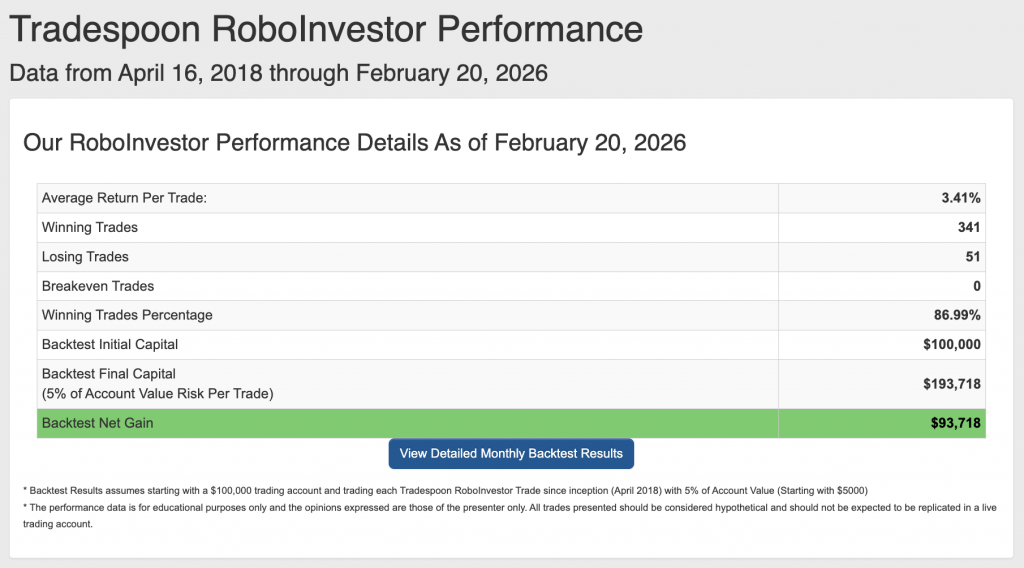
Our track record is one of the best in the retail advisory industry, with a Winning Trades Percentage of 86.96% since April 2018.
As 2026 gets underway, investors are stepping into a market that looks stable on the surface but is becoming more selective underneath. Tariff concerns briefly pressured sentiment before easing, megacap earnings exposed clear winners and losers, and the Fed’s path has grown less forgiving as inflation expectations remain sticky. Interest rates are no longer a background factor, labor-market signals are softening at the margins, and leadership is narrowing as investors demand a clearer connection between spending, margins, and profits.
Volatility remains contained but reactive, quick to spike around policy shifts, earnings surprises, and moves in the bond market. In this environment, earnings quality and forward guidance are doing the real work of setting direction. Navigating the first quarter will require a disciplined, insight-driven approach that respects the influence of rates, manages employment risk, and stays flexible enough to participate in rotation without chasing fragile momentum.
Whether you are a seasoned investor or just starting, our team is here to help you every step of the way. Don’t face the challenges of tomorrow alone–join RoboInvestor today and take your investing to the next level.
Stay alert, stay strategic—and trade smart.
And remember, we’re not talking about day trading here. I’m looking for 50-100% gains within the next 3 months, so my weekly updates are timely enough for you to act.
*Please note: RoboStreet is part of your free subscription service. It is not included in any paid Tradespoon subscription service. Vlad Karpel only trades his own personal money for paid subscription services. If you are a paid subscriber, please review your Premium Member Picks, ActiveTrader, MonthlyTrader, or RoboInvestor recommendations. If you are interested in receiving Vlad’s personal picks, please click here.
Please share this Tradespoon Market Commentary with your friends.



Comments Off on


Tradespoon Tools make finding winning trades in minute as easy as 1-2-3.
Our simple 3 step approach has resulted in an average return of almost 20% per trade!