 Special Offer: Try the 'Vlad's Portfolio Membership' for ONLY $37!
CLICK HERE TO LEARN MORE
Special Offer: Try the 'Vlad's Portfolio Membership' for ONLY $37!
CLICK HERE TO LEARN MORE
RoboStreet – Weekly Market News & Sentiment: Tariffs, AI Latest, and a Big Inflation Surprise
This week was a perfect snapshot of the market we’re living in right now: prices are still hovering near all-time highs, volatility is staying unusually calm with the VIX around 16, and yet the path to each green day has felt harder than it should. Under the surface, investors have been forced to constantly recalibrate around three forces that refuse to go away—tariff headlines, cooling macro data, and the market’s ongoing debate about how much AI optimism is already priced in.
For most of the week, that push-and-pull leaned mixed-to-negative. The S&P 500 and Dow stacked multiple losing sessions, while the Nasdaq showed brief bursts of resilience on tech rebounds but still faced pressure overall. There was rotation into value and cyclical areas at times, which provided some support, but it wasn’t enough to offset the broader weight coming from mega-cap and AI-adjacent weakness earlier in the week. The “AI bubble” fear narrative reappeared as certain high-flying names came under pressure, and the market behaved like a tape that still wants upside—but only if the data and rates cooperate.
And remember, we’re not talking about day trading here. I’m looking for 50-100% gains within the next 3 months, so my weekly updates are timely enough for you to act.
That’s why Thursday stood out. The rally didn’t come easy, but when it arrived, it was decisive. The major averages pushed higher in unison, with the S&P jumping roughly in the mid-1% range on the day, the Dow up several hundred points, and the Nasdaq leading with an approximately 2% type move at the highs. What made it notable wasn’t just the size of the move—it was the catalyst combination. Strong earnings from a key AI-linked company and a cooler-than-expected inflation report gave the market exactly what it needed: permission to take risk again, at least temporarily.
Micron’s earnings were the first spark. As a critical supplier of high-bandwidth memory used in AI server infrastructure, Micron’s results carried more meaning than a normal single-stock beat. The report helped reassure the market that AI spending isn’t just a story—it’s still flowing through real supply chains with real demand signals. After a stretch where investors had been questioning valuations and durability across the AI complex, Micron’s strength changed the tone quickly and helped lift “recently struggling” AI names off the mat.
Then the inflation data hit—and that became the accelerant. The November consumer price index came in at 2.7% year over year, below expectations around 3%. Even more important, core CPI printed 2.6% year over year, also cooler than expected. The immediate reaction was classic: stocks spiked and bond yields dropped as the market embraced the idea that inflation may be cooling faster than feared. In one release, the conversation shifted from “how long will higher rates choke momentum?” toward “does the Fed now have more room to ease in 2026?”
Rates confirmed the shift in real time. The 2-year Treasury yield dropped toward the mid-3% area, and the 10-year eased toward the low-4% range. Even so, the bigger takeaway is that yields have remained volatile overall—especially the 10-year, which has been swinging in a wide range roughly between 3.6% and 4.2%. That range matters because it’s effectively the market’s valuation thermostat. When yields drift lower, the market can tolerate higher multiples and reward growth again. When yields snap higher, the same valuations suddenly feel fragile, and investors rotate back into value, defensives, or cash-like positioning.
The Fed narrative remains a key overlay. Coming off the prior week’s Fed decision—another quarter-point cut with a message that still sounded cautious—markets have been trying to reconcile “cuts happened” with “easing might not be as fast as the market wants.” After Thursday’s CPI surprise, the probability of a January cut moved higher into the high-20% range, and the market also leaned more heavily into the idea of multiple cuts extending through the coming years. This tug-of-war between what the data suggests and what the Fed will actually deliver is a major reason the week felt so choppy: investors are simultaneously trying to price a soft landing, an easing path, and elevated uncertainty around policy and tariffs.
And tariffs truly did matter this week. The continuing updates didn’t just create headline volatility; they amplified uncertainty around margins, supply chains, and inflation itself. When tariffs are in the foreground, it becomes harder for the market to trust clean “disinflation” narratives, and it becomes harder for companies to guide confidently. That uncertainty tends to show up as rotation, hesitation, and the kind of uneven index action we saw for much of the week—especially when combined with a labor market that is clearly cooling.
On that front, the macro data gave the market a second reason to stay cautious early in the week. The delayed jobs report added fuel to recession-watch conversations as unemployment ticked up to 4.6%, the highest since 2021, while job creation slowed sharply. At the same time, business activity measures cooled to a six-month low and retail sales appeared to stall, hinting at a more cautious consumer. Put together, it paints a picture of an economy that is losing some momentum—maybe not breaking, but cooling enough that earnings expectations and risk appetite can’t remain carefree forever.
This brings me to where I’m positioned mentally: I’m in the market-neutral camp. Momentum has deteriorated, and the market is still vulnerable to the “higher for longer” risk—especially if yields re-accelerate and unemployment continues to tick up. At the same time, the fact that we’re still near all-time highs with volatility subdued tells you something important: there’s still plenty of capital that wants to buy dips, especially when inflation prints cooperate and AI demand signals remain intact.
From a levels and roadmap perspective, I still see a path where SPY can rally toward the $680–$700 zone if the market continues to believe in a controlled cooling cycle and a manageable Fed path. But in the near term, I’m watching $620–$640 as the key support band for the next few months. The longer-term trend remains intact—but the short-term tape is sensitive, and it doesn’t take much to trigger sharp rotations. For reference, please see SPY Seasonal Chart:
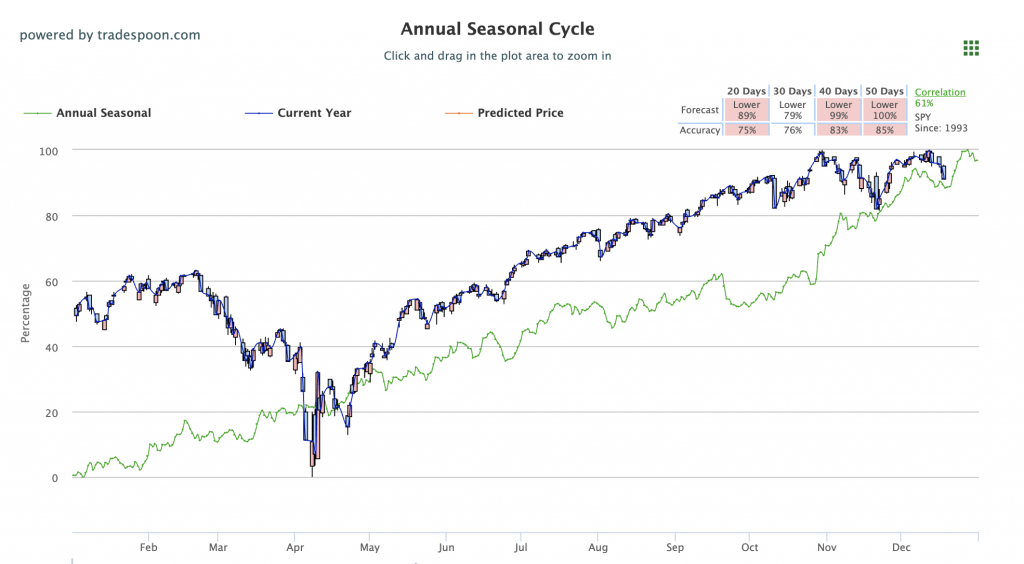
The key takeaway for the weeks ahead is clear: we are in a stock-picker’s market. Broad index exposure can still work, but it risks whipsawing investors when leadership is narrow, narratives shift quickly, and rate moves continue to dictate how much risk the market can absorb. Risk management should remain front and center—not because a crash is imminent, but because the margin for error is thinner near market highs, when volatility feels subdued, and when policy headlines, inflation data, and rate swings are driving price action.
As the year draws to a close, discipline matters more than direction. Stay neutral at the index level, be selective beneath the surface, and use volatility as an opportunity to add or trim positions rather than a reason to overreact.
This is exactly where RoboInvestor proves its value—our flagship AI-driven advisory designed for a rangebound, headline-sensitive market. It cuts through shutdown noise, tariff chatter, and AI hype to surface statistically grounded setups and highlight the most compelling risk-reward opportunities. With RoboInvestor, you can stay invested, remain disciplined, and move with precision instead of reacting to every headline.
Every other weekend, you’ll receive the RoboInvestor newsletter—a concise, focused read with market context, technical outlooks, updates on open positions, and clear, actionable trade ideas designed to have you prepared and confident for Monday’s open.
Explore our latest forecasts, trade signals, and live strategy sessions at Tradespoon.com. Navigate uncertainty with confidence—and position yourself ahead of the curve.
Whether you’re targeting blue-chip stocks, ETFs, commodities, or inverse ETFs, RoboInvestor offers a flexible, forward-looking approach tailored to today’s market conditions. Our model portfolio typically holds 12 to 25 carefully selected positions, and we’ve recently adopted an even more selective strategy—focused on quality, resilience, and opportunity.
Join us and take advantage of advanced AI technology to guide your investments with precision and confidence.
Our track record is one of the best in the retail advisory industry, with a Winning Trades Percentage of 87.01% since April 2018.
As we head into the end of 2025—with October nearly in the books—investors are navigating a market defined by renewed tariff rhetoric, an uncertain Fed path, mixed economic signals, and persistent geopolitical crosscurrents. Volatility remains contained but jumpy around headlines, while earnings and guidance are doing the heavy lifting for direction. In this backdrop, partnering with a disciplined, insight-driven framework matters more than ever to cut through noise, manage rate and labor-market risk, and position proactively for the final stretch of the year.
Whether you are a seasoned investor or just starting, our team is here to help you every step of the way. Don’t face the challenges of tomorrow alone–join RoboInvestor today and take your investing to the next level.
Stay alert, stay strategic—and trade smart.
And remember, we’re not talking about day trading here. I’m looking for 50-100% gains within the next 3 months, so my weekly updates are timely enough for you to act.
*Please note: RoboStreet is part of your free subscription service. It is not included in any paid Tradespoon subscription service. Vlad Karpel only trades his own personal money for paid subscription services. If you are a paid subscriber, please review your Premium Member Picks, ActiveTrader, MonthlyTrader, or RoboInvestor recommendations. If you are interested in receiving Vlad’s personal picks, please click here.
Please share this Tradespoon Market Commentary with your friends.



Comments Off on


Tradespoon Tools make finding winning trades in minute as easy as 1-2-3.
Our simple 3 step approach has resulted in an average return of almost 20% per trade!