 Special Offer: Try the 'RoboInvestor Membership' for ONLY $37!
CLICK HERE TO LEARN MORE
Special Offer: Try the 'RoboInvestor Membership' for ONLY $37!
CLICK HERE TO LEARN MORE
RoboStreet – Weekly Market News & Sentiment: Dow Targets a Record Close, Oil Slides on Geopolitical Relief, Earnings Turn Selective, and the 10-Year Keeps Risk on a Tight Leash
U.S. equities wrapped up the week with a split personality: strong end-of-week tape action, but lingering damage underneath from earlier volatility. The Dow pushed toward a record close—its fifth record settlement of the year—after moving above its prior peak near 49,590, while the S&P 500 and Nasdaq also traded higher. Even so, both the S&P 500 and Nasdaq were still tracking for a weekly decline, which reinforces the bigger takeaway from this week: the market can rebound quickly when headline risk cools, but it’s still struggling to sustain clean, steady momentum.
Rates remain the anchor. The 10-year Treasury yield is still elevated around the mid-4% range and continues to behave like a governor on equity enthusiasm—tightening the math on valuations and keeping leadership concentrated in areas investors view as structurally resilient. Oil added an important cross-current as well. Energy prices fell as geopolitical tensions appeared to ease, and the move accelerated after the latest inventory data showed a build in U.S. crude stocks alongside increases in gasoline and diesel inventories. That combination helps the near-term inflation narrative, but it also underscores how quickly markets are repricing geopolitical premiums as the tone shifts.
And remember, we’re not talking about day trading here. I’m looking for 50-100% gains within the next 3 months, so my weekly updates are timely enough for you to act.
The week’s dominant driver was geopolitics and policy rhetoric, particularly the market’s rapid repricing of risk tied to Greenland headlines and the threat of new tariffs. Early-week escalation injected a fresh dose of transatlantic tension into the tape and pushed investors into a more defensive posture. The market’s reaction was immediate: equities weakened, safe-haven demand rose, and yields stayed firm as investors demanded a higher risk premium for uncertainty.
The tone shifted after the Davos messaging helped cool the most acute tail-risk concerns, triggering a relief rally that powered the Dow toward record territory. The bigger point isn’t that the issue is resolved—it’s that markets moved from “escalation risk” to “negotiation likelihood” as the near-term base case. That one shift in probabilities was enough to reprice the entire week.
On the inflation front, the core PCE reading did what markets needed it to do: it came in exactly as expected. Core PCE rose 0.2% in November and 2.8% year over year, reinforcing the view that inflation is still easing, but not fast enough to force an imminent policy pivot. The delayed nature of the report—released late due to the government shutdown and reflecting November conditions—likely helped dampen the market reaction. In practical terms, the data support the idea that the Federal Reserve can hold rates steady at the January 27–28 meeting without appearing behind the curve.
Earnings added a second, quieter storyline beneath the geopolitical noise: fundamentals are holding up, but the market is increasingly selective about what it rewards. This week (January 19–23, 2026) brought heavyweight reports across technology, healthcare, and industrials, and the initial read-through is that investors are leaning into “durable demand” themes while punishing anything that hints at margin pressure, uneven growth, or top-line softness.
Intel stood out as a sentiment beneficiary. The stock performed well as Wall Street warmed to the company’s positioning around AI chips, which mattered in a week where semiconductors continued to represent one of the market’s cleanest expressions of structural demand. GE Aerospace also delivered a constructive signal, reporting a surge in orders and seeing its stock rise on the news—another example of investors rewarding tangible backlog strength and visibility.
Consumer staples and select healthcare showed the other side of the tape. Procter & Gamble and Abbott both saw their stocks dip after reporting, even though the details were not catastrophic. P&G beat earnings expectations but missed on revenue, and Abbott met earnings expectations while also falling short on revenue forecasts. The message from that price action is consistent with where we are in the cycle: results can be “fine,” but the market wants cleaner growth and fewer mixed signals, especially with yields still elevated.
In healthcare, Johnson & Johnson provided one of the strongest fundamental prints, with sales and profit rising on strength in oncology and autoimmune drugs. Importantly, their 2026 forecast topped Wall Street expectations, which tends to matter more than a single quarter’s beat in a market that is debating whether growth is slowing gently or not. United Airlines also reporte,d with investors watching closely for indications on travel demand and pricing power—an area that can quickly become a real-time gauge of consumer resilience and corporate spend.
Netflix reported earlier in the week on January 20, 2026, posting a slight beat on both earnings per share and revenue for Q4 2025. The after-hours stock reaction, however, highlighted a familiar pattern: the market isn’t just grading the quarter; it’s grading the forward narrative. Concerns around the company’s announced bid to acquire Warner Bros. Discovery and a lower-than-expected operating margin forecast for the current quarter weighed on sentiment despite the numerical beat.
Next week’s calendar raises the stakes. Microsoft and Tesla are scheduled to report on Wednesday, January 28, 2026, after the close, and Apple is expected to report on Thursday, January 29, 202,6 after the close. Those are market-moving events in any environment, but especially in one where the market is already hypersensitive to both rates and “risk premium” headlines. Even small shifts in guidance language, margin outlook, or demand commentary can ripple across sectors.
This week was a clean example of how sentiment can move faster than fundamentals. When trade threats and sovereignty rhetoric felt like they could spiral, the market shifted toward a “risk-off” stance. When the tone softened, it snapped back into a relief rally. That doesn’t mean investors are suddenly confident—it means they are trading probability-weighted outcomes aggressively, and they remain quick to reprice.
The bond market continues to shape the emotional temperature of equities. With the 10-year yield remaining elevated and volatile in a broad range between roughly 3.6% and 4.35%, investors are less willing to pay up indiscriminately. Leadership stays narrow, and the market’s appetite is highly conditional: it rewards structural growth and clear visibility, and it punishes ambiguity. The earnings reactions we saw this week fit that framework perfectly.
I’m staying in a market-neutral camp here, primarily because momentum has deteriorated even as index levels remain near highs. That’s not a bearish stance—it’s a posture built for a market that can swing sharply on headlines while rates remain a persistent constraint. The central risk is still “higher for longer,” and that risk becomes more meaningful if unemployment indicators continue ticking up. If growth cools gradually, the market can digest it. If yields remain elevated while the labor picture weakens, the tape can shift quickly from “resilient” to “fragile.”
From a levels standpoint, I still see a path for the SPY to extend toward the 700–720 zone if headline risk stays contained and earnings season confirms steady demand. But for the next few months, the 650–660 area remains the support band that matters most. Hold that range and dips can remain buyable with discipline. Lose it and the market shifts into “trend repair,” where patience and position sizing matter more than conviction.
The next two catalysts are clear. First, watch whether geopolitical rhetoric re-accelerates as we approach tariff timelines, because the market already showed you how fast it will reprice that risk. Second, watch next week’s mega-cap earnings cluster, because guidance from Microsoft, Tesla, and Apple can either stabilize leadership or expose cracks in demand and margins. In this environment, the edge isn’t predicting the next headline—it’s staying selective, respecting rates, and keeping your portfolio flexible enough that you don’t get forced into emotional decisions when the tape inevitably snaps one way or the other.
That’s exactly where RoboInvestor proves its value. Built for a rangebound, headline-sensitive tape, our flagship AI-driven advisory helps you cut through shutdown noise, tariff chatter, and AI hype to focus on what matters: statistically grounded setups and the clearest risk-reward opportunities. With RoboInvestor, you can stay invested, stay disciplined, and act with precision instead of reacting to every headline.
Every other weekend, you’ll receive the RoboInvestor newsletter—a concise, high-signal read with market context, technical outlooks, updates on open positions, and clear, actionable trade ideas so you’re prepared and confident heading into Monday’s open.
Explore our latest forecasts, trade signals, and live strategy sessions at Tradespoon.com. Navigate uncertainty with confidence—and position yourself ahead of the curve.
Whether you’re targeting blue-chip stocks, ETFs, commodities, or inverse ETFs, RoboInvestor offers a flexible, forward-looking approach tailored to today’s market conditions. Our model portfolio typically holds 12 to 25 carefully selected positions, and we’ve recently adopted an even more selective strategy—focused on quality, resilience, and opportunity.
Join us and take advantage of advanced AI technology to guide your investments with precision and confidence.
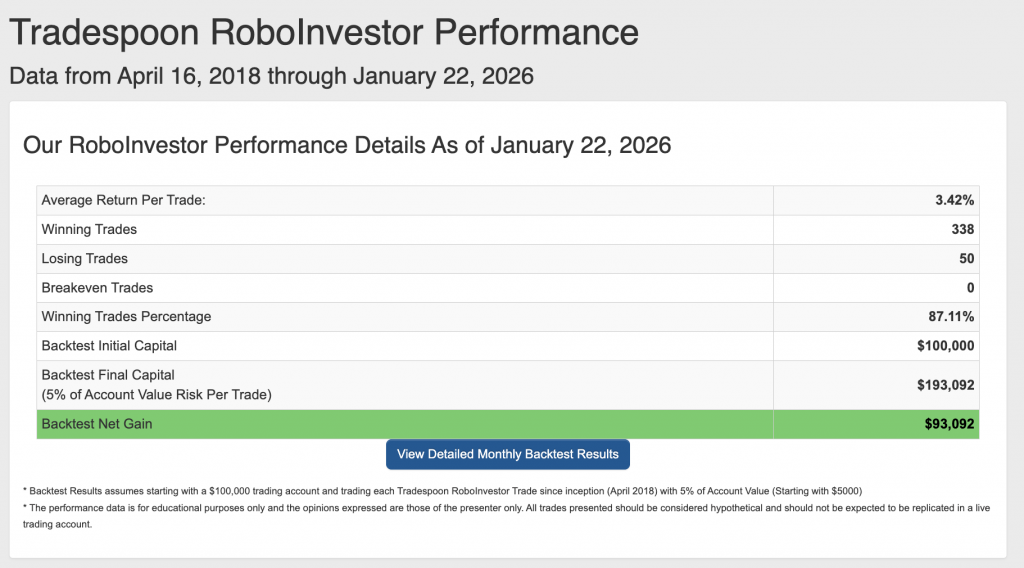
Our track record is one of the best in the retail advisory industry, with a Winning Trades Percentage of 87.01% since April 2018.
As we kick off 2026, investors are stepping into a market that still feels deceptively calm on the surface—but increasingly reactive underneath. Tariff headlines are back in rotation, the Fed path is less predictable as inflation expectations tug both ways, and the economy is sending mixed signals as rates stay elevated and labor-market indicators begin to soften at the margins. Volatility remains contained, yet quick to spike around policy shifts and geopolitical developments, while earnings and forward guidance continue to do the heavy lifting for direction.
In this environment, a disciplined, insight-driven framework matters more than ever—one that cuts through the noise, respects the bond market’s influence, manages rate and employment risk, and helps you position proactively for the opportunities and pivots that tend to define the first quarter.
Whether you are a seasoned investor or just starting, our team is here to help you every step of the way. Don’t face the challenges of tomorrow alone–join RoboInvestor today and take your investing to the next level.
Stay alert, stay strategic—and trade smart.
And remember, we’re not talking about day trading here. I’m looking for 50-100% gains within the next 3 months, so my weekly updates are timely enough for you to act.
*Please note: RoboStreet is part of your free subscription service. It is not included in any paid Tradespoon subscription service. Vlad Karpel only trades his own personal money for paid subscription services. If you are a paid subscriber, please review your Premium Member Picks, ActiveTrader, MonthlyTrader, or RoboInvestor recommendations. If you are interested in receiving Vlad’s personal picks, please click here.
Please share this Tradespoon Market Commentary with your friends.



Comments Off on


Tradespoon Tools make finding winning trades in minute as easy as 1-2-3.
Our simple 3 step approach has resulted in an average return of almost 20% per trade!